
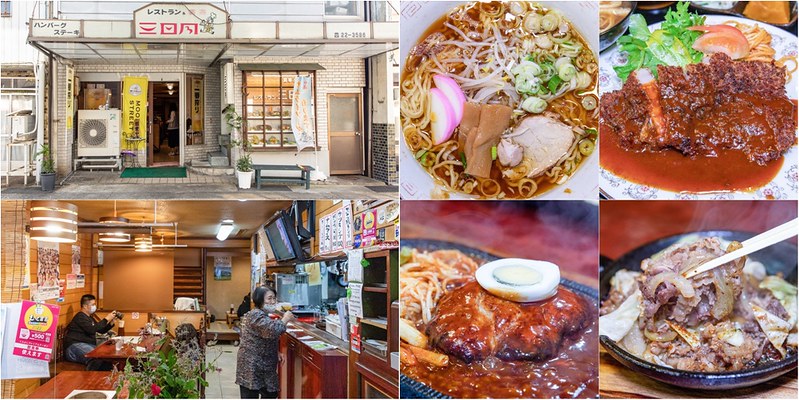
Kurayoshi's 60-year-old Restaurant Mikazuki blends Japanese, Western, and Chinese flavors. Save room for its signature beef-bone ramen and sizzling Tottori beef hamburg steak.
Restaurant Mikazuki (
Facebook fan page
): 3-2334 Shinmachi, Kurayoshi, Tottori Prefecture. Tel: 0858-22-3586. Hours: 12:00-15:00 and 18:00-22:00 (closed Tuesdays).
Whenever I visit a city, I always look for a long-established restaurant where I can try local food that, at first glance or mention, might seem available anywhere in Japan. I especially like places with a strong Showa-era atmosphere and a blend of Japanese and Western cooking. Mikazuki, located in Kurayoshi's historic district and in business for more than 60 years, combines not only Japanese and Western food but Chinese cooking as well. Its beef-bone ramen, a Tottori specialty, is considered the most delicious bowl around by many local residents. Its Japanese-Western hamburger steak and tonkatsu are also distinctive and delicious. If you come to Tottori and visit Kurayoshi, you really should stop by to meet the grandmotherly proprietress and savor the aromas from her kitchen.
Kurayoshi is the main city of central Tottori, with a 400-year-old historic district filled with red-tiled roofs and white plaster walls. Its foremost old restaurant is naturally the one I shared recently, "
Machiya Seisui-an
," while today's subject, Mikazuki, is another shared memory for many people from Kurayoshi. Although it has a rating of only 3.27 on Tabelog, it is an old Kurayoshi restaurant that I personally love and highly recommend. Mikazuki is a short distance from the center of the historic district, about another five or six minutes west of the well-known Dairenji Temple.
Related dining article
[The Sixth Tottori Food Installment of Tetsuro Degawa's Can I Charge My Bike?] Machiya Seisui-an: A Century-Old Kurayoshi Restaurant Serving Twelve-Color Mochi Shabu-Shabu and Tohaku Beef Shabu-Shabu
Food models are displayed in a glass case at the entrance. They are probably one of those shared features of restaurants left over from the Showa era, especially Japanese-Western places like this one.
The exterior gives off a Showa-era feeling, but the restaurant is bright enough inside, and both the tables and the space are very clean. The grandmotherly lady who greeted us at the door was also extremely kind. During our meal, nearly all the other customers were regulars from the neighborhood.
When one elderly regular heard that we were from Taiwan, he paid no attention to whether we understood Japanese and announced that he would sing us a song. I was stunned when I heard the words: "The Three Principles of the People shall be our guide; with this we establish the Republic, with this we advance to a state of great unity." He actually sang it from beginning to end. He said he had learned it in kindergarten and seemed to have visited Taiwan when he was young. Then he said a great deal more that I could not fully understand. I told him that almost nobody in Taiwan today can sing this "national anthem" (or Kuomintang party song, if you prefer) all the way through.
As at many old restaurants, the walls were covered with autograph boards from famous visitors, including the mayor of Kurayoshi. At that moment I thought this was absolutely the kind of restaurant Goro would love.
The restaurant offers an enormous selection. The slim menu booklet alone has dozens of dishes across three broad categories: Western, Japanese, and Chinese. Several Japanese set meals are posted on the wall, while the whiteboard lists seasonal specials.
Every part of Japan has its own distinctive ramen. In Tottori, beef-bone ramen and su ramen are broadly the two most representative styles. Incidentally, Tottori even has Michelin-recognized ramen!
[Michelin in Tottori, Japan] Hot Air: Michelin Ramen Made with Local Ingredients in a 500-Year-Old Rural Tottori Hot-Spring Village, Plus Three Free Footbaths
Beef-bone ramen may remind some people of Oita, but the versions from the two regions are slightly different. Oita beef-bone ramen tends to have a pale broth, while Tottori's version looks at first like a darker soy-sauce ramen. One theory says that Tottori beef-bone ramen incorporates methods from northeastern China (Manchuria). Along with a light salty soy aroma, the broth carries the rich fragrance of beef-bone fat. After a few sips it coats the tongue and lips, which is extremely appealing. It is slightly on the salty side but still within an approachable range. I liked it very much, especially that distinctive fatty aroma.
The noodles are Chinese-style curly noodles with good broth absorption and a satisfying bite.
The toppings resemble those on soy-based chuka soba: fish cake, bamboo shoots, bean sprouts, chopped scallions, and char siu that is a little dry but not unpleasantly so.
The sizzling-plate hamburger steak arrived with the sauce still bubbling. Alongside the generously sized patty were Showa-style Western Napolitan spaghetti and fries, plus a little Chinese-style stir-fried cabbage. Mikazuki really does bring Japanese, Western, and Chinese cooking together, lol.
It was my first time seeing slices of hard-boiled egg placed on a hamburger steak. There was something indescribably cute about it.
The hamburger was exceptionally soft and tender, with juices that spurted out when bitten. One bite filled my mouth with the meat's sweetness and rich fatty aroma. The sauce was thicker than I expected. It seemed to be based on the demi-glace sauce commonly used in Japanese yoshoku, but overall it was even more aromatic, sweet, and tangy. It probably contained some of the hamburger's own juices as well. Together, it was outrageously delicious.
The sizzling hamburger meal also came with salad, rice, and iced coffee. A Japanese flag was planted in the rice, giving it a wonderfully old-fashioned look.
The tonkatsu set likewise came with rice and a tasty miso soup containing fried tofu, plus three small side dishes.
The white porcelain plate was beautiful and delightfully old-fashioned.
In addition to the tonkatsu, there was a small mound of Napolitan spaghetti and a fresh vegetable salad.
The frying method for this pork cutlet differed slightly from the three-step breading method now common in Japan, so its crispness was a little different as well. Its oily aroma had a faint toasted quality that paired nicely with the similarly sweet-and-tangy sauce. The pork was tender and had good-quality fat. When I asked the proprietress, she said it was pork from Mount Daisen in Tottori. It was unexpectedly excellent.
We also ordered the garlic-fried wagyu listed on the whiteboard. It had a rich savory saltiness and a garlic flavor that was milder than expected but very pleasant, plus a light dusting of chili powder with no real heat. Overall, the wagyu was sweet, richly marbled, aromatic, and delicious. Although it was a little salty, I loved the way the slight char from the bottom of the iron pan mingled with the onions. The cabbage seemed to have been tossed in at the end, so it retained a pleasant crunch. It made me long for a beer.
):
3-2334 Shinmachi, Kurayoshi, Tottori Prefecture. Tel:
0858-22-3586. Hours: 12:00-15:00 and 18:00-22:00 (closed Tuesdays).
Source: 小虎食夢網 | Original URL: https://www.foodtigertw.com/blog/posts/3050229124
Where would you stay for this story?
This is a stay-recommendation demo. Partner links will be enabled after confirmation.
Kaike Onsen and Tottori stays
Choose an onsen inn, city hotel or stay area that fits the article context.