
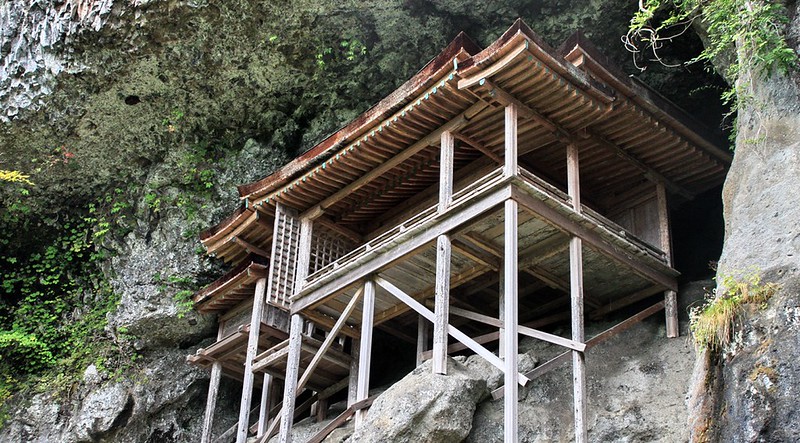
Nageiredo Hall at Sanbutsuji Temple on Mount Mitoku is famed for its dramatic, hard-to-reach setting. A National Treasure and part of Japan Heritage, it rewards travelers ready to tackle a mountain pilgrimage.
Mount Mitoku Sanbutsuji Temple's Nageiredo Hall (
official website
): 1010 Mitoku, Misasa-cho, Tohaku-gun, Tottori Prefecture. Telephone: 0858-43-2666. Hours:
8:00 a.m.-3:00 p.m. (at least two people are required to enter the mountain; fee: 1,200 yen)
Everyone is familiar with World Heritage Sites, and some may even know that Japan had twenty-five of them as of 2022. But have you heard of Japan Heritage? Tottori has a Japan Heritage story. Why is it called Japan's most dangerous national treasure and the hardest one to reach? Visit Tottori, travel to Mount Mitoku and Sanbutsuji Temple not far from Kurayoshi and Misasa Onsen, then fight your way up to Nageiredo Hall, and you will have the answer.... First, you should know that it is closed in poor weather. Visitors may not travel alone, use fire, eat, or carry trekking poles, and they must wear the straw rope sandals prepared by the temple, among other rules. Oh, I nearly forgot: you also have to pay 1,200 yen....
First, a brief explanation of Japan Heritage. Established in 2015, the program aims to follow the World Heritage model by preserving Japanese culture, promoting tourism in Japan, and further revitalizing the economy. Recognition has several requirements. One is to connect national treasures, important cultural properties, intangible cultural properties, and folk cultural properties already recognized in different areas into one complete story based on their historical background, the local environment and customs, and traditions passed down through generations. A single Japan Heritage designation represents one complete historical and cultural story and the corresponding cultural properties. A municipality submits an application to the Agency for Cultural Affairs through its prefectural board of education. After a committee of cultural experts completes its review, the Agency for Cultural Affairs decides whether to grant recognition.
On April 24, 2015, the Agency for Cultural Affairs recognized eighteen Japan Heritage stories from eighty-three applications.
On April 20, 2016, nineteen of sixty-seven applications were recognized as Japan Heritage.
By 2022, a total of 104 projects had passed the review.
On December 13, 2019, February 13 was declared Japan Heritage Day (
because the Japanese reading of the number two is the same as the first sound in Nihon, meaning Japan, while the thirteenth also sounds similar to the Japanese word for heritage). For details on all 104 Japan Heritage stories recognized to date, see the
official Japan Heritage website.
Japan Heritage stories can likewise cross administrative boundaries or remain within one administrative area. Without counting administrative areas separately, Tottori currently has a total of four.
Tottori's four Japan Heritage stories are:
1. A Site for Purifying the Six Roots of Perception and Healing the Six Senses: Viewing Japan's Most Perilous National Treasure and One of the World's Leading Radon Springs, Mount Mitoku
Video URL
2. Japan's Largest Daisen Cattle and Horse Market, Nurtured by Faith in Jizo: Tottori Daisen (
3. An Extraordinary Space Woven from the Dreams of Men Who Crossed Rough Seas: Kitamaebune Ports of Call and Shipowner Settlements. A cross-prefectural Japan Heritage story covering Tottori Prefecture (Tottori City and Hamada City) and sixteen prefectures and cities. (
Story URL
4. Spectacular Scenery and Hidden Places Born of the Sea Winds: Inaba and Tajima, the Land Where the Kirin, a Sacred Beast That Brings Happiness, Dances (Hyogo and Tottori) (
Japan Heritage story number twelve, "A Site for Purifying the Six Roots of Perception and Healing the Six Senses," consists of two parts: Mount Mitoku, where the six roots are purified, and Misasa Onsen, where the six senses are healed. Both are important Japanese cultural assets with histories of 1,300 years. Both can be reached by transferring at Kurayoshi Station on the Sanin Main Line. Misasa Onsen is about fifteen minutes away, while Sanbutsuji Temple at the foot of Mount Mitoku is about forty minutes away. In this article, we will first discuss the more difficult destination, Mount Mitoku.
Mount Mitoku was founded 1,300 years ago and has long been regarded by ascetics as both the most difficult pilgrimage and the one that must be completed. Its story must begin with
En no Gyoja Ozunu (634-701), the founder of Japanese Shugendo.
Shugendo is a form of spiritual practice that trains the self through austerities. Practitioners undergo severe discipline in mountains and forests to obtain sacred supernatural power.
Legend says that En no Ozunu practiced severe austerities in the wilderness, living on pine needles, grasses, and bracken. He mastered the Peacock Wisdom King ritual and acquired the ability to fly.
When En no Ozunu (
En no Gyoja) attained enlightenment, he is said to have thrown three lotus petals into the sky. One of them drifted down onto
Mount Mitoku in the old province of Hoki. From then on, this place became a sacred center of
Shugendo known for the Legend of the Lotus.
The Mount Mitoku Japan Heritage cultural properties include the six blue circles in the illustration: Mount Mitoku, the Mount Mitoku Ascetic Path, Sanbutsuji Main Hall, Sanbutsuji Monju Hall, Sanbutsuji Bell Tower, and Sanbutsuji Inner Sanctuary, Nageiredo Hall. Two more elements are the Mount Mitoku fire-walking ritual held each year on the final day of October, and Buddhist vegetarian cuisine with Mitoku tofu. Together, these eight elements form the purification of the six roots within the Japan Heritage story "A Site for Purifying the Six Roots of Perception and Healing the Six Senses."
From the foot of Mount Mitoku, you can clearly see Sanbutsuji's Nageiredo Hall, an astonishing structure beneath the mountain cliff.
Kaiseiin at Mount Mitoku is the place for Buddhist vegetarian cuisine.
This vegetarian cuisine represents
the tongue among the "six purified roots." Unfortunately, service has not yet resumed since the COVID-19 pandemic.
There are several important rules for climbing to Mount Mitoku's Nageiredo Hall. First, solo travel is prohibited, meaning that no one may enter the mountain alone. Trekking poles are not allowed. Neither smoking nor lighting incense or any other use of fire is permitted, and visitors may not even chew gum. Naturally, no food may be eaten along the route. There is no water source during the ninety-minute round trip, so you must bring your own drinking water. The Main Hall is open for worship from 8:00 a.m. to 5:00 p.m., but anyone wishing to climb to Nageiredo must register before 3:00 p.m. Entry is also prohibited in rain or poor weather. Whether climbing is allowed on a given day depends on announcements from the
official Sanbutsuji Temple website.
Before the stone steps leading to the Main Hall is a suikinkutsu water harp. Pour water over the nearby statue of Fudo Myoo, and it produces a mysterious sound like a koto.
At the top of the stone steps is Sanbutsuji's Main Hall. Members of the general public may worship as far as this point from 8:00 a.m. to 5:00 p.m. for an offering of 400 yen. Those entering the mountain pay an additional 800-yen entry fee, bringing the total to 1,200 yen.
The Main Hall represents the nose among the "six purified roots." Many photographs of ascetics hang on its walls, and the route certainly looks steep. Still, this is spiritual training, after all....
Your shoes must be inspected before the climb. If they fail, you have to change into these straw sandals. Supposedly ninety percent of shoes are rejected, so it is best simply to put on the sandals used for spiritual practice.
Next, each person is given a strip of cloth bearing the words "purification of the six roots." Wearing it is optional and not compulsory.
The Sanbutsuji Treasure Hall contains seven standing wooden statues of Zao Gongen, but photography is prohibited.
Beyond the red gate is Shukuiri Bridge, with flowing water below it. Local residents say the bridge resembles a spiritual boundary; after you cross it, you enter the sacred realm of Mount Mitoku.
There are nine structures along the pilgrimage path from Shukuiri Bridge to Nageiredo Hall, but most are concentrated in the second half. The first half consists entirely of wild, jungle-like trails and rocky paths. Before we knew it, about half an hour had passed, and we finally saw the Eleven-Faced Kannon Hall and Nogiwa Inari. A very small, charming torii stands in front of the shrine, which is said to have been built in the mid-Edo period.
Next comes the Gyoja Path, a slope covered in tree roots that resembles rock climbing. It looks dangerous, but in practice it is safer than expected. Whether you use your hands or feet, there is always something to hold or step on. Nevertheless, you do need a basic level of physical strength.
Not a single nail was used in the timber framework beneath Monju Hall. The hall is said to have been built in 849. This construction method, in which a building projects over a steep slope or cliff, is called kakezukuri, or overhanging construction.
Although the usual account dates Monju Hall to 849, one group of scholars used documents discovered inside the building to estimate that a date around 1567 is more likely. Inscriptions referring to the Azuchi-Momoyama period (1573-1603) and other dates are engraved into the metalwork on interior doors and the metal fittings of the ornamental railing posts.
Monju Hall represents the body among the "six purified roots." The worship route follows the edge of the wooden platform all the way around, but you must pay close attention to every step beneath your feet. The scenery here is wonderfully refreshing. In poor weather, visitors turn back at this point.
Sanbutsuji's Jizo Hall enshrines the guardian and life-prolonging Jizo Bodhisattva. It was built around the Muromachi period (1336-1573) and uses the same kakezukuri construction technique.
Sanbutsuji's Bell Tower represents the ear among the "six purified roots." Its construction method and date remain a mystery. The present bell is said to have been recast in 1680. Ascetics ring it to settle their minds before continuing toward Nageiredo Hall.
Sanbutsuji's Sutra Repository is
where Shugendo practitioners stored scriptures. It was built during the Heian period (794-1185) in kasuga-zukuri, an architectural style distinctive to Japanese shrines.
From here, you can see Sanbutsuji's inner sanctuary, Nageiredo Hall, which represents the eye among the "six purified roots." It is the symbol of all Mount Mitoku and the final destination of the ascetics. Built in 706, it received three Buddhist statues in 849 when the monk Jikaku Daishi Ennin placed images of Shakyamuni, Amida, and Dainichi Nyorai inside the temple. The three Buddhas gave Sanbutsuji, "Temple of the Three Buddhas," its name. The official name of the building in front is Zao Hall, and the rear structure is Aizen Hall.
Built into a mountain wall at an elevation of only nine hundred meters, Sanbutsuji resembles the Hanging Temple on Mount Heng in Shanxi, China. Although there is still a difference in sheer magnificence, both present astonishing, breathtaking scenery.
In a rocky grotto before Nageiredo stands a Kannon Hall built in 1648. To reach Nageiredo, visitors must pass between the rock and the hall. The cave resembles a womb, and walking through it symbolizes being born anew. Its principal image is the standing Sho Kannon statue, an Important Cultural Property.
Motoyuikakedo Hall is where the hair of monks tonsured at Sanbutsuji is kept. Motoyui means the cord used to tie up hair. Its principal image is Prince Siddhartha, and the structure was built in the early Edo period.
Finally, to the right of Nageiredo is Fudo Hall, likewise fitted into the mountain wall. It was built in the late Edo period and enshrines Fudo Myoo.
8:00 a.m.-3:00 p.m.
(at least two people are required to enter the mountain; fee: 1,200 yen)
Transportation:
About forty minutes by local bus from JR Kurayoshi Station (take the Misasa Line between Kurayoshi Station and Misasa, and get off at Mitokusan Sando Iriguchi)
Bus timetable
About fifty minutes by car from Innosho Interchange on the Chugoku Expressway via National Route 179
About fifty minutes by car from Yubara Interchange on the Yonago Expressway via National Routes 313, 482, and 179
Source: 小虎食夢網 | Original URL: https://www.foodtigertw.com/blog/posts/3050247832
Where would you stay for this story?
This is a stay-recommendation demo. Partner links will be enabled after confirmation.
Kaike Onsen and Tottori stays
Choose an onsen inn, city hotel or stay area that fits the article context.