
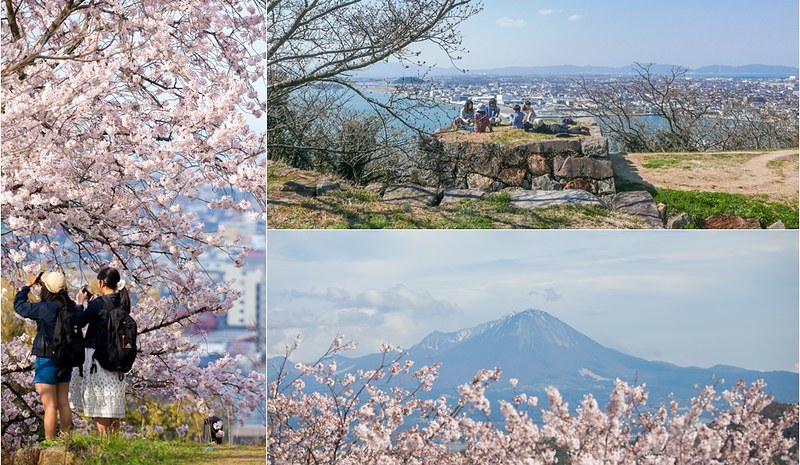
Climb to Yonago Castle Ruins, once hailed as San'in's finest castle, for a sixfold panorama of sky, sea, mountains, city, castle, and cherry blossoms. It is one of Japan's Top 100 Castles and a National Historic Site.
Yonago Castle Ruins (Famous Castle No. 169; built in 1470; abandoned in 1871) (
Official Website
): Nishimachi, Yonago, Tottori Prefecture. Phone: 0859-22-7111 (Yonago City Hall). Cherry blossom season: late March to mid-April every year. Admission: free.
Even seasoned travelers to Japan rarely talk about going to Tottori to see the cherry blossoms. Yet Japan is the land of cherry blossoms, and they can be enjoyed throughout the country; Tottori is naturally no exception. This article will not only take you cherry-blossom viewing in Tottori, but also into one of Japan's 100 Famous Castles: the Yonago Castle Ruins, acclaimed as the finest castle in the Sanin region and a seaside castle in the sky. From the summit of Mount Minatoyama, about 90 meters above sea level, you can take in a magnificent 360-degree panorama formed by six elements: the sky, sea, Mount Daisen, the streets of Yonago, the castle ruins, and cherry blossoms.
Yonago lies on the border between Tottori and Shimane prefectures. To the north is
Sakaiminato, the hometown of GeGeGe no Kitaro,
while nearby Hoki is home to Hoki beef, derived from an original lineage of Japanese wagyu. Following the Sanin Main Line east leads to Daisen, while heading west takes you into Shimane Prefecture. Mount Daisen, revered by Tottori residents as a sacred mountain, rises in this area. Minatoyama Park, where the Yonago Castle Ruins are located, is widely regarded as the best scenic spot in all of Tottori for viewing the mountain.
Yonago Castle, also known as Kume Castle or Minatoyama Castle, was first built in Bunmei 2 (1470). Kikkawa Hiroie continued its construction in Tensho 19 (1591), and it was fully completed in Keicho 7 (1602), after the Battle of Sekigahara. This splendid mountain castle once had a five-story main keep and a four-story secondary keep, earning it the name “the finest castle in the Sanin region.” In the early Edo period, it served as the seat of the Yonago Domain, also called the Hoki Domain. Like many renowned castles from the age of warring states, it was abandoned under the castle abolition order after the Meiji Restoration in 1871.
Surviving remains at the Yonago Castle site include the main keep enclosure, Kita-no-Naizenmaru, Higashi-no-Iidemaru, and the second enclosure. Its stone walls, square defensive entrances, vertical moats, stone quarry, rice storehouse, stables, and Ofunade-kuruwa naval compound can still be clearly seen. The main and second enclosures are designated a National Historic Site, and part of the third enclosure, formerly Minatoyama Stadium, was added to the designation in 2021.
(The cherry blossom photographs in this article came from
Tottori Prefecture's Photo Gallery,
a website where some photographs can be used free of charge after submitting an application.)
Beyond the history and culture of the Yonago Castle Ruins, Minatoyama Park is home to 450 cherry trees that burst into bloom from late March to mid-April. They form a beautiful near-and-far composition with Mount Daisen in the distance, the Chugoku region's highest peak at 1,729 meters and a mountain also known as Izumo Fuji. This is a favorite destination for people chasing the cherry blossoms in Tottori.
Compared with many celebrated sites called castles in the sky, Yonago Castle is an easy climb. After entering Minatoyama Park, it takes only about 15 minutes to reach the main keep site at an elevation of 90 meters.
The stone steps and walls along the way seem to carry six centuries of history and culture, while the wooded trail is shaded by greenery. In mid-March, cool breezes and dappled sunshine make the walk especially pleasant.
After passing the Iron Gate, the remarkably intact and imposing stone walls of the main enclosure come into view, surrounded by rows of cherry trees covered in buds.
Besides the elevated views from one of Japan's 100 Famous Castles, the climb up Yonago Castle reveals different sides of Mount Daisen from varying heights and angles. This is another reason many Tottori residents enjoy climbing the castle hill. Seen from a distance, the mountain truly does resemble Mount Fuji, so it is easy to understand why it is called Izumo Fuji.
I took these photographs of Mount Daisen while climbing from the foot of the mountain. In March, thick snow still covered its summit, and the wind blowing from afar carried a faint chill.
At the site of the main keep, the stone embankments and trenches in the ground remain remarkably well preserved.
This side offers a complete view of the streets of Yonago.
Turn around and the Sea of Japan and Sakaiminato Bay stretch before you. The limitless 360-degree view is truly refreshing.
Several young people sat down right there even though the cherry blossoms had not yet opened. It was impossible not to imagine how beautiful the trees beside them would look in full bloom.
Yonago Castle Ruins (Famous Castle No. 169) (
Access: A 15-minute walk from JR Yonago Station, or take the Dandan Bus to Minatoyama Koen-mae and walk five minutes.
Source: 小虎食夢網 | Original URL: https://www.foodtigertw.com/blog/posts/3049971728
Where would you stay for this story?
This is a stay-recommendation demo. Partner links will be enabled after confirmation.
Kaike Onsen and Tottori stays
Choose an onsen inn, city hotel or stay area that fits the article context.