
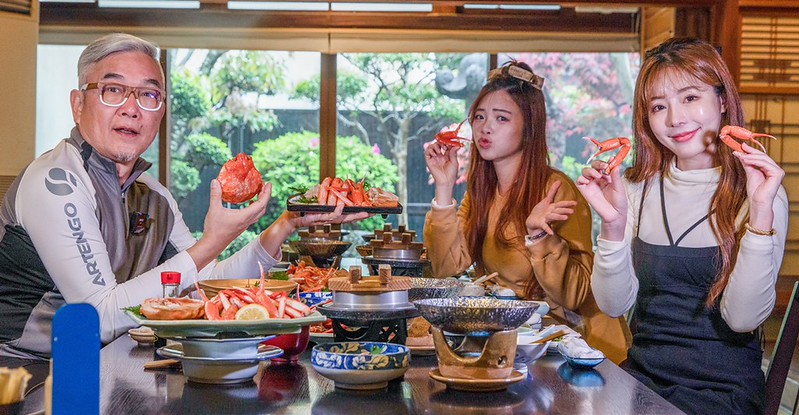
Ajidokoro Misa in Sakaiminato is known for its red snow crab kaiseki. Lunch starts around 3,300 yen, making it a good choice for travelers who want to savor Tottori crab course by course.
Ajidokoro Misa (
official website
): 6 Kyo-machi, Sakaiminato City, Tottori Prefecture. Tel: +81-859-42-3817. Hours: 17:30–23:00 (lunch requires advance booking; closed Sundays).
Crab is undoubtedly one of the kinds of seafood Taiwanese visitors love most in Japan. Hokkaido is probably the place everyone can readily name, but many may not know that Tottori was once Japan’s leading prefecture for crab catches. That earned it the punning nickname “Kanitoriken,” or “Crab-Catching Prefecture.” Sakaiminato accounts for nearly 60 percent of its crab catch and, in my opinion, is also the best-value place in Japan to eat crab. Ajidokoro Misa is probably the best-value restaurant among all the crab feasts I have eaten in Japan. This crab kaiseki meal gives each person one and a half crabs, served in a private room overlooking a beautiful Japanese garden, yet costs only ¥3,300.... This restaurant will definitely be included in this October’s Xiaohu Foodie Tour of Tottori autumn leaves, hot springs, sake, and Michelin dining.
Ajidokoro Misa has been open in Sakaiminato for only around a decade, but inside and out it is filled with the time-honored atmosphere of a long-established restaurant. According to my friend in Tottori, the crab dishes are so inexpensive because the owner is the chairman of the Sakaiminato Red Snow Crab Association. With a restaurant run directly by the chairman and the crab-fishing port next door, low prices and freshness come naturally.
Incidentally, “
Ajidokoro Misa
” also operates an inn. Whether you stay on a one-night, two-meal plan or come just for a meal, you can enjoy inexpensive, delicious crab dishes right at their source. We had originally hoped to book “
Kanikkichi
,” the world’s only two-Michelin-starred crab restaurant. Unfortunately, its reservations were already booked a full year ahead.... I hope that one day my wish to taste its crab will come true.
The dining spaces here are distinctly Japanese. Most are private rooms that can be joined together, and the floors are mainly tatami, so guests must remove their shoes.
That day, we were seated in an exceptionally beautiful private room with a view of a Japanese garden. It felt just like dining at an upscale ryotei. Note that Misa normally opens only in the evening; lunch requires an advance reservation for a party of at least eight.
This was the menu that day. Each person received one and a half red snow crabs: one whole crab boiled and another half crab for shabu-shabu. The meal also included an assortment of sashimi caught in the Sea of Japan off Tottori, crab kamameshi, chawanmushi, miso soup, pickles, and dessert. Hearing that all this cost only ¥3,300 was astonishing.
Alongside the delicious crab dishes, the restaurant serves local Tottori sake, including some new brews made just the previous month.
For the sake of taking photos, we asked the restaurant to bring every dish at once. At ¥3,300, the entire spread was a magnificent sight. Even if crab is cheaper in Tottori, one crab at the market would surely cost ¥2,000 or ¥3,000. This price was extraordinarily generous.
The sashimi selection contained four or five varieties, all landed at Sakaiminato: Tottori sea bream, white squid, and octopus legs that were both delicately crisp and soft. The intensely savory chawanmushi contained crabmeat too, showing just how generous the meal was. The two slices of salmon, incidentally, were Tottori’s famous “
Tottori Kotoura Salmon
.” Every year from August 19 through October 23, Kotoura also holds the Kotoura Salmon Festival.
These pickles were a little saltier than usual and were made by curing innards from crab, squid, and similar seafood. They paired especially well with sake.
The red snow crab below was one whole boiled crab. The plate above held half a raw crab, which could be eaten as sashimi or cooked as shabu-shabu. Every diner received one and a half red snow crabs in total.
The sashimi-grade red snow crab was, as expected, fine-textured, tender, and very sweet. It was far above the quality one would expect for just ¥3,000. I suggest eating one or two legs raw and saving the rest for crab shabu-shabu, so you can enjoy two different expressions of Tottori red snow crab.
If you want a clear broth, you can even put the emptied shells and crab legs into the pot to deepen its flavor. After they had simmered, the vegetables and mushrooms in the broth—especially the long green onions—became unbelievably savory and sweet.
To be honest, I am not that passionate about eating crab, especially a variety with relatively little meat.... Fortunately, the restaurant had removed most of the shell. All I had to do was use the crab spoon on the table, make a light cut, peel it back, and eat. Once boiled, the red snow crab was sufficiently sweet, and its moist, substantial flesh was deeply satisfying.
You can dip the crabmeat in vinegar or eat it with the crab tomalley inside the shell. Or you can do what I did: remove all the meat, pile it luxuriously into the shell, then mix it with the tomalley underneath. The satisfaction of filling your mouth with the full savor of crab cannot compare with merely eating one or two legs. It was pure happiness.
Although the shabu-shabu portion was described as half a crab, once the crab kamameshi and crab chawanmushi were included, the meal contained nearly two crabs’ worth in all.
There was no chance that freshly cooked crab kamameshi would disappoint. The moment the lid was lifted, the fragrance of rice and the savor of crabmeat surged upward together. The delicious steam alone was enough to make me swoon, and the crab rice itself was extraordinarily savory and sweet.
You can also save half of the crabmeat piled in its shell and place it over the crab kamameshi. In an instant, it becomes a crab rice bowl enriched with crab tomalley. Tell me: isn’t that level of satisfaction worth far more than ¥3,300?
Do not let the server take away the empty crab shell. Order a bottle of warm sake, pour it into the shell, and use it for a final toast. This is the San’in custom when eating crab, so when in Rome, do as the locals do.
The final dessert was a brown-sugar matcha pudding, and it too was delicious.
This is the seafood rice bowl ordered by our friend from Tottori. When we asked why she had not ordered the crab meal, her answer was unexpectedly that it was not enough food.... So she let us have the crab instead. How touching is that...?
Ajidokoro Misa: 6 Kyo-machi, Sakaiminato City, Tottori Prefecture. Tel: +81-859-42-3817. Hours: 17:30–23:00 (closed Sundays).
Source: 小虎食夢網 | Original URL: https://www.foodtigertw.com/blog/posts/3050507604
Where would you stay for this story?
This is a stay-recommendation demo. Partner links will be enabled after confirmation.
Kaike Onsen and Tottori stays
Choose an onsen inn, city hotel or stay area that fits the article context.