
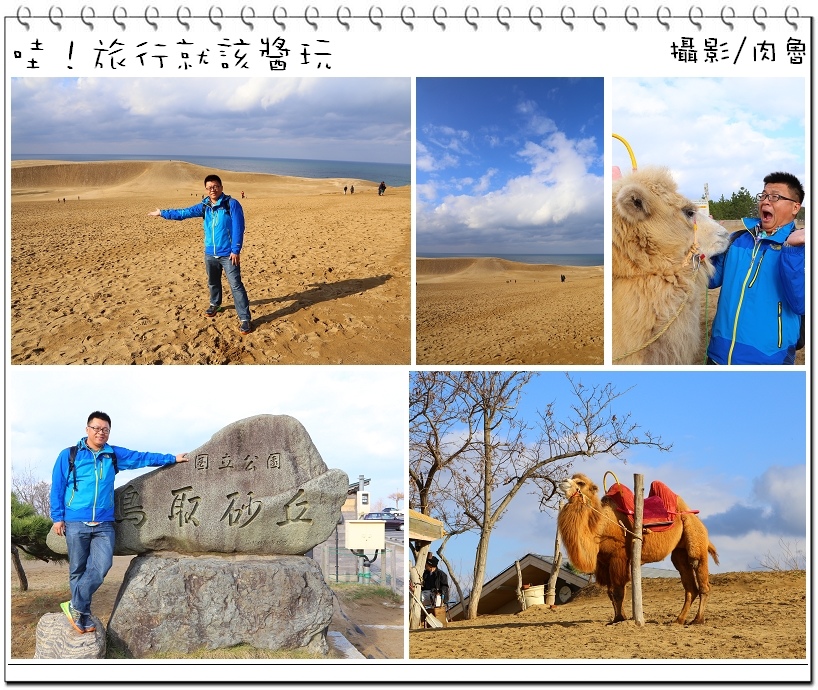
The Tottori Sand Dunes stretch about 16 kilometers east to west and are around 30 minutes by bus from JR Tottori Station. Visit in the morning for a better chance of seeing untouched wind ripples in the sand.
Feb
Mon
Japan's Tottori Sand Dunes: An Incredibly Surreal and Beautiful Hidden Landscape Formed by 100,000 Years of Natural Forces. It Feels Like Wandering Through the Sahara, and You Can Even Ride a Camel Across the Dunes (About 2.5 Hours from Osaka to Tottori Station and 0.5 Hours from Tottori Station to the Dunes)
Japan's Tottori Sand Dunes are an incredibly surreal, beautiful hidden landscape formed by 100,000 years of natural forces. They give you the magical feeling of wandering through the Sahara Desert, and you can even ride a camel across the dunes.
Tottori is Japan's least populous prefecture, yet it possesses the dreamlike Tottori Sand Dunes. This enormous dune field stretches sixteen kilometers east to west and two kilometers north to south, with a height difference of nearly one hundred meters, and borders the beautifully winding Sea of Japan. The Tottori Sand Dunes truly are a breathtaking natural wonder. If you want to visit Tottori, Roulu recommends combining it with a trip to Osaka and Kyoto.
It takes about 2.5 hours by JR train from Osaka to Tottori Station, followed by about half an hour by bus from Tottori Station to the Tottori Sand Dunes. A two-day, one-night or three-day, two-night itinerary in Tottori works very well. The dunes are unquestionably a hidden destination you must visit when traveling in Japan.
★ Tottori Station ←→ Tottori Sand Dunes Transportation Timetable
Tottori City Tourist Association:
http://www.torican.jp/chinese_hantai
Tottori Sand Dunes:
http://www.city.tottori.lg.jp/geopark/tai/index.html
Download a Tottori map:
Click here to download
Official bus timetable website:
http://www.moon.sannet.ne.jp/kururi/timetable/sakyu/
Bus timetable list:
Tottori Station → Sand Dunes bus timetable
Sand Dunes → Tottori Station bus timetable
▲ To reach the Tottori Sand Dunes, you can take a 1,000-yen taxi or catch a bus from Tottori
Station. The dunes are considered one of Japan's most fantastic landscapes, and they were a Japanese attraction I had longed to visit for years. They are like a vastly enlarged version of the Gangzai Desert in Pingtung, Taiwan, or a seaside version of the Sahara. Visit once and I guarantee you will exclaim in amazement and fall madly in love with the Tottori Sand Dunes, because they are as beautiful as a dream.
▲ The Tottori Sand Dunes cover a vast area, so an early-morning visit is generally recommended. You can then see the unusual wind ripples formed by a full night of wind. Why go so early? Once visitors arrive and walk across the dunes, their footsteps erase the ripples completely.
▲ Climb the stairs and an immense desert paired with the blue ocean fills your view. Oh my...can this really be so dreamlike? In the distance are raised dunes shaped like a horse's back, and each visitor walking across them looks like a tiny ant. On the right is a lone, weathered tree. The Tottori Sand Dunes are genuinely overwhelming.
▲ The Tottori Sand Dunes are so beautiful that they resemble a mirage. The dune makes a smiling curve, with an arc descending and then rising again. It is truly breathtaking.
▲ There is a low hollow ahead, and that is the oasis of the Tottori Sand Dunes, where groundwater bubbles to the surface. I heard it fills with water and becomes a pond in spring, then dries up completely in summer. I visited in autumn, when the oasis felt only slightly damp. A real desert oasis had appeared in the Tottori Sand Dunes. Japan takes practical, diligent care of environmental protection. Since the dunes lie beside the sea, they also face the serious problem of gradually losing sand. To preserve their existing appearance, researchers study everything from geology to winds arriving from different directions. The effort is remarkable; representatives from the Sahara have even come to the Tottori Sand Dunes to learn from it.
▲ When visiting the Tottori Sand Dunes, never write anything in the sand. You may be photographed and reported. Beautiful scenery should simply be viewed and photographed, so please be sure to follow the dunes' rules.
The Tottori Sand Dunes extend from Mount Shichi in the east to Cape Keta in the west. Sediment carried into the Sendai River was blown together by winds from the Sea of Japan,
forming the dunes over 100,000 years. They are also one of Japan's Top 100 Geological Sites. The first time I stepped onto the Tottori Sand Dunes, their beauty felt unreal, and it still does today.
▲ To climb the "Horse's Back" at the Tottori Sand Dunes, you need to advance one careful step at a time. The slope makes every step difficult, but walking on it is genuinely fun.
▲ If you visit the Tottori Sand Dunes in autumn, wear thicker clothing because the sea wind can be very cold. In winter, the dunes may be covered entirely in snow. They show a different character in each of the four seasons and are definitely worth the long journey from Osaka.
▲ Let us head toward the Horse's Back ahead. It feels as though we have stepped through Doraemon's Anywhere Door and emerged in the Sahara Desert.
▲ This is the other side of the Tottori Sand Dunes. Their major changes in elevation also make them suitable for paragliding and hang gliding. The area in the distance is where you can try these activities.
▲ Sunshine, ocean, the Tottori Sand Dunes, and a coastline stretching as far as the eye can see: the view is wonderfully refreshing.
▲ Jump to your heart's content for photographs. Fly over the Tottori Sand Dunes and experience the appeal of nature shaped by 100,000 years.
▲ One particularly surprising sight at the Tottori Sand Dunes is a camel. Camels were introduced to give the dunes an even more compelling desert atmosphere. They are not merely there to be viewed; for a fee, you can sit on one and ride across the dunes.
▲ Without an explanation, this truly looks as though I am traveling the Silk Road. It gives me the uncanny feeling of passing through time and space.
▲ Wow! Someone is riding a camel. How could that be any cooler? This is absolutely one of the things you must do at the Tottori Sand Dunes. Ha ha.
▲ Camels can carry either one person or two. Once you sit on the camel, a handler leads it slowly along. It is fantastic.
▲ The price is 1,300 yen for one rider and 2,500 yen for two. It is a wonderfully novel experience at the Tottori Sand Dunes.
▲ Be careful when watching the camels, because they often spit. It would be quite an experience to be hit. Their expressions also change constantly, making me laugh just by looking at them.
▲ I tried posing cutely with the camel too, and its expression fit the occasion perfectly. Ha ha. It must have been thinking, "What is this person doing...?"
▲ Ha...the camel and I look like close friends. In reality, I risked being spat on to get this close to it. It really is an adorable camel.
▲ When you visit the Tottori Sand Dunes, you absolutely must walk to the distant Horse's Back. Seen from afar, does it not truly resemble a horse's back? The dune on the left looks just like a desert cliff.
▲ Come on, let us head toward the Horse's Back. Look at the people climbing it and you can see how steep the slope is. There is no need to be afraid: the sand is soft and loose, and walking across it is great fun.
▲ Walking through the Tottori Sand Dunes seems to turn time back to childhood. Sitting and playing in the sand and running back and forth across the dunes fills the whole experience with childlike delight.
▲ It takes only fifteen minutes on foot to reach the Horse's Back. From its high point, you can look over the winding coastline of the Sea of Japan. If you have enough time, you can also walk down to the dunes below. Since fewer people go there, you may still see the patterns made by the wind.
▲ I looked back across the Tottori Sand Dunes from the Horse's Back. The sight was beautiful and dreamlike.
▲ The Tottori Sand Dunes are a source of pride for Tottori residents. They even made their own camel costume and were preparing to enter Japan's famous costume-performance television contest. Is that not fun? Spring is nearly here, so plan a trip to Tottori, Japan. I guarantee that you will fall in love with this warm, friendly little prefecture and marvel at its natural landscapes. Besides the Tottori Sand Dunes, Tottori also has Hakuto Shrine, where people pray for good romantic relationships. Its incredibly cute rabbit-shaped charms will make you lose all self-control while shopping.
★ Tottori Station ←→ Tottori Sand Dunes Transportation Timetable
Tottori City Tourist Association:
http://www.torican.jp/chinese_hantai
Tottori Sand Dunes:
http://www.city.tottori.lg.jp/geopark/tai/index.html
Download a Tottori map:
Click here to download
Official bus timetable website:
http://www.moon.sannet.ne.jp/kururi/timetable/sakyu/
Bus timetable list:
Tottori Station → Sand Dunes bus timetable
Sand Dunes → Tottori Station bus timetable
Tottori Kirin Lion ★ Sightseeing Loop Bus (the drawback is that it runs only on holidays)
Official website:
http://www.torican.jp/bus
Operating days: Saturdays, Sundays, and public holidays except New Year's Day, plus the summer season from July 20 to August 31
Fare: 300 yen for a single ride or 600 yen for a one-day pass
Tottori sightseeing map:
Japan: Make Use of Tottori's 1,000-Yen Sightseeing Taxi Discount. This Tourist Service Is Available Only to International Visitors and Can Be Used Even by One Person. Cars Have a Japanese-Chinese Interpretation System, So You Can Communicate Easily Without Speaking Japanese. Each Ride Lasts a Full Three Hours. For the Tottori Sand Dunes, Hakuto Shrine, Hakuto Coast, Uradome Coast, Tottori Castle Ruins, or Amedaki Falls, the 1,000-Yen Sightseeing Taxi Is the Right Choice.
Japan: Takumi Kappo, with Exquisite Tottori Wagyu, Evenly Marbled and Melting in Your Mouth. A Comfortable Wooden Japanese Building with Tatami Rooms. Must-Eat Wagyu Shabu-Shabu in Tottori at the Birthplace of Japanese Shabu-Shabu.
Japan: Tottori's Hakuto Shrine, with Japan's Cutest Rabbit Charms and Irresistible Rabbit Souvenirs. The Myth of the White Rabbit of Inaba, a Deity for Praying for Good Relationships, and Hakuto Coast, a Sacred Place for Lovers.
Roulu: Traveling Through Taiwan's Hidden Places and Exploring the Beautiful Scenery of Japan and Korea
Posted by Roulu in
Popular (
International Travel
Japan Travel
Source: 肉魯 走遍全台灣●環遊全世界 | Original URL: https://damon624.pixnet.net/blog/posts/43484885
Where would you stay for this story?
This is a stay-recommendation demo. Partner links will be enabled after confirmation.
Kaike Onsen and Tottori stays
Choose an onsen inn, city hotel or stay area that fits the article context.