
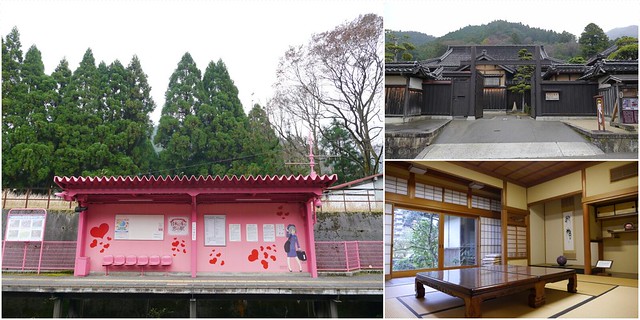
Pair the pink Koi-Yamagata Station with the historic Ishitani Residence for a half-day Tottori trip that blends a love-themed stop with traditional architecture.
Tottori's best-known tourist attractions are the Tottori Sand Dunes and the Mizuki Shigeru Museum, but if you want a deeper understanding of Tottori's history and character, this article will show you two completely different kinds of travel fun. They are especially suitable for history-loving men and women, as well as couples in love (laughs).
First, let us look at transportation. These two attractions happen to be on the same railway line. From Tottori, take the Inbi Line directly to Chizu Station. You can first visit the historic Ishitani Residence, then go to Koiyamagata, the pink station that couples should not miss, for a perfect photo together.
On the day of my visit, I planned around the train timetable and chose to visit Koiyamagata Station first.
It is easy to take a photo in front of the pink installation. Even if you do not have a selfie stick, there is a camera stand directly opposite it.
Place your camera or phone here and set the self-timer to take the perfect romantic selfie.
You can also write a message of love here and put it in the mailbox, allowing your sweetheart to receive the tender words you send.
This is an unmanned station, and no ticket is required to enter and look around the platform. Beyond the station's exterior, the inside is also filled with pink bubbles of romance.
I have heard that four railway stations in Japan have the character for "love" in their names, but I do not know whether all of them market themselves as cleverly as Tottori does, turning themselves into must-visit romantic attractions.
The wall beside the platform lists all the romance-related features installed at Koiyamagata Station.
Even the station sign makes unabashed use of a pink heart.
The posts supporting the traffic mirrors are pink too.
At this "Bell of Love," you can also buy an ema plaque and write down your romantic wish.
[Koiyamagata Station]
Ouchi, Chizu, Yazu District, Tottori Prefecture
Transportation: Take a local train on the Chizu Express Chizu Line directly to the station.
Admission: Free
View a larger map
Next, take the train from Koiyamagata Station. Six minutes later you will arrive at Chizu Station, from which you can walk to the Ishitani Residence, an Important Cultural Property occupying a site of roughly 3,000 tsubo.
Information about opening hours and admission fees is posted at the entrance.
Upon entering the Ishitani Residence, you will see three different wind chimes hanging from the eaves, all featuring very traditional wooden designs.
Look upward:
The ceiling is about 14 meters high.
Heavy crossbeams span the upper part of the soaring hall. In traditional Japanese architecture, the first area inside the entrance is a doma, an earthen-floored space where visitors can change footwear before stepping inside.
Beside the main hall is a tiny room that was once the maid's quarters.
On the right side of the doma is a large cooking stove with a sink. This was the kitchen used by the Ishitani family.
The doma also has a hearth for a cooking pot. When lit in winter, it kept visiting guests warm.
When visiting the Ishitani Residence, I strongly recommend asking whether a guided tour is available. It will help you understand the home's distinctive features much better.
The windows have a different design in every room. Can you spot the differences?
The Ishitani family were extremely wealthy timber merchants in the early Showa era. When they built this mansion, they used valuable logs brought in from many different regions. Walking through the rooms, looking closely, and appreciating the grain of the wood is therefore like taking an engaging tour of prized timbers.
Outside the house stretches a magnificent Japanese garden that offers a different beautiful view in every season.
A 3,000-tsubo house is truly difficult to clean, so clever ideas were incorporated into its design. For example, this opening below the window allowed dust to be swept directly out of the house.
The pulls used to open the doors of the tatami rooms are also highly unusual. This one was actually made from the hilt of a sword.
I especially liked this hexagonal corridor lamp, another valuable antique preserved from the time when the house was built. Unfortunately, the surveillance camera and smoke detector beside it look far too modern (laughs).
The house itself is enormous, yet the bathroom is remarkably small. Evidently, people in the past truly did not care whether bathing was comfortable.
The 3,000-tatami house was also so large that the owner would have had to shout himself hoarse whenever he suddenly needed a servant. A call bell was therefore installed beside the reception room that he used frequently.
We then went upstairs. Although the house is Japanese in style, its staircase is Western: steep, but beautiful.
There is a private shrine, directly beneath which the master's room occupied the first floor. Rituals are still held at the shrine, and it is also available for couples to hold wedding ceremonies.
An old safe stands on the second floor. Of the emblems painted on it, the one on the right is the crest of Tokugawa Ieyasu, while the one on the left is the Ishitani family crest. Viewed along a horizontal line, the Tokugawa crest is positioned slightly higher (my photo is not level). This was done out of respect for the Tokugawa government.
If you lean out to look at the roof, you can see onigawara tiles fitted to the ends of the main beams to ward off evil spirits.
At the end of the tour, we arrived at the master's room. Every New Year, the master's family would gather here to share a meal and exchange New Year's greetings.
There is also a storehouse next door where exhibitions are held from time to time and can be viewed free of charge.
Today's exhibition featured paper sculptures. Their marvelous forms were works of extraordinary craftsmanship.
[Ishitani Residence]
396 Chizu, Chizu, Yazu District, Tottori Prefecture
Opening hours: 10:00-17:00
Closed: Wednesdays, but open every day from April through November.
Admission: 500 yen
More:
Sanin - Tottori (10)
Compare Tottori accommodation prices
Recommended unlimited mobile-data SIM cards for Japan
All cards replaced with the new version starting December 1, 2016
★ 5 days / 120 hours → NT$899
★ 14 days / 336 hours → NT$1,499
Enter one of the following discount codes at checkout when purchasing a card
SA0050A4FD
→Save NT$30 on the 5-day / 120-hour card
SA0051A307
→Save NT$50 on the 14-day / 336-hour card
Reference guide to using a travel SIM card in Japan:
[Recommended High-Speed 4G Internet in Japan, with Discount Codes] J Walker Unlimited SIM Card: iPhone 6 / i5 Setup Instructions, Convenient, Fast, and Power-Efficient
Source: 小虎食夢網 | Original URL: https://www.foodtigertw.com/blog/posts/3047405838
Where would you stay for this story?
This is a stay-recommendation demo. Partner links will be enabled after confirmation.
Kaike Onsen and Tottori stays
Choose an onsen inn, city hotel or stay area that fits the article context.