
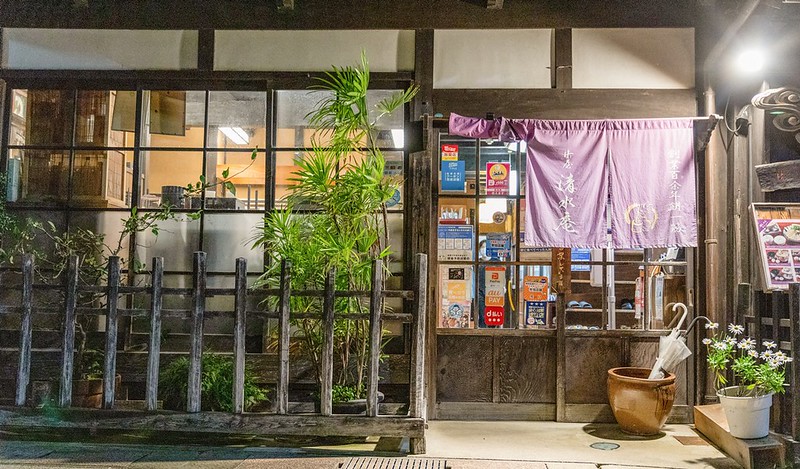
Step into Machiya Seisuian, a century-old shop in Kurayoshi, and try its twelve-color mochi shabu-shabu. Do not miss the local flavor of Tohaku Wagyu from Tottori.
Machiya Seisuian (
Official website
):
1-876 Sakaimachi, Kurayoshi City, Tottori Prefecture. Tel:
0858-22-4759. Hours: 11:00 a.m.–2:00 p.m. and 5:00 p.m.–6:00 p.m. (lunch only on Wednesdays; closed Tuesdays)
Tabelog: 3.46
“Tottori really is more than just sand.” Before this trip, several friends who had never visited Tottori joked about that again. After eating at this century-old restaurant in Kurayoshi, one of them repeated the line with a sigh of appreciation. Today, apart from the iconic Tottori Sand Dunes, most Tottori travel still concentrates on coastal destinations along the San'in Main Line, such as Yonago and Sakaiminato. Naturally, that also includes Conan Station in Yura and Kitaro in Sakaiminato, essential pilgrimages for many manga fans. Kurayoshi, also on the San'in Main Line, is a major city in central Tottori and one of the prefecture's most important tourism areas. It has the white-walled storehouses and red roof tiles of a 400-year-old historic district and is also widely popular because of its proximity to Misasa Onsen, designated Japan Heritage. The restaurant that represents Kurayoshi cuisine is today's century-old establishment, Machiya Seisuian, known for twelve-color mochi shabu-shabu and Tottori Tohaku wagyu shabu-shabu, made with beef described as an ancestor of Japanese wagyu.
Since the title invokes “Degawa Tetsuro no Juden Sasete Moraemasen ka?” let us first discuss the program. “Can You Let Me Charge Up?” premiered in August 2014 and aired irregularly as part of Saturday Special until January 2017. At the time, its title was simply “Can You Let Me Charge Up?” As the response and ratings grew, it even became the highest-rated program in its time slot in 2015. TV Tokyo ultimately decided to give it an official Saturday prime-time slot at 7:54 p.m. beginning in April 2017. It formally added Degawa Tetsuro's name to the original title and set the goal of “Crossing All of Japan! Conquering All 47 Prefectures.” That is my goal as well. I have currently reached 45, with three prefectures, Toyama and Fukui, remaining.
Degawa Tetsuro was once voted by Japanese women the celebrity they least wanted to sleep with and the most disgusting entertainer. After enduring so many years, he finally got a hugely successful program of his own. Anyone who has watched it knows how deeply popular he is now. Those interested can refer to an earlier article by Xiaohu:
Japan, Shikoku – Marugame Food in Kagawa: Honetsukidori Ikkaku (Original Marugame Store) and “Degawa Tetsuro no Juden Sasete Moraemasen ka?”
That article contains more explanation about the program and how this currently popular Japanese comedian went from reviled to beloved. If you are interested, go out and turn right.
All right, I learned about this century-old Kurayoshi restaurant by watching that program. An episode broadcast in November 2021 started from Hawai Onsen in Tottori, a hot-spring district one stop before Kurayoshi, and headed toward Izumo Taisha in Shimane. The special guests traveling by electric bike in that episode were Ryumon Yamamoto and Yoshio Kojima. Along the way, an inn owner recommended Machiya Seisuian's twelve-color mochi to Degawa Tetsuro. On the program, Degawa often asks passersby about famous nearby restaurants, attractions, and other places.
Kurayoshi's busiest historic district is some distance from Kurayoshi Station, about a 30-minute walk. Naturally, buses connect from the station, and you can also take a taxi for around 1,500 yen. We will find another opportunity to discuss Kurayoshi's white walls and red tiles, along with the course of its development, perhaps paired with the local autumn leaves and ginkgo trees.
Our reservation that day was for 6:30 p.m., so first enjoy a few photos of Kurayoshi's old streets at night. One word describes them: quiet. Several izakayas and restaurants were still open, but there were essentially no pedestrians on the road.
According to its official website, Machiya Seisuian is a restaurant with a century of history, although its exact founding date cannot be found online. The machiya townhouse in Kurayoshi dates from the Meiji period. Its exterior looks a little like a Japanese inn or an Edo-period post station. In a phrase, it has the charm of antiquity.
Seisuian's signature is Kurayoshi's hand-pounded mochi, offered since the restaurant's founding. Through Seisuian's ingenuity, it became a hot-pot dish called mochi shabu, passed down to the present and now a representative food of both Kurayoshi and Seisuian.
Inside the building, the counter on the left resembles the front desk of a Japanese inn. A long Japanese-style corridor runs through the center, and glass cabinets along it hold many antiques reflecting Kurayoshi's long-established businesses.
Naturally, there are also autograph boards and photographs from famous people around the world. It seems that quite a few Korean programs have visited to report from here.
As expected of a century-old restaurant, the dining areas are uniformly covered with tatami and filled with the atmosphere of an old house. The moment you enter, you are surrounded by the comforting fragrance of tatami mats.
I loved this wooden corridor at night: the wood-framed windows, the light and shadow, the polished wood floor with its slight shine, and the wooden staircase. If a full moon were visible outside the window as well, it would be truly beautiful.
I forgot to photograph the menu, so anyone who needs it should consult the
official website menu
. Besides the signature 1,100-yen mochi shabu, there are mochi-shabu sets combining different meats and seafood. Naturally, the restaurant also offers Japanese dishes commonly found in diners, including set meals, eel over rice, soba, tempura, seafood rice bowls, grilled meat, and fried chicken.
Having done my homework before the trip, I decided to order the same way Degawa Tetsuro did: the 2,200-yen Tohaku beef mochi shabu. It also came with a small serving of udon, chawanmushi, and a small side dish. The beef and mochi were arranged in small bamboo baskets, creating something of the feeling of an English three-tiered afternoon tea.
The hot pot is shaped like the taiji symbol. Both sides contain broth made from kombu and bonito flakes. One side holds ingredients often paired in sukiyaki, including napa cabbage, shiitake mushrooms, and tofu, along with fish cake and other processed seafood products. The main reason for dividing it in two is to cook meat on one side and mochi on the other, the left side without vegetables.
Tottori Tohaku beef is said to be the ancestor of Japanese wagyu. This claim is especially widespread in Tottori, although I have, of course, heard similar accounts in Shimane concerning Mishima cattle and in other prefectures.
Still, there is no denying that this Tohaku beef is sweet, tender, and delicious. Its fat is not as heavy as that of the so-called three great Japanese wagyu brands. In shabu-shabu, it is so easy and pleasurable to eat that I could effortlessly finish ten plates. It is outrageously delicious. I also think Tohaku beef has one unusual characteristic: it looks a little like pork and even tastes a little like it, especially the belly cut.
Next came Seisuian's star, its twelve-color mochi. The first-generation owner reportedly devised this way of eating it because mochi was relatively firm at the time, and large, hard pieces were difficult for older people to eat. All twelve colors use natural ingredients: carrot from the upper left downward, shiitake mushroom, matcha, pumpkin, sesame, blueberry, chili pepper from the upper right downward, corn, mugwort, shrimp, yuzu,
and chestnut.
The method is simple: swish a piece in the broth for five to ten seconds, depending on the texture you prefer. Never drop it into the pot, though. Not only will you be unable to retrieve it, but it will also stick completely to the bottom. As for eating it, the texture is somewhat like cheese: sticky, smooth, and capable of stretching into strands. I could not distinguish most of the ingredients by taste. Yuzu, matcha, and shrimp were the more obvious ones. I would not call it exceptionally delicious, but it certainly is distinctive.
Besides Tohaku beef, mochi shabu can also be paired with pork, seafood, and other ingredients.
My companions ordered ginger pork, fried chicken, and a seafood rice bowl. I sampled one small bite of each, and all were at the standard level of an ordinary diner. My suggestion is to order the signature mochi shabu when you come here, unless your only purpose is to experience the atmosphere of this century-old wooden house.
0858-22-4759. Hours: 11:00 a.m.–2:00 p.m. and 5:00 p.m.–6:00 p.m. (lunch only on Wednesdays; closed Tuesdays)
More:
San'in – Tottori (25)
Source: 小虎食夢網 | Original URL: https://www.foodtigertw.com/blog/posts/3050225532
Where would you stay for this story?
This is a stay-recommendation demo. Partner links will be enabled after confirmation.
Kaike Onsen and Tottori stays
Choose an onsen inn, city hotel or stay area that fits the article context.