
To discover Tottori’s local sake, start with Otani Sake Brewery, a brewer with over 150 years of history. Take a closer look at the craft behind its signature label, Takaisami.
Otani Shuzo (
official website
): 368 Urayasu, Kotoura-cho, Tohaku-gun, Tottori Prefecture. Telephone: +81 858-53-0111. Hours: 8:00 a.m.-5:30 p.m. (closed Saturdays and Sundays)
I would not claim to understand sake, although I have at least tried quite a lot of it. Yet if you asked me what sake Tottori has, I could not have given an immediate answer. From that day onward, however, I had one: Takaisami, made by Otani Shuzo. While you are at it, remember Urayasu, a little station and town on the Sanin Main Line. And what ability does this brewery possess that has led prime ministers and two figures who represent football and baseball in Japanese minds, Hidetoshi Nakata and Shohei Ohtani, to endorse it?
In the past, I rarely took trains while visiting Tottori. Even when I did, I usually traveled directly from Tottori to Kurayoshi, or even straight to Sakaiminato, without paying much attention to the small stations between them. This time I deliberately got off at two small stations. One was in the town of Hamamura, where I stopped for hot springs and Michelin-listed ramen. We discussed that in
[Japan, Tottori Michelin] Hot Air: Visit a 500-Year-Old Hot-Spring Town in Rural Tottori for Michelin Ramen Made with Local Ingredients and Enjoy Three Free Footbaths
Whether Hamamura or Urayasu, both are the kind of rural Japanese town I like. I had simply lacked a reason to stop along the way. After leaving the station, I somehow felt that Goro should be standing in front of this old white wooden station building, producing his signature rumbling "don, don, don" before switching on his food radar in a town where he had no idea what restaurants he might find.
After the rumbling came a somewhat forlorn shopping street in front of the station and the occasional car speeding past, with a straight route onward to the Sea of Japan on the Sanin coast. At that moment, I seemed to hear the click of a camera shutter beside my fingers and the waves one or two kilometers away. Yet the aroma of sake from the other direction was already teasing the drinking bug in my stomach......
Walking south after leaving Urayasu Station, I found a field glowing an oily yellow. A quick search revealed that it was Tottori's famous Kotoura Sunflower Field.
Farther on, the road felt like an ancient post route through Tohaku, with faint traces of its former prosperity. Unfortunately, I was in a hurry and could not stop to photograph it properly. Before long, I saw a large yellow Takaisami sign.
At first, I thought this was a monument bearing someone's name. Looking more closely, it seemed to commemorate the opening of Prefectural Route 44, the Tohaku-Nozoe Line.
Otani Shuzo exists like a hidden retreat in a town whose bustle has faded. Even from a distance, before turning the corner, I could smell the drifting aroma of sake.
Praised as the leading brewery in the Sanin region, Otani Shuzo was founded in 1872, the fifth year of the Meiji era. That gives it a history of 150 years, and it has won recognition from two successive prime ministers. In 2007, then-toji master brewer Toshikazu Sakamoto, and later Hiroshi Sota, received the Medal with Yellow Ribbon as Contemporary Master Craftsmen. Otani Shuzo is therefore one of the foremost breweries not only in Tottori, but throughout the Sanin region. A Tottori friend says it is also the brewery with the highest sales volume in the prefecture. More importantly, it has won the gold prize at the Annual Japan Sake Awards thirteen times.
The brewery looks traditional and understated, yet the entrance actually has an Instagram photo spot and check-in sign. Since we had come all this way, we simply had to take a picture and check in.
Otani Shuzo's greatest feature is its use of sake rice grown in Tottori, beginning with Yamada Nishiki and now including Goriki rice found only in Tottori (the tallest plant at the far right). All of this rice is grown by the brewery itself, and its fully integrated process from cultivation through brewing is another distinctive feature.
"Wow," they even have a rice-polishing machine, reportedly an item many breweries can only dream of owning. I learned from the television drama Liquid: The Miraculous Brewer that these machines are extraordinarily expensive, costing tens of millions of yen.
We had reserved the following tour in advance. For details, see the tour instructions on the official website,
About Brewery Tours.
Basically, nearly every brewery offers this kind of tour. Their rules are broadly similar, and most require advance booking unless the visit is a brief, simple one. The Otani Shuzo tour lasts around one hour and is limited to fifteen people. From November through April of the following year, visitors can also see actual brewing work in progress.
Rice polishing, washing, steaming, preparing koji, making the yeast starter, developing the mash, and pressing: the young owner of the current generation personally explained the general process. A cool atmosphere filled the facility, together with sake aromas everywhere.
These brewing processes are generally the same from place to place. Anyone interested in sake should watch the three-episode drama mentioned earlier, Liquid: The Miraculous Brewer, starring the handsome Hideaki Ito. Once you finish it, you will understand most of the entire brewing process, and we do not need to master the finer details.
I love this photograph. The window resembles a time machine and conveys a mood in which you cannot tell what age you are in. The mist on the glass even creates a slight illusion of falling snow.
This is the final pressing stage. After pressing, sheets of white residue are removed one by one. This is the familiar sake kasu, or sake lees. Besides saving labor, this more modern machine extracts more sake and leaves purer lees behind. They have a texture like cheese and are often made into cookies, desserts, curry, coffee, and even cosmetics.
The final action is filtration. This was my first time seeing such a completely manual method, although I do not know whether they performed it specially for our media visit.
Next came the highlight of the tour: tasting. The brewery owner generously prepared eight bottles for us to sample.
The first three represented relatively new styles of sake: three junmai ginjo labels named Sakura, Ake, and Kinosai.
Junmai Ginjo Sakura, 500 ml
Rice: Yamada Nishiki; polishing ratio: 50%; alcohol: 13%; sake meter value: -14.1; acidity: 4.6
Its special feature is yeast isolated from cherry blossoms in Kotoura. The taste is extremely refreshing. Perhaps it was merely suggestion, but I truly seemed to detect a faint cherry-blossom fragrance. Personally, I think it is very suitable as an aperitif or a sake for toasts.
Junmai Ginjo Ake, 500 ml, 1,650 yen
Rice: Yamada Nishiki; polishing ratio: 50%; alcohol: 12%; sake meter value: -67.0; acidity: 6.0
Its distinctive feature is red yeast, reportedly a type also used for red wine. The brewed sake has an unusual pale pink color rarely seen in sake. It brings the tartness and astringency of red wine and is highly distinctive.
Junmai Ginjo Kinosai, 500 ml
Rice: Gohyakumangoku; polishing ratio: 50%; alcohol: 12%; sake meter value: -23.0; acidity: 2.6
This bottle is distinguished by its use of white-wine yeast. Along with sake's slight sharpness, it has a refreshing, fruity sweetness and acidity, followed by an exceptionally charming finish. I liked it very much.
These three bottles are available together in a presentation box, and three friends each bought one on the spot.
Special Junmai Sake, 300 ml. This is one of Otani Shuzo's signature products and is very reasonably priced at 600 yen.
Rice: Yamada Nishiki and Tamaei; polishing ratio: 50%; alcohol: 15%; sake meter value: +3.8; acidity: 1.3
A friend says this sake represents the bold character of Sanin sake. Although it is a junmai made with rice polished to 50%, it has ginjo-level delicacy, while the latter part of its finish returns to the rounded, mature quality of junmai. Paired with seafood from the Sea of Japan, it is a perfect match.
The following bottles are all brewed with Goriki rice, a variety found only in Tottori.
Junmai Ginjo Goriki, 300 ml
Rice: Goriki; polishing ratio: 50%; alcohol: 15%; sake meter value: +3.9; acidity: 1.4
Overall, sake brewed with Goriki rice has more weight than ordinary varieties. The figures cannot convey its intensity in the mouth. Let the sake move around your palate for a moment and you discover the notably full body of this series, although you can also faintly taste a light, lively acidity.
The next three bottles form a set. All have strong, rich flavors, and each is hotter and more pungent than the last.
Jun Gin Tokukara, 300 ml
Rice: Yamada Nishiki and Tamaei; polishing ratio: 50%; alcohol: 15%; sake meter value: +7.8; acidity: 1.3
It undergoes a long fermentation at low temperature. It does not seem especially hot upon entering the mouth, but once it slips down the throat, a bracing sake aroma rises behind it.
Jun Gin Chokara
Rice: Yamada Nishiki and Tamaei; polishing ratio: 50%; alcohol: 15%; sake meter value: +11.6; acidity: 1.3
This bottle has a highly distinctive flavor. Its heat is unusual for junmai ginjo, yet the finish retains the full sweet freshness of that style. Personally, I think it would be exhilarating with strongly flavored meat.
Jun Gin Gokukara, 300 ml
Rice: Yamada Nishiki and Tamaei; polishing ratio: 50%; alcohol: 15%; sake meter value: +14.9; acidity: 1.4
The yeast character in this bottle is extremely pronounced. Its heat and dryness fill the mouth and strike the throat..... I probably could not drink it on its own. For some reason, it suddenly made me want curry rice....
This is called the sales area, but it actually looks more like an office. Otani Shuzo's popular sake labels from across the years are displayed here.
Incredibly, there was even a collaboration bottle with Shohei Ohtani. I do not know whether they have a personal connection or merely share the surname Otani. Miyagi and Tottori are certainly far apart.... Reportedly, this special limited edition was released when Ohtani won the MVP award in 2021. Unfortunately, it is now out of stock (sob).
Besides Shohei Ohtani, the latest god of Japanese baseball, there was also Hidetoshi Nakata, an equally representative figure in Japanese football.
Anyone who has studied sake a little will know that Nakata has his own sake brand in Japan: the junmai daiginjo "N," created with Takagi Shuzo in Yamagata Prefecture, the brewery behind Juyondai. He reportedly visited nearly three hundred sake breweries while establishing this label. Judging from the date of his signature, this visit indeed took place before he founded the brand in 2010.
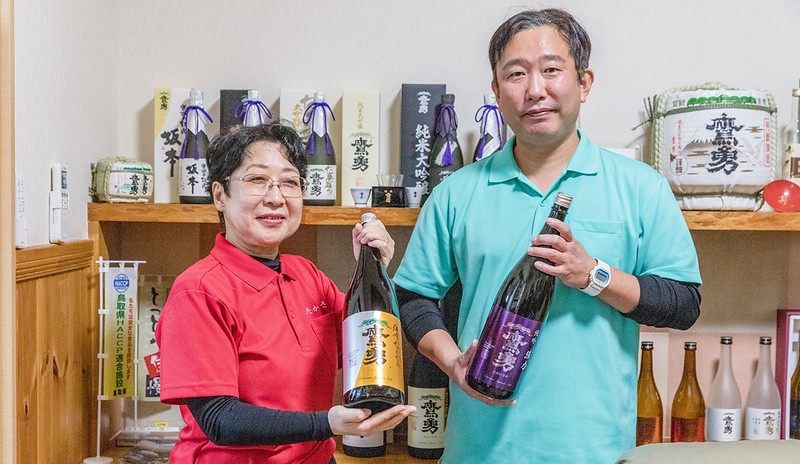
I asked president Shuko Otani and the master brewer to hold the sake they most confidently recommended for our photograph. They selected these two bottles respectively. I am sure everyone now knows which one to buy, right? XD
Besides its signature labels Takaisami and Goriki, Sakamoto is another Otani Shuzo creation in which the brewery takes great pride.
):
368 Urayasu, Kotoura-cho, Tohaku-gun, Tottori Prefecture. Telephone:
+81 858-53-0111. Hours: 8:00 a.m.-5:30 p.m. (closed Saturdays and Sundays)
Source: 小虎食夢網 | Original URL: https://www.foodtigertw.com/blog/posts/3050252320
Where would you stay for this story?
This is a stay-recommendation demo. Partner links will be enabled after confirmation.
Kaike Onsen and Tottori stays
Choose an onsen inn, city hotel or stay area that fits the article context.