
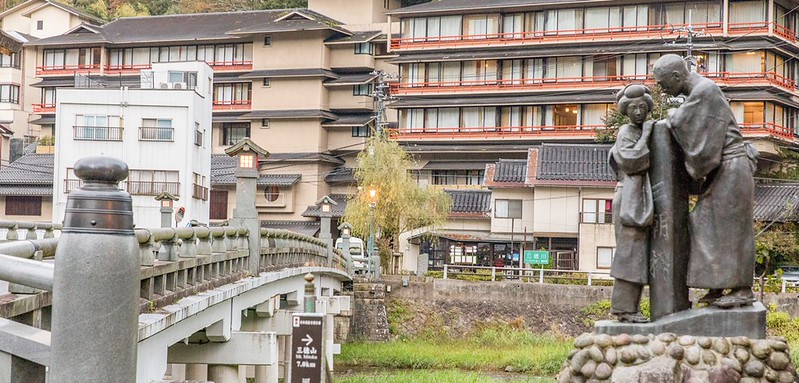
Misasa Onsen has a thousand-year history and is recognized as a Japan Heritage site. It is an ideal place to stay overnight during a Tottori trip and slowly enjoy the atmosphere of a hot spring town.
Misasa Onsen (
Official Website
): 174 Yamada, Misasa-cho, Tohaku-gun, Tottori Prefecture; telephone: +81 858-43-0431.
Japan Heritage: A Site for Purifying the Six Roots and Healing the Six Senses
(No. 12)
The previous two articles briefly explained the meaning of Japan Heritage through Okinawa's “
Urasoe Castle Ruins
” and Tottori's “
Nageiredo Hall of Sanbutsuji Temple on Mount Mitoku
,” if you happened to read them. Today's Misasa Onsen and Mount Mitoku belong to the same Japan Heritage story, “A Site for Purifying the Six Roots and Healing the Six Senses.” Mount Mitoku represents purification of the six roots, while Misasa Onsen represents the latter half of this heritage story, the “healing of the six senses.” Put simply, the story tells how ancient monks purified their six roots through ascetic practice on treacherous Mount Mitoku, then descended to Misasa Onsen and healed their six senses there.
First, some background on Japan Heritage. The program was established in 2015 with the aim of following the World Heritage model to preserve Japanese culture, promote tourism, and further revitalize the economy. Recognition as Japan Heritage comes with several conditions. One is to link national treasures, Important Cultural Properties, Intangible Cultural Properties, and Folk Cultural Properties already recognized in various parts of Japan into a complete story based on their historical background, local character and customs, and traditions passed down through generations. Each Japan Heritage designation represents a coherent historical and cultural story together with the relevant cultural assets. A municipality submits its application to the Agency for Cultural Affairs through its prefectural board of education. A committee of cultural experts reviews it, after which the agency decides whether to grant recognition.
On April 24, 2015, the Agency for Cultural Affairs recognized 18 Japan Heritage stories from 83 applications.
On April 20, 2016, 19 of 67 applications were recognized as Japan Heritage.
By 2022, a total of 104 stories had passed the review.
On December 13, 2019, February 13 was designated Japan Heritage Day (
because the reading of the number two is the same as the “ni” in the Japanese word “Nihon,” while the thirteenth also sounds similar to the Japanese word for heritage). For detailed information on the 104 Japan Heritage stories recognized to date, see the
Japan Heritage official website
. Japan Heritage stories may also span multiple administrative regions or lie within a single region. Disregarding overlaps among administrative areas, Tottori currently has a total of four.
Tottori's four Japan Heritage stories are:
1: A Site for Purifying the Six Roots and Healing the Six Senses—Viewing Japan's Most Perilous National Treasure and One of the World's Leading Radon Springs: Mount Mitoku (Mitokusan) (
Video URL
2: Japan's Largest Daisen Cattle and Horse Market, Nurtured by Jizo Worship: Mount Daisen, Tottori (
3: A Different World Woven from the Dreams of Men Who Crossed Rough Seas—Kitamaebune Ports of Call and Shipowners' Settlements: a cross-prefectural Japan Heritage story encompassing Tottori Prefecture (Tottori City and Hamada City) and 16 prefectures and cities. (
Story URL
4: Spectacular Scenery and Hidden Places Born from the Winds of the Sea of Japan—The Land of Inaba and Tajima, Where the Kirin, a Sacred Beast That Brings Happiness, Dances (Hyogo and Tottori) (
Japan Heritage story No. 12, “A Site for Purifying the Six Roots and Healing the Six Senses,” consists of two parts: Mount Mitoku, where the six roots are purified, and Misasa Onsen, where the six senses are healed. Both are important Japanese cultural assets with 1,300 years of history. Both can be reached by transferring at Kurayoshi Station on the San'in Main Line. Misasa Onsen is about 15 minutes away, while Sanbutsuji Temple at the foot of Mount Mitoku is about 40 minutes away. In the previous article, we took everyone up to Japan's hardest-to-reach National Treasure, “
.” This article introduces Misasa Onsen, the place where the six senses are healed.
First, watch the video about Tottori's Japan Heritage story, “A Site for Purifying the Six Roots and Healing the Six Senses,” from the official Japan Heritage website.
The six roots purified through worship and ascetic practice on Mount Mitoku are sight, hearing, smell, taste, body, and mind. The six senses healed at Misasa Onsen are viewing, listening, fragrance, flavor, touch, and spirit. In addition to being part of Japan Heritage, Misasa Onsen has a “Legend of the White Wolf.” According to legend, the hot spring was discovered in 1164 by Okubo Sama-no-suke, a retainer of Minamoto no Yoshitomo, while he was traveling to pray at Sanbutsuji Temple on Mount Mitoku. On the way, he found an old white wolf inside a great camphor tree of which only the roots remained. Because he was in the midst of religious training, he spared it. After reaching Mount Mitoku, he dreamed of a bodhisattva seated among the roots of the great tree. When he descended the mountain and dug beneath the roots, a great volume of hot spring water emerged. This is said to be the origin of today's Misasa Onsen.
Misasa Onsen is a famous hot-spring resort that attracts the second-highest number of tourists in Tottori after Kaike Onsen. Its landmark, Misasa Bridge, is said to have once stood on the essential route to Mount Mitoku. A statue of a man and woman stands on the bridge. I looked it up and found that they are the protagonists of the 1929 (Showa 4) film “Misasa Kouta.” Set in Misasa Onsen, it tells the love story of a local girl and a painter from Tokyo. In fact, “Misasa Kouta” was originally a song written in 1927 (Showa 2). It boosted tourism to Misasa Onsen and helped fuel interest in travel to Tottori, and was later adapted into a movie. Incidentally, the film was silent.
One account identifies Kawara-no-Yu beneath Misasa Bridge as the place where Okubo Sama-no-suke, retainer of Minamoto no Yoshitomo, first discovered the spring. It has therefore become a must-visit bath for many people drawn here by the hot springs.
The front half is a footbath, while the other half behind a screen is an open-air riverside bath. Although it is completely free, simple wooden clothes racks are provided. If you do not mind being seen, you can give it a try. There are especially many visitors bathing here and nearby in the early morning. Misasa Onsen contains radon produced by the natural decay of radium, making it a rare radioactive spring. Okayama University Hospital once operated the Misasa Medical Center here for balneotherapy, so Misasa Onsen developed as a hot-spring district serving both tourism and recuperation.
Visit Misasa Onsen in autumn and you will see fall foliage covering the areas around Misasa Bridge and Mount Mitoku. Together with the bridge lamps in an old-fashioned design, it creates a distinctly Showa-era atmosphere.
Hot-spring inns and hotels large and small line both banks of the river, including Misasa-kan, where we stayed that night. We will introduce this well-known local ryokan next time.
Beside the Misasa Kouta statue begins Misasa Onsen's liveliest street, the stone-paved Onsen Hondori.
The hot-spring town has izakaya and local craft shops, as well as the entertainment venues typically found in Japanese hot-spring districts at night.
Kajikawa Barbershop is a landmark long-established shop on Misasa Onsen's main street. Inside are antique barber chairs and other old barbershop artifacts. Unfortunately, we had not made an appointment that day, and a customer was getting a haircut, so we felt it would be rude to go in and disturb them.
The farther in you walk, the more obvious the old hot-spring-town character becomes. As dusk deepens, soft yellow lights come on along both sides, making the historic district feel even warmer.
In the middle section, beside Yakushido Hall, is the free Yakushi-no-Yu footbath. Hot-spring inns of all sizes are densely clustered around here, and the stone-paved roads on both sides are particularly prominent. Ryokan employees pass in wooden geta, which clatter with every step.
Farther in, many restaurants and shops were still closed because of the pandemic, and there were fewer and fewer pedestrians on the main street. There was also a public bath whose operating status was unclear.
We had originally hoped to book Hashizuya, but unfortunately it was full that day.
Hashizuya official website
The night view of Misasa Onsen Hondori. As night falls, visitors in yukata begin to emerge for a stroll, bringing a little more life to the post-pandemic hot-spring town.
At the end of Onsen Hondori is another of Misasa Onsen's famous bridges, Koitani Bridge. It is said to have appeared many times in the film, and the male and female protagonists walked here together on more than one occasion.
The bridge has ema plaques depicting matchmaking frogs. Compared with the other bridge, this one feels much quieter.
The view from the bridge also feels considerably more desolate.
Below the bridge, an unidentified heron was foraging, quietly approaching its prey. Incidentally, people say that on quiet mornings in the past, the call of “kajika” in the Mitoku River could be heard. The source describes it as a sculpin, a fish resembling a salamander.
An early-November morning scene along the Mitoku River: a little chilly, a little beautiful, and enough to make me want to stay one more night.
): 174 Yamada, Misasa-cho, Tohaku-gun, Tottori Prefecture; telephone: +81 858-43-0431
【Tottori, Japan—Japan Heritage Part One】Nageiredo Hall of Sanbutsuji Temple on Mount Mitoku: A Journey to Japan's Most Perilous and Hardest-to-Reach National Treasure
【Japan Heritage Part Two—Okinawa】Urasoe Castle Ruins: Surveying the Rise and Fall of the Thirteenth-Century Ryukyu Kingdom at a Glance
Source: 小虎食夢網 | Original URL: https://www.foodtigertw.com/blog/posts/3050260688
Where would you stay for this story?
This is a stay-recommendation demo. Partner links will be enabled after confirmation.
Kaike Onsen and Tottori stays
Choose an onsen inn, city hotel or stay area that fits the article context.