
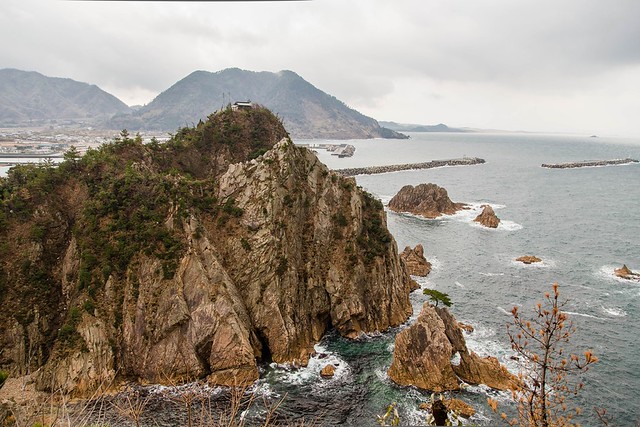
Uradome Coast lies within the San’in Kaigan Geopark. Take an island cruise to admire the dramatic coastline, then finish with a seafood squid ink set meal.
[Travel in Tottori, Sanin, Japan] Sanin Kaigan National Geopark—Uradome Coast (Island Cruise and Seafood Set Meal)
When you hear “Tottori,” what first comes to mind? Endless sand dunes? Or perhaps Conan and Kitaro? Many people may not know that the coast near the Sea of Japan in Tottori contains an entire
nationally designated Place of Scenic Beauty, also selected among Japan’s 100 Best Beaches:
a “geopark” filled with magnificent and delightful natural scenery.
Today, Xiaohu is taking everyone to visit the Sanin Kaigan National Geopark—
the Uradome
Coast section in Iwami District, Tottori. In addition to operating sightseeing cruises, the Uradome Coast Island Cruise facility itself contains a shop selling local gifts and a restaurant specializing in local seafood, particularly squid dishes.
Because the weather was poor that day and the boat could not go out, the tourism bureau arranged a professional guide to lead us along the coast and admire the extraordinary works of nature left along the Sanin shoreline.
Sanin Kaigan National Park
(Japanese reading:
San'in Kaigan Kokuritsu Koen
) is a
national park
in Japan’s Sanin region.
Its area extends from
Kyoto Prefecture’s
Amino Coast in Tango,
through Hyogo Prefecture’s
Tajima Mihonoura,
and as far as
Tottori Prefecture’s
eastern
Tottori Sand Dunes,
covering 75 kilometers of shoreline facing the
Sea of Japan.
It follows this coastal expanse.
The Uradome Coast
(a nationally designated Place of Scenic Beauty and one of Japan’s 100 Best Beaches) is at its most spectacular along the nature trail beginning in Iwami District. Its sights include Sengan Matsushima, Natane Island, the Natane Five Islands, Sengan Matsushima, Ryujin Cave, Kannon-ura, Nishi Horai Island, Tarobei Island, Kamogaiso Coast, Kuroshima, the Shiroko Cliffs, Mizushiri Sea Cave, Camel Island, and Iwatsubame Sea Cave.
Do not be put off by the stairs at the very beginning. The climb is actually not very high, with the highest point only a little over 100 meters above sea level. Along the way, the path feels like a woodland trail, and the professional guide explains the area’s green ecology.
The opening view is the most stirring of all and also the most celebrated landmark on the entire
coast: Sengan Matsushima. Unfortunately, light rain and fine snow came and went that day, so the weather was not ideal. In summer, with blue sky, white clouds, and sea and sky merging into one, the view must be breathtakingly beautiful.
The origin and story of the name Sengan Matsushima go back to the Edo period. A feudal lord is said to have offered a reward of one thousand kan to anyone who could move the pine tree on the little island into his home garden, giving the island its name. Whether anyone later received those thousand kan is apparently not clearly recorded.
What is clear is that the pine now on the island is the second generation, not the original tree from the Edo period. The first is said to have died, so I imagine no one ever claimed that one-thousand-kan reward =)
The scenery along the whole coast is delightful. The complete walking trail is perfectly safe as long as visitors do not climb beyond the rope barriers. Because the mountain path winds up and down, every section presents the scenery from a different angle.
Anyone who enjoys photography will understand: you keep shooting upward from below, then keep deleting downward through the roll... Honestly, I have forgotten how many photographs I took and how many I deleted. In any case, this place truly is spectacular.
Notice the shrine at the top of the hill. If we had not been short on time, I would really have liked to climb up there. The summit is said to be beautiful and to have a poignant story behind it. Unfortunately, I forgot the story as soon as I heard it and could not find any related information online either. XD
Along the entire coast, naturally sculpted rocky shores that separated from the Asian continent display nature’s extraordinary craftsmanship. Pine trees also grow everywhere, making beautiful scenery effortless to find.
This little platform occupies a fortunate position where both Sengan Matsushima and Kannon-ura can be seen at once.
With Kannon-ura embraced on the right and Sengan Matsushima on the left, standing here calls to mind the talented Cao Zijian’s line from “Rhapsody on the Bronze Bird Terrace”: “Embrace the two Qiaos in the southeast, and rejoice with them morning and night.”
One corner of Kannon-ura demonstrates the rich geology of the rocky coast. According to our guide, it is even more beautiful from the farther side, while taking the Island Cruise reveals a different face of this geopark.
To tell the truth, I wanted to continue walking and see the beauty of the Natane Five Islands. Sadly, there was not enough time, so that will have to wait for another visit.
Following this journey through the Sanin Kaigan Geopark, Xiaohu will also share the familiar Tottori Sand Dunes and
Genbudo Park
(a nationally designated Natural Monument).
On the way back, we had a distant view over Iwami’s fishing harbor and the town as a whole.
This old house hidden in Iwami is said to have survived from the Edo period.
After walking a short mountain trail in the cold wind, we returned to the warm building at the Island Cruise dock.
The building is divided into three parts: the dining room on the left, a gift center in the middle, and the Island Cruise ticket counter and boarding point on the right.
Different water activities are available according to the season. Besides viewing the geopark’s natural rocky shores from the sea, visitors can fish and feed seabirds.
What could daikon pickled with squid possibly taste like? I was extremely curious, BUT....
Squid soft-serve ice cream seemed even more unbelievable. Unfortunately, it was not sold before the end of February. (Sob.)
Squid appears to be a local specialty, so naturally this place is known for all kinds of squid dishes. Beyond squid soft serve, there are squid burgers, squid curry rice, squid tempura, and more....
In addition to several regular set meals, a daily set that changes with that day’s catch is also offered. But limiting it to just one customer a day is a bit much....
At first, I thought the restaurant was tiny, but opening the curtain revealed a surprisingly spacious dining area—and it even faced the sea....
The view is of the harbor, but the dining atmosphere is still full of character.
A whole table packed with food was a pleasure just to look at.
That day, we had the ¥1,200 sashimi set meal.
Besides the sashimi in the center, which varies with the day’s ingredients, it included seasonal Matsuba snow crab, miso soup, two small side dishes, and white rice—the kind that seems to taste good wherever you eat it in Japan.
The two kinds of sashimi, octopus, squid, and shellfish were all exceptionally fresh and delicious. The plump, sweet rockfish in particular was unbelievably good....
One Matsuba crab leg, a piece of crab meat, and a small serving of crab tomalley left both the palate and the heart completely satisfied.
This dish was made by simmering the innards of an unidentified fish. It was slightly springy, a little sticky when bitten, and became faintly powdery as it was chewed. Far from tasting fishy, it was pleasantly sweet and very good!
The miso soup contained Matsuba crab packed with roe. Could anything be more blissful?
The squid burger’s jet-black bun did not actually taste much like squid. The squid patty inside resembled the cuttlefish patties we often eat.
The squid tempura consisted of squid legs wrapped in batter colored with squid ink. It likewise did not taste strongly of squid, but it earned full marks visually and at least fully satisfied my curiosity.
The most interesting dish was the pitch-black squid curry rice. Honestly, although the curry was certainly black, it still did not have much squid flavor—despite leaving the inside of my mouth completely black afterward. It was a little viscous, while the curry tasted milder and had a certain marine savor I cannot quite describe. Regardless of whether it truly tasted like squid curry, judged purely on flavor it was genuinely delicious.
Uradome Coast Island Cruise address:
Tottori Prefecture,
Iwami District, Iwami Town,
Otani
2182. Telephone:
0857-73-1212. Hours:
11:00–14:00 (lunch only)
Uradome Coast Island Cruise official website:
ttp://www.yourun1000.com/index.cgi?contents=top
Iwami Tourism Association: http://www.iwamikanko.org/places/view/92
Transportation:
For visitors traveling by car
Toward the Tottori Sand Dunes from Tokyo, Nagoya, or Osaka
From Osaka by car:
approximately 2 hours 50 minutes
From Nagoya by car: approximately 5 hours 20 minutes
From Tokyo by car: approximately 9 hours 20 minutes
Toward the Tottori Sand Dunes from Kyushu, Shikoku, Hiroshima, or Okayama
From Okayama by car:
approximately 2 hours 55 minutes
From Hiroshima by car:
approximately 4 hours 35 minutes
From Shikoku (Matsuyama) by car:
approximately 3 hours 55 minutes
From Kyushu (Moji) by car: approximately 6 hours 50 minutes
Source: 小虎食夢網 | Original URL: https://www.foodtigertw.com/blog/posts/3044509561
Where would you stay for this story?
This is a stay-recommendation demo. Partner links will be enabled after confirmation.
Kaike Onsen and Tottori stays
Choose an onsen inn, city hotel or stay area that fits the article context.