
[Tottori Travel] Sakaiminato Transportation Guide: Mizuki Shigeru Road, Mizuki Shigeru Museum, and Kitaro Train @ Essential Four-Day Late-Autumn Tottori Itinerary (D4-3)
SERENE1102
Published
2017-02-27
· Updated
2018-04-27
[Tottori · Sakaiminato Attractions] Sakaiminato Transportation Guide: Mizuki Shigeru Road, Mizuki Shigeru Museum, and Kitaro Train
@ Essential Four-Day Late-Autumn Tottori Itinerary (D4-2)
D4: Tour Sakaiminato Fish Market and Watch a Red Snow Crab Auction — Breakfast: Komeda's Coffee —
Sakaiminato: Mizuki Shigeru Road and Mizuki Shigeru Museum
— Lunch:
Kappo Kotobuki (
Kappo Kotobuki
) feast of sashimi, tempura rice bowl, and eel rice — Okayama Airport — Taipei (Tigerair, arriving at approximately 8:30 p.m.)
arrival)
Before the trip, I did not feel strongly about following a GeGeGe no Kitaro route. I had read the Kitaro manga, but could hardly call myself a fan. Yet the moment I arrived, I began taking pictures as if possessed.... I had once teased people for buying related merchandise, but even I bought a pile of it.... I have to say, “The Japanese truly know how to market!” More interestingly, after visiting the Mizuki Shigeru Museum, you cannot help liking the story and may even want to find the manga and read it. That is precisely the pleasure of travel.
Japanese marketing expands from a point to a line and then an entire area; a whole city and its tourism bureau will mobilize together. That approach has been extremely successful in Tottori, a city of anime, so both Conan Airport and Kitaro Airport have received official names.
For example, the station in Sakaiminato became “Kitaro Station.”
The entire street was named Mizuki Shigeru Road after the creator of Kitaro. The marketing is thoroughly integrated, and Yonago—and even Tottori—quickly became essential stops for Taiwanese travelers following the Sanin route.
Created by blogimove. All rights reserved.
GeGeGe no Kitaro
is a manga created by Japanese artist Shigeru Mizuki, known as the “professor of yokai,” and serialized beginning in 1959. Mizuki had previously created many types of manga without becoming popular. Only after this work became a bestseller did the public recognize him as a manga artist. In 1967, the title was changed to
GeGeGe no Kitaro,
which remains in use today.
The story centers on Kitaro, a boy who is the last survivor of the Ghost Tribe, and his yokai friends in a mysterious forest as they solve problems between the human and yokai worlds. The fun naturally comes from meeting different yokai, each with a special power. Calling it an ancient version of X-Men might even work (laughs).
For Sakaiminato, I personally recommend the Kitaro Train above every other form of transportation. Boarding at Yonago Station is best, since the station itself has plenty of Kitaro decorations.
Sakaiminato ⇔ Yonago one-way fare: 320 yen; travel time: approximately 45 minutes
JR Sakai Line timetable (weekdays)
JR Sakai Line timetable (Saturdays and holidays)
After leaving the train, you are at the station named for Kitaro. Although we arrived by minibus, we still had to go inside for a look.
Waiting areas decorated with Kitaro and his companions appear not only inside the station but all along Mizuki Shigeru Road.
No Japanese attraction is complete without a photo board, so of course we had to take a picture!
The station-exclusive Sakaiminato Yokan is a highly unusual and remarkably realistic souvenir!
There are four types of Kitaro train, one car of each, and luck determines which one you ride. I wonder whether all four are joined together on crowded holidays? I hear the fleet has recently grown to six different trains.
Although we did not ride a Kitaro train that day, we were lucky enough to see one enter the station. Perhaps because it was a quiet weekday, it had only two cars, but that was still enough to make us happy.
Mizuki Shigeru Road begins at Kitaro Station and has more than a hundred bronze statues large and small. Visitors compete to photograph them, and on busy holidays you may have to wait in line....
Frankly, I am not a Kitaro devotee, so I could not name most of the monsters. We were also short on time that day, so I could only take quick photographs as we passed.
I took far too many to post them all, so I selected a few that I considered comparatively “cute” (a grave mistake). This one, for example, is the must-photograph Medama Oyaji, Kitaro's father.
A Kitaro riding a postcard greets everyone by the mailbox in front of the station. This is another essential statue to photograph.
Mizuki Shigeru Road extends roughly 200 to 300 meters from the station. Statues of Kitaro and his companions line both sides, and even the streetlights are shaped like Medama Oyaji.
Kitaro and his companions also appear everywhere on the paving tiles.
This was probably the cutest monster I saw that day. I do not know its distinguished name, but it looks a little like a pineapple XD.
Are these two monsters as well? They look fairly normal....
Shaking hands with Nezumi Otoko for a commemorative photograph is another essential activity on Mizuki Shigeru Road....
I do not know how many Kitaro statues stand along this street, but they always draw the biggest crowds for photographs.
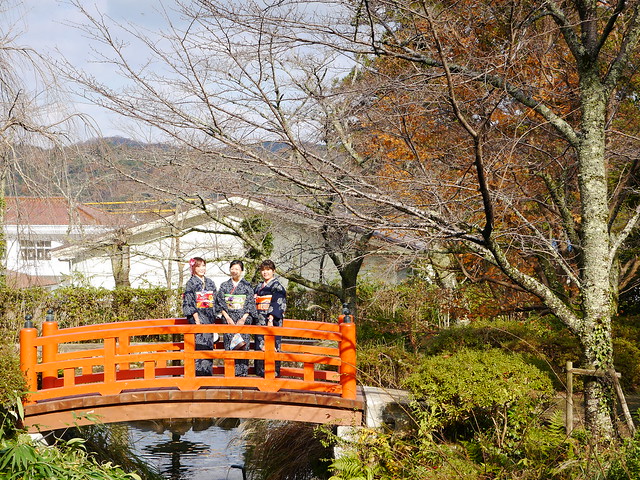
My favorite spot is this Kitaro on the bridge. Unfortunately, the cherry blossoms were still closed buds. One week later, it would surely have been spectacularly beautiful.
A Kitaro park stands midway along Mizuki Shigeru Road and gives many people a place to rest on their return. Numerous Medama Oyaji streetlights stare directly at you (gasp).
Do even the roadside trees have to grow like yokai...? Apparently this tree naturally grew into this shape without pruning. No wonder people say that anything near a yokai becomes strange XXD.
The park's yokai pond is quite cute, and the urinating Kitaro naturally attracts the most camera shutters....
Many stores, restaurants, and teahouses join in by displaying signs featuring Kitaro and his companions.
This shop sells many Kitaro figurines. Collectors should definitely go inside, but bring plenty of yen because you are certain to lose control!
Yokai dessert shops like this are also everywhere on Mizuki Shigeru Road, eager to shake every last yen from visitors' pockets XD.
There are several places that 小虎 strongly recommends, including this small, charming Yokai Shrine. The Medama Oyaji floating in the water basin would not cooperate. I kept telling him to look at the camera, but he insisted on gazing at the sky; it took ages to capture this photograph (laughs).
There are many amusing features inside. Since this is a Yokai Shrine, everything naturally has an obvious connection to yokai. Even the amulets on the wall feature characters from Kitaro.
This little water basin is also shaped like a soul.
In the Kitaro story, Kitaro's father worries so much about baby Kitaro after his own death that his eyeball comes out and becomes Medama Oyaji, who continues caring for the little boy. The stone enshrined at the Yokai Shrine is similarly a small piece that one day fell inexplicably from a huge rock, echoing the strange appearance of Medama Oyaji.
Naturally, an amulet shop stands beside the shrine.... I wonder whether they also offer a Kitaro goshuin seal....
Insert a coin to draw a fortune. A different Kitaro character delivers the fortune each time, so every visitor may see someone different.
Sakaiminato Station and Mizuki Shigeru Road have many commemorative stamp points like this. Collect at least 20 for a Kitaro sticker, or find all 37 to receive a souvenir. Curiously, the final line says that collecting 40 earns an even greater special gift.... Does that mean the last three are difficult secret stamps?
If you have time, be sure to visit this post office beside the Yokai Shrine.
Why? Letters sent here receive a Kitaro postmark!
I especially enjoy looking at and buying regional postcards sold only in different parts of Japan. Their vivid illustrations depict local products or famous sights, giving them excellent commemorative value. Oddly, there is no Kitaro card—perhaps because of copyright?
I immediately mailed a postcard and got the postmark! The postal employee carefully applied it very neatly.
Nearly every shop on Mizuki Shigeru Road uses the Kitaro story as its selling point. This corner bakery, for example, sells Kitaro yokai bread that looks impressively accurate!
I was full and did not buy any. Friends who tried it said the flavor was merely all right (laughs).
The latter half of Mizuki Shigeru Road is a Kitaro shopping arcade containing the Mizuki Shigeru Museum. The yokai-manju shop at the entrance is very famous and attracts many souvenir shoppers.
Yokai mascots appear randomly at any time in front of the Mizuki Shigeru Museum. If you see one, do not hesitate to take a photograph together! On my first visit, I met Kinoshita, an office worker from the story, and exchanged business cards with him. His character is lazy, so if you see him sitting in the park, resting or dozing, he is giving a dedicated performance (laughs).
On my second visit, I met Sunakake Baba. Her special power is scattering sand to confuse people's minds, so meeting her on the street means having sand continually tossed at you.... She is another amusing character.
I recorded a video for everyone. If the old lady throws sand at you, you can throw it back at her too.
The Mizuki Shigeru Museum is inside the covered shopping arcade.
This charming female yokai often greets visitors at the entrance, though I do not know her name. Of course, you can strike a cute pose and take a picture with her.
The sculpture at the entrance shows little Kitaro meeting his father, Medama Oyaji. They say Kitaro fans tear up when they see this scene.
Naturally, a Kitaro statue in front of the museum is available for visitor photographs.
Turn this machine in front of the museum clockwise 15 times and release it to hear a yokai voice.... Terrifying.
At the museum entrance, Kitaro, Medama Oyaji, and Shigeru Mizuki say, “Welcome.” Mizuki lost his left arm during World War II. In one battle, he was the only member of his unit to escape by pretending to be dead. Yet on returning to the army, he was humiliated with the accusation, “Why did you cling to life and run back?” His manga stories thereafter carried an antiwar character.
He also survived wartime on a South Pacific island, where Indigenous people gave him food and clothing. Many years later, he returned and reunited with the people who had helped him, leaving behind a heartwarming tale.
Admission requires a ticket, and audio guides are available. Because there is a Chinese version, 小虎 recommends renting one. Listening in numerical order lets you understand Mizuki's life, his original purpose in creating Kitaro, and his ideals.
Photography is prohibited on the first floor, but freely allowed on the second. Upstairs are numerous yokai cutouts and works by Shigeru Mizuki displayed on the walls.
This wall uses words and drawings to reveal secrets about many characters, bringing an understanding smile =)
Besides manga on the walls, a small library in one corner of the second floor lets visitors enjoy Mizuki's masterpieces.
Shigeru Mizuki traveled for research throughout the world so many times that his footprints covered nearly the entire globe. He visited Taiwan alone as many as five times.
The objects in the glass cases are yokai souvenirs Mizuki brought back from around the world.
This is quite entertaining: a newly installed 3D photography area.
Mizuki himself returned to visit the museum every few years and left traces of each visit. This manga was the work he left on his final visit before his death.
Today, anyone registering a vehicle in Sakaiminato can also apply for a special Kitaro license plate.
Every yokai that appeared under Mizuki's brush has a name of its own!
Yokai apartments?
Kitaro's house. Many scenes from the manga can be seen inside the museum, and devoted fans should feel a strong connection.
Besides the Mizuki Shigeru Museum, I also recommend Yokai Paradise behind it. This is where my wallet's defenses collapsed XD.
It is only a three-minute walk from the museum, essentially just behind the building and around two corners.
Kitaro and monsters appear throughout the square and surrounding area.
A place to rest and have a drink.
Kitaro's house. Children who are not too large can even go inside for a photograph!
A stamp station stands in the center of the square, featuring popular yokai that appeared in the Kitaro story. The children stamp away with tremendous delight.
Yokai Paradise's main “spending” zone. Anyone lacking willpower or deep pockets should not enter....
The prize machine costs 500 yen per turn. The possible prizes displayed behind it are naturally all related to Kitaro. Since I am rarely lucky, I did not even dare consider trying.
An army of yokai manju... perfect to take home for friends!
I accidentally bought a bottle of Kitaro sake as well....
Is this a crossover between different manga or different dolls...? Could it be an alternative Beauty and the Beast?
My spoils. For someone who rarely buys things while traveling, this was a loss of reason XD.
Kitaro Train timetable: (boarding at Yonago Station is recommended)
Yokai names for each Sakai Line station
Yonago Station
Nezumi Otoko
Station
Bakuromachi Station
Koropokkuru
Fujimicho Station
Zashiki Warashi
Goto Station
Dorotabo
Sambommatsuguchi Station
Sodehiki Kozo
Kawasakiguchi Station
Kasa Bake
Yumigahama Station
Azuki Arai
Wadahama Station
Tsuchikorobi
Misakiguchi Station
Sunakake Baba
Oshinozu Station
Betobeto-san
Nakahama Station
Ushi Oni
Takamatsucho Station
Sunekosuri
Amariko Station
Konaki Jijii
Agarimichi Station
Ittan Momen
Babasakicho Station
Kijimuna
Sakaiminato Station
You can also ride a Kitaro bus, although I still think the Kitaro Train is cooler:
The fare is a flat 100 yen regardless of distance and is paid when boarding. One circuit of the city takes about an hour. Please contact the operator for a detailed timetable. Inquiries: City Loop Bus Operations Office, Tel: 0859-44-1140. The main stops below are listed in clockwise order; the counterclockwise route runs in reverse.
Sakaiminato City Hall
Yumeminato Tower
Yonago Airport
Saiseikai Sakaiminato General Hospital
Sakaiminato Station
Daiba Park · Sea and Life Museum
Port Joint Government Building (Immigration Bureau · Customs)
Sakaiminato Police Station
Motomachi Hospital
Sakaiminato sightseeing map
Sakaiminato City Tourism Association:
http://www.sakaiminato.net/site2/page/map/timetable/JR/2012jrsakai/
(A Chinese-language option is available.)
View a larger map
[Mizuki Shigeru Museum]
5 Honmachi, Sakaiminato, Tottori (Honmachi Arcade)
0859-42-2171
Admission: 700 yen
Business hours: 9:30 a.m.–5:00 p.m.
Late Autumn! [Complete Essential Four-Day Tottori Itinerary]
Source: 右上世界食旅 | Original URL: https://www.travalearth.com/post-31396161/
The original article is offline. This page is based on an archived web copy
Where would you stay for this story?
This is a stay-recommendation demo. Partner links will be enabled after confirmation.
Kaike Onsen and Tottori stays
Choose an onsen inn, city hotel or stay area that fits the article context.