
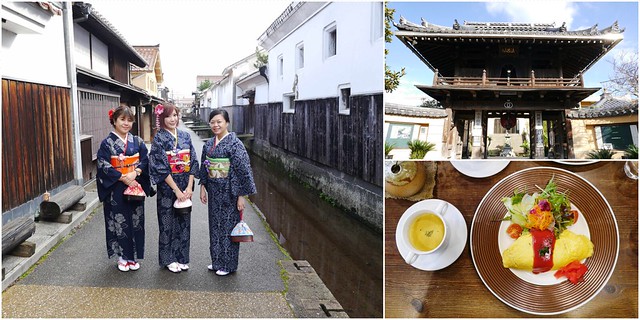
Dress in a kimono made with Kurayoshi Kasuri, a traditional Tottori textile, and stroll through the White Wall Warehouses and Akagawara area for a more local old-town experience.
[Tottori and Kurayoshi Travel] Wear a traditional Kurayoshi Kasuri kimono on a day trip around the White-Wall Storehouses and Akagawara
Kurayoshi, in central Tottori Prefecture, has a beautiful traditional district called the White-Wall Storehouses and Akagawara. Change into a Kurayoshi Kasuri kimono, the traditional clothing once worn in the Kurayoshi area, and every photo you take can become a profile picture or even be used for matchmaking (laughs). Girls, you absolutely have to come.
Transportation: Take a bus from stop number 2 in front of Kurayoshi Station and you will arrive in only twelve minutes. From 7:30 a.m. until 6:40 p.m., buses run roughly every ten to twenty minutes, so service is quite frequent. See the details here.
Outbound buses
Return buses
Fare: about 220-250 yen
Your first stop can be the information center, where you can leave your luggage and pick up a map. The parking lot is next door, so if you are driving, simply come straight here and park.
I took this particular photo to let everyone know that there are keyed lockers large enough for full-size suitcases. As I recall, even the biggest cost only 500 yen, a little cheaper than in major cities.
One of the things I enjoy most about sightseeing in Japan is that I do not need to prepare a map in advance. There are always maps available, and they come in many forms.
This one, for example, clearly lists the products sold at each location, so you can decide where to eat lunch before setting out.
Today I am going to Akagawara Building No. 1 for the experience of wearing a traditional Kurayoshi Kasuri kimono. This program must be booked in advance by email or telephone, and English is understood. If you are worried about communication, you can ask your hotel in Japan or the Platinum Secretary service to make the reservation for you.
Telephone: 0858-24-5371
Email: kanko@apionet.or.jp
Experience duration: two hours, with two sessions per day
1. 11:00 a.m.-1:00 p.m. (dressing begins at 10:30 a.m.)
2. 2:00-4:00 p.m. (dressing begins at 1:30 p.m.)
Fee: 3,800 yen. Add 1,000 yen for lunch or 2,000 yen for a guided tour.
The road was nearly deserted. Even on a holiday, only a few tourists, including us, were happily wandering along this quiet street.
The contrast between the modern scene on the left and the old-fashioned scene on the right was especially interesting. There is a round ball of grass on the right side of the photo, reminding me of a custom at some Japanese sake breweries. In spring, green grass is bound into a large ball. When the entire ball turns brown, it means the sake brewed that spring has matured. I do not know, however, whether the owner of this house also makes sake.
Drying persimmons beside the window is another common sight during autumn in Japan. They look delicious!
We soon entered Kurayoshi's White-Wall Storehouse district. A dozo is a storehouse; the traditional building in the previous photo is its front. The back adjoins the small Tamagawa River. Storehouses were usually built with their backs against a river to make transporting cargo by water easier, but judging from this water level and the river's width, I doubt it could serve that purpose. At most, children could float paper boats on it (laughs).
This stretch of the Tamagawa reminded me of the large irrigation canals I saw as a child when visiting my grandmother's rural home in Yunlin, except that the current here is slower and the water clearer all the way to the bottom.
Akagawara stands beside the opposite bank of the Tamagawa. These buildings were once used simply as warehouses and differ slightly from the white-walled storehouses. Besides offering the kimono experience, Akagawara Building No. 1 sells souvenirs. Below are the various types of businesses I found in the Akagawara complex, so you can visit or dine according to your interests.
(Akagawara Building No. 1) Converted from the storehouse of a Taisho-era soy sauce factory. Many Tottori souvenirs fill its spacious interior, which also has a dining area.
(Akagawara Building No. 2) Hakota Doll Workshop, a studio that handcrafts local folk toys.
(Akagawara Building No. 3) Nakano Chikugei occupies a converted sake-brewery storehouse. This long-established bamboo-craft shop was founded in 1912, the first year of the Taisho era.
(Akagawara Building No. 5) Kura is a cafe where you can enjoy coffee ground with a stone mill.
(Akagawara Building No. 6) Kuwata Soy Sauce Brewery, where rare wooden soy-sauce barrels from the Meiji and Taisho eras stand in rows.
(Akagawara Building No. 7) The main store of Gensui Sake Brewery, founded during the Kaei era. Tastings and free brewery tours are available, although tours require reservations.
(Akagawara Building No. 8) Tora-gura, the Japanese Confectionery Hall, sells local specialties and crafts and includes a tea area.
(Akagawara Building No. 10) Kurayoshi White-Wall Storehouses Tourist Information Center. It can answer any question about sightseeing in Kurayoshi and stocks a rich selection of tourist brochures.
(Akagawara Building No. 11) Pottery Hall, where you can enjoy a short pottery-making experience.
(Akagawara Building No. 12) Kyuwa displays notable local products as well as paintings and works by local artists.
(Akagawara Building No. 13) Shirakabe Club, a white-walled storehouse built in the Meiji era and registered as a National Tangible Cultural Property. Drinks and meals are available.
(Akagawara Building No. 14) Toriya sells distinctive small goods and ornaments and includes a cafe where visitors can rest.
(Akagawara Building No. 15) Japanese Cuisine Asuka, a restaurant converted from a traditional townhouse that serves Japanese food made with local ingredients.
(Akagawara Building No. 16) Tea House Awayuki, Dairy Shop Rakutaro, and clay-goods shop Petit Koneruchan.
At the entrance, I could already see a chibi manga illustration of a beautiful girl dressed in traditional kimono. It seemed I should be able to transform successfully too (laughs).
Three of us were taking part, but only two people could change at once. While the others were dressing, I took photos to show everyone the various souvenirs sold here.
The Nijisseiki pear is Tottori's signature fruit, and an extraordinary number of sweets are made from it. This best-selling Nijisseiki Pear Jelly even comes in a pear-shaped container. A friend once brought one back for me, but I thought the flavor was merely all right. It is jelly, after all.
Every kind of sweet and savory food looked tempting. As long as your stomach or suitcase is big enough, you can take it all home.
Finally, I tried a Nijisseiki pear soft-serve cone. Of course I had to! It had a pleasant pear fragrance and was quite delicious.
I have to say this is a wonderful place to shop. Conan fans should also look at the Conan merchandise in this section.
There is also this section of figurines and tableware, although I do not know why figurines are sold here. It appeals to male geeks.
Then it was my turn to try the experience. In addition to the traditional kimono, you can choose a yukata experience, although it is slightly more expensive at 5,000 yen.
Besides dressing you, the experience provides wooden sandals, tabi socks, a small handbag, and hair styling. Choosing a hair accessory alone left me dazzled by the options...
Ta-da! This is how I looked after dressing. The distinctive feature of the traditional Kurayoshi Kasuri kimono is its indigo dye. In the past, ordinary residents wore it as everyday clothing; in modern terms, it was probably as commonplace as jeans.
The garment itself is somewhat plain, but that makes the obi look especially luxurious and vivid. The feeling is completely different from wearing a kimono in other cities. Two women helped dress us. I truly have no idea how anyone could put on something so complicated alone and keep it from falling apart.
The dressing staff braid and pin up the hair of girls with medium-length or long hair. Their technique is excellent: the result is beautiful and does not slip loose.
For short-haired girls, they simply pin on one preferred floral hair ornament. It seems long hair offers better value after all (laughs).
There are many temples nearby. Lanterns line both sides of this Benten approach, making it especially suitable for photographs.
You can try making a traditional kite at this Fuu Workshop.
When A-Lin previously served as a tourism ambassador for the San'in region, she was filmed trying the experience here.
Utsubuki Park is one of Japan's Top 100 Cherry Blossom Spots and the premier cherry-blossom destination in the San'in region. In spring, about 4,000 cherry trees and roughly 40,000 azaleas bloom together in a spectacular display. It is green in summer, covered in autumn foliage in fall, and graced by camellias in winter, making it beautiful in every season. It has also been selected as one of Japan's Top 100 Urban Parks.
The timing of our visit was not ideal: the maple leaves were gone, but the cherry blossoms had not yet arrived. We could still imagine this little bridge under a canopy of crimson blossoms. If we came when the cherry trees were in full bloom, I wonder how many people would be treading across it.
The pond in Utsubuki Park is called Hagoromo Pond. Legend says that long ago, a celestial maiden bathed here and a farmer hid her feather robe. Unable to return, she had no choice but to marry the farmer and bear his children. One day, she found the robe, put it on joyfully, and flew back to heaven. Missing their mother, the children beat gongs and drums and played instruments beside the mountain, hoping to lure their celestial mother home. The mountain next to the park was therefore named Mount Utsubuki, meaning "beat and blow." Did their mother return in the end? No...
This is the Mount Utsubuki I just mentioned.
The Kotozakura Memorial Museum is the childhood home of a famous Japanese sumo wrestler. Producing a yokozuna in such a small town is a tremendous honor. If you are interested in sumo, you can come and visit.
Shirakabe Club is also known as Akagawara Building No. 13. It was formerly a bank and has now been converted into a Western-style restaurant that is quite famous locally. A fairly large earthquake had struck a few weeks before our visit, however, badly damaging the exterior, which was under repair.
The neighboring Machiya Seisuian has a Tabelog score of 3.46. Its best-known dish is a colorful mochi hot pot, so it is another option if you like hot pots.
Today, however, I ate at Shirakabe Club, which had not yet been restored after the earthquake and was temporarily continuing business at another nearby location called Yume-gura.
The small blackboard outside says Shirakabe Club, but the restaurant will move back to its original site once repairs are complete.
The menu includes the 1,200-yen Shirakabe Lunch, the 1,000-yen Salad Lunch, and Nostalgic Omurice.
This space originally served as a place to make and sell handicrafts, and visitors can watch artisans painting their work.
The cute, elegant dolls look a little like the glasswork popular in the Yamagata area of northeastern Japan.
Next, take a look at the dining space. Although the exterior is purely Japanese, the interior has an elegant, classical Western style.
The Shirakabe Lunch includes a hamburger steak with house-made tomato sauce, herb bread, and fresh-fish dishes. The plentiful arrangement is attractive, although I did not eat it.
I ordered the 1,000-yen Nostalgic Omurice. As soon as it reached the table, the salad's colors stimulated my appetite. It was also the first time in my life that I had seen red pickled ginger served with omurice.
The pumpkin potage seemed to contain quite a lot of cream and tasted extremely milky and smooth. Personally, however, I prefer a version with less cream.
The omurice was made in a very traditional way, with ketchup fried rice inside, carefully wrapped in a thin, tender layer of egg. The ketchup was fairly tart, and the dish as a whole was healthy and delicious.
Dessert after the meal was chocolate cake. Its bittersweet flavor lingered on the tongue, and the quality was quite high.
There was no particular reason for taking this picture. I simply thought the two adjoining buildings were beautiful.
Although this is a district of traditional Japanese architecture, elegant Western houses like this one also stand here.
[Kurayoshi White-Wall Storehouses and Akagawara]
Uomachi, Togiyamachi, Higashinakamachi, Shinmachi 1-chome, and Sakaimachi 1-chome, Kurayoshi, Tottori Prefecture
0858-24-5371
Transportation:
Take a bus from stop number 2 in front of Kurayoshi Station and you will arrive in only twelve minutes. From 7:30 a.m. until 6:40 p.m., buses run about every ten to twenty minutes, so service is quite frequent. See the details here.
[Akagawara Building No. 1] (location of the traditional Kurayoshi Kasuri kimono experience)
Shinmachi 1-chome, Kurayoshi, Tottori Prefecture
0858-23-6666
Hours: 9:00 a.m.-5:00 p.m.
View a larger map
More:
San'in-Tottori (10)
Compare Tottori accommodation prices
Compare Yonago accommodation prices
Recommended unlimited mobile-data SIM card for Japan
All cards replaced with new versions from December 1, 2016
Five days or 120 hours: NT$899
Fourteen days or 336 hours: NT$1,499
Enter the following discount code at checkout when purchasing a card to receive a discount
SA0050A4FD
Save NT$30 on five days or 120 hours
SA0051A307
Save NT$50 on fourteen days or 336 hours
Instructions for using a travel SIM card in Japan:
[Recommended high-speed 4G internet in Japan, with discount code] J Walker unlimited SIM card, installation instructions for iPhone 6 and iPhone 5, convenient, fast, and energy-efficient
Source: 小虎食夢網 | Original URL: https://www.foodtigertw.com/blog/posts/3047251056
Where would you stay for this story?
This is a stay-recommendation demo. Partner links will be enabled after confirmation.
Kaike Onsen and Tottori stays
Choose an onsen inn, city hotel or stay area that fits the article context.