
SERENE1102
Published
2018-05-17
Updated
Kurayoshi, in central Tottori, has a beautiful traditional streetscape called the “Shirakabe Dozogun and Akagawara” district. Here you can change into Kurayoshi kasuri, the kimono traditionally worn in the Kurayoshi area. Photos taken anywhere here could serve as profile pictures—or even matchmaking photos (laughs). Girls simply have to try this indigo-dyed kimono: refined on the outside, exhilarating within, graceful, and slimming. One advantage of dressing up is that you will not feel hungry even after walking for half a day (perhaps because your stomach is tied too tightly), and every photo makes you look poised and elegant. The drawback is the sad moment when you take it off, because it made you look so slim.
Getting there: Take a bus from bus stop 2 in front of Kurayoshi Station, and you will arrive in only 12 minutes. From 7:30 a.m. to 6:40 p.m., buses run roughly every ten to twenty minutes, so service is quite frequent. See here for the detailed timetable.
Outbound timetable (click the link)
Return timetable (click the link)
Fare: approximately ¥220–¥250
Your first stop can be the information center, where you can leave your luggage and pick up a map. The parking lot is right next to it, so if you are driving, simply park here.
I took this photo especially to let everyone know that there are keyed lockers large enough for big suitcases. As I recall, even the largest one cost only ¥500, a little less than in major cities.
One of my favorite things about sightseeing in Japan is that I do not need to prepare a map beforehand. Maps are always available, and they come in many forms.
Created by blogimove. All rights reserved.
This map clearly lists the products sold at each location, so you can even decide where to have lunch in advance.
Today I am going to Akagawara Building No. 1 to experience wearing the traditional Kurayoshi kasuri kimono. This program must be booked in advance by email or telephone, and English is accepted. If you are concerned about communication, you can ask your hotel in Japan or a platinum concierge to make the reservation.
Telephone: 0858-24-5371
Email:
[email protected]
Experience duration: two hours, with two sessions per day
1. 11:00 a.m.–1:00 p.m. (dressing begins at 10:30 a.m.)
2. 2:00–4:00 p.m. (dressing begins at 1:30 p.m.)
Price: ¥5,000; add ¥1,000 for lunch or ¥2,000 for a guided tour.
Reference website
https://www.kurayoshi-kankou.jp/tourplan/5/
The streets were almost empty. Even on a holiday, only a few visitors, including us, happily wandered through this quiet neighborhood.
The contrast between the modern scene on the left and the old-fashioned one on the right was particularly interesting. A round cedar ball hung on the right side of the photo and reminded me of a custom at some Japanese sake breweries. In spring, fresh green cedar leaves are tied into a large ball. Once the entire ball turns brown, it signals that the sake brewed that spring has matured. I do not know, however, whether the owner of this house also makes sake.
Persimmons drying beside windows are another common autumn sight in Japan. They look delicious!
We soon turned into Kurayoshi’s Shirakabe Dozogun district. “Dozo” means storehouse; the traditional building in the previous photo is its front. The small Tamagawa River runs closely behind it. Storehouses were generally built with their backs facing a river so goods could be transported by water, but judging from this river’s depth and width, I doubt it could serve that function. At most, children could float paper boats on it (laughs).
This section of the Tamagawa reminds me of the large irrigation canal I saw as a child near my grandmother’s rural home in Yunlin, only the current here is gentler and the water clearer all the way to the bottom.
On the other side beside the Tamagawa is the “Akagawara” area. These buildings were once used solely as storehouses and differed slightly from the white-walled ones. In addition to the kimono experience, Akagawara Building No. 1 also sells souvenirs. Below is some additional information I found on the different businesses in the Akagawara buildings, so you can choose where to visit or dine according to your interests.
(Akagawara Building No. 1) A Taisho-era soy sauce storehouse converted into a shop. Many Tottori souvenirs fill the spacious interior, which also has a dining area.
(Akagawara Building No. 2) Hakota Doll Workshop, a studio that makes local folk toys by hand.
(Akagawara Building No. 3) Nakano Chikugei occupies a converted sake storehouse and is a long-established bamboo craft shop founded in 1912, the first year of the Taisho era.
(Akagawara Building No. 5) Kura is a cafe where you can enjoy coffee ground with a stone mill.
(Akagawara Building No. 6) Kuwata Soy Sauce Brewery is lined with wooden soy sauce barrels from the Meiji and Taisho eras, now a rare sight.
(Akagawara Building No. 7) The main store of Gensui Shuzo was founded during the Kaei era. Tastings and free brewery tours are available, although tours require reservations.
(Akagawara Building No. 8) Torazo, the House of Japanese Sweets, sells local specialties and handicrafts and has a tea area inside.
(Akagawara Building No. 10) The Kurayoshi Shirakabe Dozogun Tourist Information Center can help with anything related to sightseeing in Kurayoshi and offers a wide range of informative brochures.
(Akagawara Building No. 11) The Pottery Hall offers short pottery-making experiences.
(Akagawara Building No. 12) Kyuuwa displays famous local products as well as paintings and works by local artists.
(Akagawara Building No. 13) Shirakabe Club is a white-walled storehouse dating from the Meiji era and a nationally registered tangible cultural property. Drinks and meals are served here.
(Akagawara Building No. 14) Toriya sells custom-made trinkets and decorations and also has a cafe where visitors can rest.
(Akagawara Building No. 15) Japanese Restaurant Asuka occupies a converted machiya townhouse and serves Japanese cuisine made with local ingredients.
(Akagawara Building No. 16) Tea House Awayuki, Dairy Shop Rakutaro, and the clay-goods shop Petit Koneruchan.
At the entrance, I immediately saw a cute, cartoon-style girl wearing the traditional kimono. Surely I could transform successfully too (laughs).
There were three of us participating, but only two people could change at a time. While the others got dressed, I took photos to show the various souvenirs sold here.
The Nijisseiki pear is Tottori’s signature fruit, and an enormous variety of sweets are made from it. This is the best-selling Nijisseiki Pear Jelly, packaged in a container shaped like a pear. A friend once brought one back for me, but I thought the flavor was merely all right—it was basically just jelly.
All kinds of sweet and savory foods looked tempting. If your stomach or suitcase is large enough, you can take them all home.
Finally, I tried a Nijisseiki pear soft-serve cone. Of course I had to! It had a pleasant pear aroma and was quite delicious.
I have to say that this is a very easy place to shop. If you are a Detective Conan fan, take a look at the Conan merchandise in this section too.
Or browse the figurines and tableware over here, although I do not know why figurines are sold here. Perhaps male anime fans like to visit?
Next it was my turn. In addition to the traditional kimono, you can try a yukata experience, although it is slightly expensive at ¥5,000.
Besides dressing assistance, the experience provides geta sandals, tabi socks, a small handbag, and hairstyling. Just choosing a hair ornament left my head spinning.
Ta-da—this is how I looked after dressing. The defining feature of the traditional Kurayoshi kasuri kimono is its indigo dye. In the past it was everyday clothing for ordinary residents; in modern terms, it was probably as commonplace as a pair of jeans.
The clothing itself is rather plain, but that makes the obi look especially bright and gorgeous. The feeling is completely different from wearing a kimono in other cities. Two women helped dress us, and I have no idea how anyone could put on something so complicated alone without having it come apart.
The dressing staff braid and pin up the hair of girls with medium-length or long hair. They are highly skilled, creating beautiful styles that do not slip loose.
For girls with short hair, they simply pin on a favorite flower ornament. It seems long hair gives you better value after all (laughs).
There are many temples nearby. Lanterns line both sides of this Benten approach, making it especially suitable for photographs.
This Kaze Kobo workshop offers a traditional kite-making experience.
When A-Lin previously served as a tourism ambassador for the San’in region, she was specially filmed trying the experience here.
Utsubuki Park is one of Japan’s “100 Best Cherry Blossom Viewing Sites” and the leading blossom destination in the San’in region. In spring, about 4,000 cherry trees and 40,000 azaleas bloom together in a spectacular display. The lush greenery of summer, autumn leaves, and winter camellias make it beautiful in every season, and it has also been selected as one of Japan’s 100 Best Urban Parks.
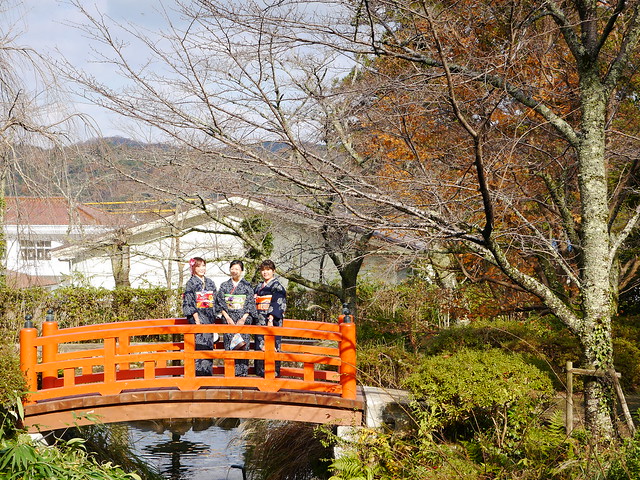
Our timing was not ideal: the autumn leaves were gone and the cherry blossoms had not yet appeared. Still, we could imagine this small bridge beneath a canopy of crimson blossoms. If you come during full bloom, who knows how many people will crowd onto it.
The pond in Utsubuki Park is called Hagoromo Pond. Legend says that in ancient times a celestial maiden bathed here, and a farmer hid her feather robe. Unable to return to heaven, she married the farmer and bore his children. One day she found the robe, happily put it on, and flew back to the celestial realm. Missing their mother, the children beat gongs and drums and played instruments beside the mountain in hopes of luring her back. The mountain next to the park was therefore named Mount Utsubuki, or “Beat and Blow.” Did their mother return in the end? No.
This is the Mount Utsubuki I just mentioned.
The Kotozakura Memorial Hall is the childhood home of a renowned Japanese sumo wrestler. Producing a yokozuna in such a small town is a tremendous honor. If you are interested in sumo, you can visit the hall.
Shirakabe Club, also known as Akagawara Building No. 13, was formerly a bank and is now a Western-style restaurant famous locally. However, a fairly powerful earthquake had struck a few weeks before our visit, badly damaging the exterior, which was under repair.
Next door, Machiya Seisui-an has a high Tabelog score of 3.46. Its best-known dish is a colorful mochi hot pot, so it is worth considering if you enjoy hot pot.
Today, however, I ate at Shirakabe Club, which had not yet recovered from the earthquake and was continuing to operate temporarily at another nearby location called Yume Kura.
The small blackboard outside reads “Shirakabe Club,” but the restaurant will move back to its original location once repairs are complete.
The menu offers the ¥1,200 Shirakabe Lunch, the ¥1,000 Salad Lunch, and Nostalgic Omurice.
This space was originally used to make and sell handicrafts, and you can watch artisans at work painting.
The cute, elegant dolls look a little like the “glasswork” popular around Yamagata in the Tohoku region.
Next, let us see the dining area. The exterior is purely Japanese, but the interior has an elegant, classical Western style.
The Shirakabe Lunch includes a hamburger steak with house-made tomato sauce, herb bread, a fresh-fish dish, and more. It is attractively and generously plated, although I did not order it.
I had the ¥1,000 Nostalgic Omurice. As soon as it arrived, the colors of the salad whetted my appetite. It was also the first time in my life I had seen omurice served with red pickled ginger.
The pumpkin soup seemed to contain a great deal of cream, making it extremely milky and smooth. Personally, though, I prefer a flavor with less cream.
The omurice was made in the classic style. Inside was ketchup fried rice, carefully wrapped in a thin, tender layer of egg. The ketchup was fairly tart, and overall the dish was wholesome and delicious.
Dessert after the meal was chocolate cake. Bittersweet flavors lingered on the tongue, and the quality was very high.
There was no special reason for taking this photo; I simply thought the two adjoining buildings were beautiful.
Although this is a district of traditional Japanese architecture, elegant Western-style houses like this also stand here.
[Kurayoshi Shirakabe Dozogun and Akagawara]
Uomachi, Togiyamachi, Higashinakamachi, Shinmachi 1-chome, and Sakaimachi 1-chome, Kurayoshi, Tottori Prefecture
0858-24-5371
Getting there: Take a bus from stop 2 in front of Kurayoshi Station, and you will arrive in only 12 minutes. From 7:30 a.m. to 6:40 p.m., buses run roughly every ten to twenty minutes, so service is quite frequent. See here for the detailed timetable.
Outbound timetable
Return timetable
[Akagawara Building No. 1] (location of the traditional Kurayoshi kasuri kimono experience)
1-chome, Shinmachi, Kurayoshi, Tottori Prefecture
0858-23-6666
Business hours: 9:00 a.m.–5:00 p.m.
Reservation email address
View a larger map
Late Autumn! [Complete Guide to a Four-Day Must-See Tottori Itinerary]
Source: 右上世界食旅 | Original URL: https://www.travalearth.com/post-31866111/
The original article is offline. This page is based on an archived web copy
Where would you stay for this story?
This is a stay-recommendation demo. Partner links will be enabled after confirmation.
Kaike Onsen and Tottori stays
Choose an onsen inn, city hotel or stay area that fits the article context.