
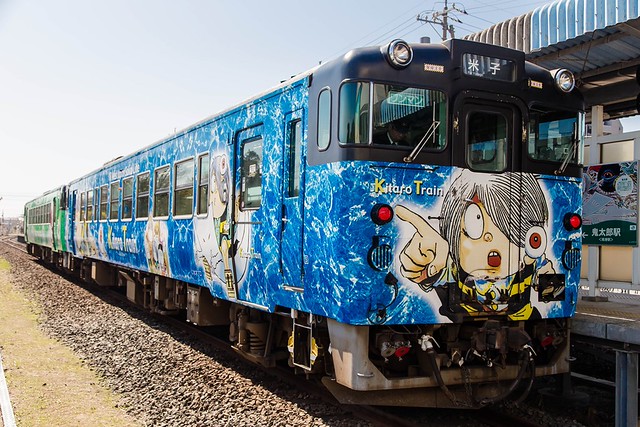
Mizuki Shigeru Road in Sakaiminato pairs well with the museum and the Kitaro Train. From the streets to the transport, manga characters appear everywhere, making it a fun area to explore slowly.
[Sakaiminato, Tottori Prefecture] Mizuki Shigeru Road, Museum, and Kitaro Train
GeGeGe! Before the trip, I honestly did not feel strongly about this stop. Although I had seen the Kitaro manga, I could hardly call myself a devoted yokai fan. But the moment I arrived, it was as though a spirit had bewitched me: I took photos like mad and even bought piles of merchandise, despite having previously teased other people for buying such things.
I have to admit it: “The Japanese really know how to market something.”
Japanese marketing expands from points to lines and then across an entire area; whole cities and tourism bureaus mobilize together. This approach has been extremely successful in Tottori, the land of manga, to the point that Conan Airport and Kitaro Airport have become official nicknames.
For example, this station in Sakaiminato has become “Kitaro Station.”
The entire street is named Mizuki Shigeru Road after Shigeru Mizuki, the creator of Kitaro. The marketing is comprehensive, and in no time Yonago and even Tottori became must-visit stops for Taiwanese travelers following the San’in rail route.
GeGeGe no Kitaro
is a
Japanese
manga by
Shigeru Mizuki,
a cartoonist known as the
“Yokai Professor.”
Its serialization began in 1959. It was originally titled
Hakaba Kitaro,
but in 1967 its creator Shigeru Mizuki renamed it
GeGeGe no Kitaro,
the title that has remained in use ever since.
The story centers on Kitaro, a boy who is the last survivor of the Ghost Tribe, as he battles yokai that use sorcery and commit all manner of evil. Wearing a yellow-and-black striped chanchanko vest and traditional Japanese wooden sandals, the boy uses his
hair,
chanchanko vest,
and geta sandals
as weapons. Together with a group of yokai friends living in a mysterious forest, he resolves troubles in both the human and yokai worlds.
My top recommendation for getting to Sakaiminato is undoubtedly the Kitaro Train. Yonago is the best station from which to board, and the station itself has plenty of Kitaro-themed features.
Sakaiminato ⇔ Yonago one-way fare: ¥320; travel time: approximately 45 minutes
JR Sakai Line timetable (weekdays)
JR Sakai Line timetable (Saturdays and holidays)
Once you get off, you are at the station named after Kitaro. We arrived by minibus, but we still had to go inside for a look.
Benches decorated with Kitaro and his companions are found not only inside the station but throughout Mizuki Shigeru Road.
No Japanese tourist attraction is complete without a photo cutout board. Of course you have to take a picture!
There were four kinds of Kitaro train, one car of each type, and which one you boarded depended entirely on luck. I wondered whether all four were coupled together when holiday crowds were large. I have heard that the fleet was recently expanded to six different designs.
Although we did not ride the Kitaro Train that day, we were lucky enough to see one pull into the station. Perhaps because it was a weekday with few passengers, it had only two cars, but that was still enough to make us happy.
Starting from Kitaro Station, Mizuki Shigeru Road has more than a hundred bronze statues large and small. Visitors compete to take photos with them, and on crowded holidays you even have to wait in line.
To be honest, I am not a Kitaro fan, so I could not name most of the monsters. We were also in a bit of a hurry that day, so all I could do was look around quickly and take photos.
I took far too many pictures to post them all, so I have selected a few that I thought were relatively “cute”—a major misuse of the word—for everyone’s reference. One essential photo is Kitaro’s father, Medama-Oyaji, or Eyeball Father.
Kitaro riding a postcard greets everyone beside the mailbox in front of the station. This is another statue you have to photograph.
Mizuki Shigeru Road in front of the station is roughly 200 to 300 meters long. Many statues of Kitaro and his companions stand along both sides, and even the streetlights are shaped like Medama-Oyaji.
Kitaro and his companions also appear everywhere in the paving tiles underfoot.
This was probably the cutest monster I saw that day. I do not know its distinguished name, but it looks a little like a pineapple.
Are these two monsters as well? They look fairly normal.
Shaking hands with Nezumi Otoko for a souvenir photo is another essential thing to do on Mizuki Shigeru Road.
I do not know exactly how many Kitaro statues there are on this Kitaro street, but they always attract the largest crowds posing for photos.
My favorite spot among them is Kitaro on the bridge. Unfortunately, the cherry blossoms were still closed buds. One week later, the scene would surely have been overwhelmingly beautiful.
Around the middle of Mizuki Shigeru Road is a Kitaro park where many people rest on their way back. The park has numerous Medama-Oyaji streetlights staring directly at you—startling indeed.
Do even the roadside trees have to grow like yokai? I heard this tree took this shape on its own without being pruned. No wonder they say that anything close to a yokai becomes strange too.
The yokai pond in the park is rather cute, and nothing attracts more camera shutters than the statue of Kitaro urinating.
Many shops, restaurants, and teahouses have joined in by hanging signs featuring Kitaro and his companions.
This store sells many Kitaro figurines. Collectors should definitely take a look inside, but make sure your wallet contains enough yen, because you are certain to lose control!
Yokai dessert shops like this are everywhere along Mizuki Shigeru Road, apparently determined to shake every last yen from visitors’ pockets.
There are several spots that Little Tiger personally recommends very highly. One is this small, charming yokai shrine. The Medama-Oyaji floating in the water basin refused to cooperate. I kept asking him to look at the camera, but he insisted on gazing up at the sky. It took ages to capture this picture (laughs).
A shrine must have a place beside it selling amulets. I wonder whether they also offer Kitaro goshuin seals.
What exactly is a yokai amulet supposed to protect you from?
This is the planned site of the Yokai Warehouse. It may already be complete by the time you visit; remember to come back and share the news with Little Tiger.
There are many places to collect commemorative stamps at Sakaiminato Station and along Mizuki Shigeru Road. Collect twenty or more and you receive a Kitaro sticker; find all thirty-seven and you can claim a souvenir. More amusingly, the final line says that collecting forty earns an even more impressive, special gift. Does that mean the final three are hidden stamps that are especially hard to find?
The latter half of Mizuki Shigeru Road is a Kitaro shopping street, and the Mizuki Shigeru Museum is located within it. The yokai manju shop in front of the arcade is very famous and is where many visitors buy souvenirs.
Costumed yokai characters appear at random times outside the Mizuki Shigeru Museum. If you see them, do not hesitate to ask for a photo together!
Naturally, there is also a Kitaro statue in front of the museum for visitors to pose with.
Turn this machine in front of the museum clockwise fifteen times, then let go, and it makes a yokai sound. Terrifying.
At the museum entrance, Kitaro, Medama-Oyaji, and Shigeru Mizuki tell everyone, “Welcome.”
Admission requires a ticket, and audio guides are available to borrow. Little Tiger recommends getting one because there is a Chinese version. Listen to each numbered entry in sequence, and you will learn about Mr. Mizuki’s life and the original intentions and ideals behind his creation of Kitaro.
Photography is generally prohibited on the first floor, but visitors can take pictures freely on the second. Upstairs are many yokai standees, along with works by Mr. Shigeru Mizuki displayed on the walls.
This wall reveals many secrets about the characters in words and pictures, bringing a knowing smile to your face.
Besides reading manga on the walls, visitors can use a small library in a corner of the second floor to enjoy Mr. Mizuki’s major works.
Mr. Shigeru Mizuki repeatedly traveled around the world to gather material, leaving footprints across virtually the entire globe. He visited Taiwan alone as many as five times.
The items in the glass cases are yokai souvenirs that Mr. Mizuki brought back from different parts of the world.
Every yokai that appeared beneath Mr. Mizuki’s brush has a name of its own!
A yokai apartment?
Kitaro’s house. Many scenes from the manga can be seen inside the museum. If you are a Kitaro fan, they should resonate strongly with you.
In addition to the Mizuki Shigeru Museum, behind it is a Yokai Paradise that I also strongly recommend. This is where my wallet finally surrendered.
The attraction is only a three-minute walk from the Mizuki Shigeru Museum. It is essentially behind the museum, just two turns away.
Kitaro and monsters appear everywhere around the paradise’s plaza and surroundings.
A place to rest and have a drink.
Kitaro’s house. Children who are not too large can even go inside to take pictures!
There is a stamp station in the middle of the plaza featuring the more famous yokai that appeared in Kitaro stories. The children were stamping away with tremendous enthusiasm.
This is the main place in Yokai Paradise where your wallet is “defeated.” Anyone lacking self-control or deep pockets should stay out.
The prize machine costs ¥500 per try, and the possible prizes are displayed behind it. Naturally, everything is related to Kitaro. Little Tiger has never had much luck and did not even dare consider trying.
The Kitaro Lego set was the cutest souvenir I found on this trip. I bought two to use as raffle prizes at the “Love Convention.”
An army of yokai manju—perfect to take home and give friends to eat!
Kitaro sake. I accidentally ended up buying a bottle of that too.
Is this a crossover between different manga, or between different dolls? Could it count as an alternative Beauty and the Beast?
My spoils. For someone who rarely buys anything while traveling, this qualifies as completely losing control.
Kitaro Train timetable (boarding at Yonago Station is recommended)
Yokai names for stations on the Sakai Line
Yonago Station
Nezumi Otoko
Station
Bakuro-machi Station
Koropokkuru
Fujimicho Station
Zashiki-warashi
Goto Station
Dorotabo
Sambommatsuguchi Station
Sodehiki Kozo
Kawasaki-guchi Station
Kasa-bake
Yumigahama Station
Azuki-arai
Wadahama Station
Tsuchikorobi
Misakiguchi Station
Sunakake-babaa
Oshinozu Station
Betobeto-san
Hama Station
Ushi-oni
Matsucho Station
Sunekosuri
Amariko Station
Konaki-jijii
Agarimichi Station
Ittan-momen
Babasakicho Station
Kijimuna
Sakaiminato Station
You can also ride a Kitaro bus, although I still think the Kitaro Train is cooler.
The fare is a flat ¥100 regardless of distance and is paid when boarding. One circuit of the city takes about an hour. Contact the operator for a detailed timetable. Inquiries: City Loop Bus Operations Office, telephone 0859-44-1140. The main stops are listed below in clockwise-route order; the counterclockwise route travels in the reverse sequence.
Sakaiminato City Hall
Yumeminato Tower
Yonago Airport
Saiseikai Sakaiminato General Hospital
Sakaiminato Station
Daiba Park and Sea and Life Museum
Port Administration Office (Immigration Bureau and Customs)
Sakaiminato Police Station
Motomachi Hospital
Sakaiminato sightseeing map
Sakaiminato City Tourism Association:
http://www.sakaiminato.net/site2/page/map/timetable/JR/2012jrsakai/
(A Chinese-language option is available.)
View a larger map
Mizuki Shigeru Museum address (near Sakaiminato Station): 5 Honmachi, Sakaiminato, Tottori Prefecture 684-0025 (Honmachi Arcade Street)
More travel information on the San’in region:
[Travel in Tottori, San’in, Japan] San’in Kaigan Geopark—Uradome Coast (Island-Cruising Sightseeing Boat and Seafood Squid Set Meal)
[Travel in Japan] [Transportation from Kansai Airport to Tottori Station] Souvenirs and Desserts at Shin-Osaka Station, Including Transportation Details and How to Buy the ICOCA Package
[Travel in Japan—Lodging in Hyogo, San’in] Kinosaki Onsen—Sennen no Yu Koman, One Night with Two Meals
[Travel in Kyoto, Japan] [Miyazu, Tango, Kyoto Prefecture] Amanohashidate, One of Japan’s Three Scenic Views, and Kasamatsu Park
[Travel in Japan] [Food in Tango, Kyoto Prefecture] Mansukero Chirashi Sushi (Tango Barazushi)
[Travel in Japan] [Shimane, San’in] Izumo Taisha Grand Shrine
Source: 小虎食夢網 | Original URL: https://www.foodtigertw.com/blog/posts/3044674246
Where would you stay for this story?
This is a stay-recommendation demo. Partner links will be enabled after confirmation.
Kaike Onsen and Tottori stays
Choose an onsen inn, city hotel or stay area that fits the article context.