
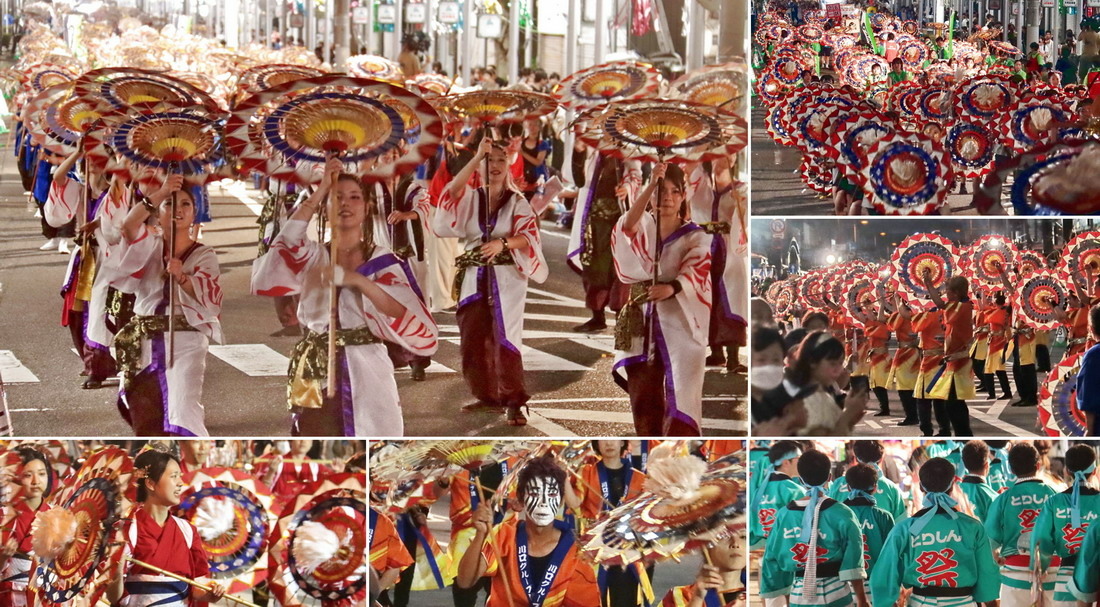
Tottori Shan-Shan Festival has earned a Guinness World Record, with around 4,000 dancers moving together while waving colorful umbrellas. The grand procession is a vivid way to feel the energy of Tottori’s summer festival season.
Aug
Thu
Tottori, Japan: Tottori Shan-Shan Festival, a Guinness World Records festival where 4,000 people perform a dazzling umbrella dance together in a deeply moving spectacle
#SaninFestivalsJapan #TottoriShanShanFestival #TottoriUmbrellaDanceFestival #ShanShanFestival #ObonFestival #GuinnessWorldRecords #ExploreTottoriWithToripy
Tottori Shan-Shan Festival
Dates and times:
August 13–15 every year. Eve festival on August 13 (smaller scale, 6:00–9:00 p.m.); simultaneous umbrella dance on August 14 (the largest event, 6:30–9:00 p.m.); fireworks on August 15 (from 8:00 p.m.)
Scale:
The 59th festival was held in Reiwa 5 (2023), with 82 teams (2023) and around 4,000 participants.
Certified by Guinness World Records in 2014 as the world's largest umbrella dance, with 4,000 participants
Location:
In front of Tottori Station, along Hondori, Wakasa Kaido, Katahara-dori, Chizu Kaido, and Taiheisen-dori, as shown below
▲ Image source:
Official website of the 59th Tottori Shan-Shan Festival
The main purpose of this trip to Tottori in the scorching August heat was to see Tottori City's colorful and magnificent Shan-Shan Festival. This year's 59th festival, held in 2023, was especially significant because it returned to the city center in full scale after a four-year absence. The 56th festival was canceled due to the pandemic, the 57th was held without spectators, and the 58th took place at designated venues.
Held for three consecutive days from August 13 to 15 each year, the Tottori Shan-Shan Festival is also known as the Umbrella Dance Festival. It is not only Tottori's largest and most closely watched festival, but was also certified by Guinness World Records in 2014 as the world's largest umbrella dance. The grandest event of the three days takes place on the evening of the second day, August 14, when streets are closed and 4,000 dancers perform the simultaneous umbrella dance together.
We reached the venue before the festival began at 6:30 p.m. on August 14. The main thoroughfares, Wakasa Kaido and Chizu Kaido, were already closed to traffic and packed with people. Food stalls giving off irresistible barbecue aromas were scattered along the fairly narrow sidewalks. Heads bobbed everywhere, and it seemed as though the whole city had turned out. The atmosphere was as lively as New Year's Eve.
▲ Wakasa Kaido was already bustling with people before the festival began at 6:30 p.m. on August 14.
▲ Straight Wakasa Kaido is the main viewing area and attracts the biggest crowds.
▲ Food stalls filled the streets with the aroma of grilled treats. It was almost impossible to walk past without giving in.
▲ Before the festival began in the evening, umbrella-dance teams were already visible on the streets. Old and young alike were ready for action.
▲ There are few elevated places for photography along Wakasa Kaido, the main viewing area. This photo and the next were taken from the terrace on the second floor of a FamilyMart, but the view was obstructed, so I left after taking just two shots.
▲ At 6:30 p.m., 82 teams began performing a synchronized umbrella dance to live music featuring the distinctive shan-shan sound.
▲ A “young lady?” dressed head to toe in Hello Kitty appeared. The dancers beside “her” probably never imagined that anyone could steal their attention so effortlessly.
▲ I followed “her” for a while. Besides attracting plenty of stares, “she” had many people asking for photos and handshakes.
▲ This older gentleman was completely true to himself. Although everyone looked his way, neither his expression nor his movements seemed at all unnatural. He was thoroughly enjoying himself.
The highlight of the Tottori Shan-Shan Festival is the simultaneous umbrella dance on August 14, which runs from 6:30 to 9:00 p.m.
As soon as 6:30 arrived, cheers rang out. Teams of dancers holding brightly colored paper umbrellas appeared one after another on the closed streets, moving in unison to the rhythm of music filled with the shan-shan sound. Their crisp, powerful steps and the umbrellas sweeping in every direction instantly transformed the formerly dark avenue into a brilliant, colorful scene like a strip of neon.
After each round of umbrella dancing, which lasts about five or six minutes, the dancers take a brief break and then return. They advance slowly along the closed streets forming a rectangular loop: Hondori, Wakasa Kaido, Katahara-dori, Chizu Kaido, and Taiheisen-dori. Wakasa Kaido has the largest crowds. Other streets are a little less busy, but you can still see every part of the spectacular performance.
▲ This dancer had his entire face painted. His base makeup must have been extremely waterproof. I was sweating just from watching, so imagine how the dancers must have felt.
The 59th Tottori Shan-Shan Festival in 2023 brought together 82 teams and approximately 4,000 dancers. They represented all walks of local life, including various associations, JR railway staff in Tottori, the electric utility, firefighters, schools at every level, and early-childhood education groups.
Every team differed in size and costume. Some wore casual T-shirts, others Japanese summer yukata, and still others festival attire featuring their group's own colors and emblems. The one consistent element was the colorful paper umbrella held by every dancer. Each umbrella had alternating red and white panels, blue and gold trim, and a white fabric streamer at the top resembling a Buddhist priest's fly whisk. Some teams also brought their own taiko drummers, lead vehicles, and dance leaders, giving the event a hint of friendly competition.
Local friends told me that for one or two months before the Shan-Shan Festival, groups practicing the umbrella dance can often be seen in Tottori City's major squares in the late afternoon and evening, using their time after school or work to rehearse. It shows how seriously they take the festival. Local tradition says the festival began as a prayer for rain. Long ago, Tottori suffered a prolonged drought that made life unbearable. An elderly man took up a paper umbrella and danced to pray for rain. He continued until he died, and only then did the drought end. The local people began the Shan-Shan Festival, or Umbrella Dance Festival, in his memory.
▲ This Tottori post office team wins my personal “Best Costume Award.” Their bright red summer yukata and the designs on their obi and backs were striking, making them an unquestionable focus of attention.
▲ Some teams have a captain at the front who periodically reminds the dancers to be “more energetic,” “more cheerful,” and to “smile wider”...
▲ There is beauty in sheer numbers, and the Tottori Shan-Shan Festival demonstrates it to perfection.
▲ Children frequently appear among the umbrella-dance teams, and their dancing is every bit as good as the adults'.
The Tottori Shan-Shan Festival has many food stalls along the streets closed in a rectangular loop, and the surrounding plazas and open spaces are put to use as well. I mainly photographed from Wakasa Bridge on this visit because its elevated position makes it possible to capture the dancers stretching into the distance. From the bridge I repeatedly heard thunderous taiko drums coming from around Hanami Bridge, a nearby spot with many cherry trees. Following the sound, I discovered a food market resembling a night market. I had assumed there would be fewer people at the edge of the festival venue, but just as many visitors came here to take a break or find food as gathered on Wakasa Kaido.
Hanami Bridge lies between Wakasa Bridge and Chizu Bridge, so I also took the opportunity to walk over to the Chizu Kaido side. Like Wakasa Kaido, Chizu Kaido is a long, straight avenue. Chizu Bridge is also elevated and offers views of umbrella dancers extending far into the distance. The crowd here, however, was much smaller, making photography easier. Anyone coming to the next Shan-Shan Festival should consider watching from the Chizu Kaido side.
▲ The food market near Hanami Bridge is away from the main festival venue, but its crowds rival those on Wakasa Kaido.
▲ The food market near Hanami Bridge even sold xiaolongbao. I also noticed on this trip that bubble tea, which was hugely popular before the pandemic and once certain to appear at festivals, had vanished.
▲ From the elevated Chizu Bridge, a telephoto lens can capture the umbrella dance continuing in a straight line far into the distance.
▲ The next few photographs were also taken from Chizu Bridge with a telephoto lens.
▲ Time for a group photo during the break!
齊哥的食旅探go
齊哥的食旅探go
Posted by 齊哥的食旅探go
Popularity (
Overseas travel
【Asia】Japan
Source: 齊哥的食旅探go | Original URL: https://paulchi543.pixnet.net/blog/posts/15341911285
Where would you stay for this story?
This is a stay-recommendation demo. Partner links will be enabled after confirmation.
Kaike Onsen and Tottori stays
Choose an onsen inn, city hotel or stay area that fits the article context.