
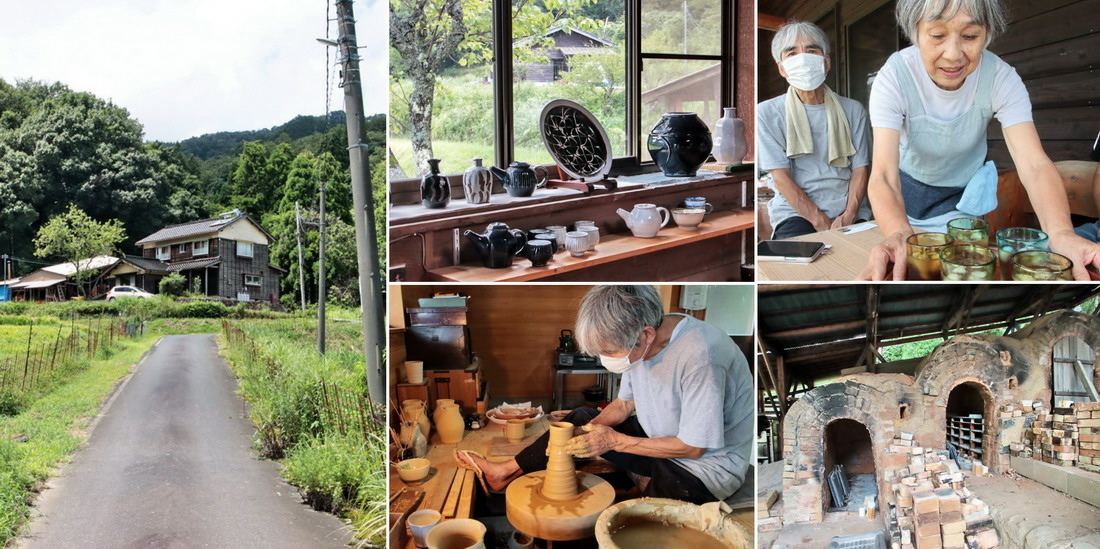
Enkoji Kiln is tucked away in the mountains, run by a potter who studied under a Living National Treasure. Using local clay, glaze, and wood, its works carry the character of Tottori’s landscape.
Tottori, Japan | Enkoji-gama, a wood-fired kiln hidden away in the mountains. Its potter studied under a Living National Treasure, and all of its clay, glazes, and firewood are locally sourced @ 齊哥的食旅探go :: Pixnet ::
Aug
Tue
Tottori, Japan: Enkoji-gama | A wood-fired kiln hidden away in the mountains. Its potter studied under a Living National Treasure, and all of its clay, glazes, and firewood are locally sourced
#TravelInJapansSaninRegion #TottoriPrefectureAttractions #IwamiTownTravel #EnkojiGama #LivingNationalTreasure #JapaneseCraftsmanship #ExploreTottoriWithToripy
Enkoji-gama, Iwami Town
Address:
525-4 Enkoji, Iwami-cho, Iwami-gun, Tottori Prefecture
Telephone:
Opening hours:
9:00 a.m.-6:00 p.m.; closed irregularly
View larger map
Each of Japan's 47 prefectures
has its own noteworthy wood-fired kilns, and the pottery they produce comes in an extraordinary variety. My first encounter was with Mashiko ware from Tochigi Prefecture. Thick and unadorned, with bold lines yet a warm feel in the hand, it combines a Zen sensibility with a fresh, cultured air. That was when I fell in love with Japan's wood-fired kilns.
For this visit to Tottori, I had originally planned to see its two best-known kilns:
Inshu Nakai-gama,
and, nearby,
Iwaiya, Tottori's secluded hot-spring inn,
with its Iwai-gama kiln.
Unfortunately, Typhoon Lan disrupted our plans, and both kilns closed at short notice. Enkoji-gama in Iwami Town, the subject of this article, had also planned to close temporarily. Luckily, while chatting with the proprietress at Iwaiya about secluded hot springs and wood-fired kilns, she went out of her way to telephone the kiln and ask if they would allow us to visit. That is how we were able to step inside Enkoji-gama, a 45-year-old kiln hidden away in the mountain woods.
Enkoji-gama is about 11 kilometers from Iwai Onsen, or roughly a 15-minute drive. Several wooden buildings stand with the mountain behind them and broad rice fields stretching out in front. There is no sign at the entrance. You leave the car by the main road—Prefectural Route 37, the Iwami-Hatto Line—and walk along a country lane for a while before arriving.
▲ Enkoji-gama, a 45-year-old kiln hidden away in the mountain woods.
▲ The country lane leading into Enkoji-gama, with rice fields extending along both sides.
▲ In this wooden building at the entrance, the kiln owner lives upstairs, while the ground floor serves as a pottery display and sales area.
▲ Enkoji-gama is run by the elderly couple Kiyoshi and Etsuko Yamashita and their daughter, Hiroyo Yamashita.
Enkoji-gama was established in 1978 and has now been operating for 45 years. Born in Tottori City, Kiyoshi Yamashita originally worked in technology at IBM. He and his wife loved pottery, and while they were still young, they began dreaming of withdrawing to the mountains and making a living from ceramics. Kiyoshi first traveled with his elder brother to study Tamba ware in Hyogo Prefecture under Kazutaka Ikuta (1927-1982), who was designated a Living National Treasure of Japan. Later, he and his brother founded Uradome-yaki in Iwami Town.
They told me that they had discovered very good clay around Enkoji in Iwami Town. The black stones in the nearby Odagawa River could be used for black glaze, while burned rice husks from the surrounding fields could be used for white glaze. Both made excellent glaze materials. They also liked the local environment, so they took the decisive step of moving here to establish an independent kiln. They built their own home and wood-fired kiln and opened Enkoji-gama in 1978, focusing mainly on pottery for everyday use.
▲ This building is the studio where Kiyoshi Yamashita and his daughter Hiroyo normally work.
▲ The studio has a wonderful view. Facing these fields as they work must give potter Kiyoshi Yamashita and his daughter Hiroyo even more inspiration.
For 45 years, Enkoji-gama has insisted on making pottery solely with clay and glaze materials found near the family home and with firewood such as red pine and cedar from Chizu. In addition to black pebbles from the Odagawa River, the glazes use the readily available rice husks from around the house and ash left after burning leaves from various broadleaf trees. These materials are used to create glazes of different colors.
I asked why they do not use Japanese black pine, a fuel chosen by many kilns. Etsuko explained that black pine contains a great deal of resin and burns too fiercely. Firing with red pine or cedar at 1,300°C produces the rustic, warm glaze colors they want. Moreover, cedar is not used as fuel for pottery coated with white glaze made from rice-husk ash, because falling ash would affect the glaze color. All these exacting choices surely embody a craftsperson's dedication.
▲ Enkoji-gama's wood-fired kiln took Kiyoshi Yamashita and other craftspeople more than a year to build. It is now fired twice a year.
▲ Red pine, cedar, and other firewood from Chizu in Tottori.
When Kiyoshi Yamashita makes pottery, he is intensely focused from kneading the clay to sitting at the wheel and throwing a form. We scarcely dared to breathe for fear of disturbing him. He habitually wears straw sandals while working. Etsuko explained that they provide more friction when he turns the wheel with his foot.
Kiyoshi's studio feels quite informal. Finished pieces sit casually among miscellaneous objects and works in progress on wooden cabinets, windowsills, and piles of boards that look ready to collapse. Some are even covered with a layer of dust. I do not know whether these are items not meant for sale, because many of them were nowhere to be seen in the sales area—a pity. There are two pottery-wheel stations in the studio: one for Kiyoshi and the other for his daughter Hiroyo. Hiroyo studied pottery in her early years under Kyoshi Matsuda at Kitagama in Okinawa and has developed her own ideas about ceramic expression. Etsuko told us that father and daughter each have their own creative convictions and styles. They help one another but do not interfere in each other's work. They do, however, share the principle of making pottery with locally produced clay and glaze materials, and both hope to create warm ceramic pieces that enrich daily life.
Watching Kiyoshi Yamashita's practiced movements, we saw him produce a straight-rimmed teacup in very little time. I wondered what this simply shaped, unfinished body would become after glazing and the application of different techniques.
▲ Clay from the hillside behind the family home is dried, cleared of stones, worked, and kneaded before finally becoming the clay used at Enkoji-gama.
▲ Wearing straw sandals while making pottery is comfortable, and it also increases friction when turning the wheel with the foot.
▲ A craftsperson's hands and practiced movements have sustained Enkoji-gama for 45 years.
Besides using local materials, Enkoji-gama pottery is distinguished by a technique called waragaki, or straw decoration. Straw is laid on the surface of an unfired piece and then covered with slip and glaze. After wood firing, the places beneath the straw retain its imprint, forming distinctive lines and textures. Some works also display kushigaki, or comb decoration. A wooden tool resembling a comb or scraper is used to draw flowing patterns through the slip or glaze on the pottery body. This creates a distinctive visual effect and tactile quality while adding a touch of Zen atmosphere.
Enkoji-gama's overall style is rustic and warm, revealing delicacy within its boldness, and I like it very much. If you have a chance to visit Iwai Onsen, consider stopping by Enkoji-gama to hunt for a treasure while you are there to enjoy its secluded hot spring. If you want to buy their work, it is also sold on their behalf at
in central Tottori City.
▲ Many cups, small dishes, teapots, and other fired pieces are placed casually around Kiyoshi Yamashita's studio, but quite a few had no counterparts in the display room.
▲ This small white dish is a classic example of the kushigaki comb-decoration technique. Its flowing design creates a distinctive visual effect and tactile quality.
▲ This is Enkoji-gama's display and sales area. The space is small and there are not many pieces, especially since the small dishes were all inside the studio. I will say it again: what a pity.
▲ The narrow-necked single-flower vase, third from the left on the top row (6,600 yen), now sits on the table in my home.
齊哥的食旅探go
齊哥的食旅探go
Posted by 齊哥的食旅探go in
Popularity (
Overseas Travel
[Asia] Japan
Source: 齊哥的食旅探go | Original URL: https://paulchi543.pixnet.net/blog/posts/15342007457
Where would you stay for this story?
This is a stay-recommendation demo. Partner links will be enabled after confirmation.
Kaike Onsen and Tottori stays
Choose an onsen inn, city hotel or stay area that fits the article context.