
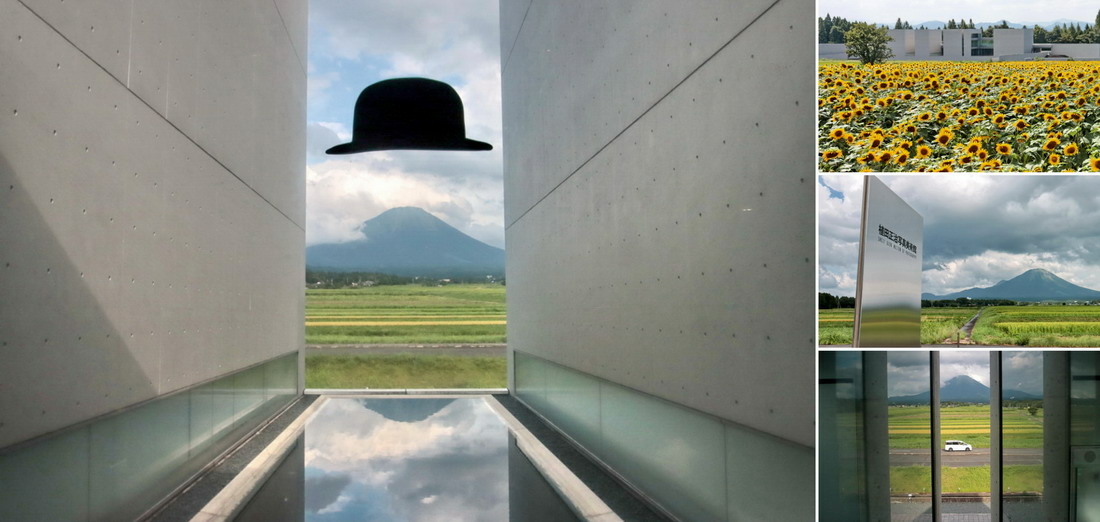
Shoji Ueda Museum of Photography frames Mount Daisen, often called Tottori’s Little Fuji, as part of its view. The minimalist architecture plays with light and water reflections, and the black-hat photo spot has become a favorite.
Tottori, Japan | Shoji Ueda Museum of Photography Frames Tottori's Little Fuji—and a Black Hat Turns It into a Hip Photo Spot @ Qi-ge's Food and Travel Tango :: PIXNET ::
Sep
Fri
Tottori, Japan: Shoji Ueda Museum of Photography | Framing Tottori's Little Fuji—and a Black Hat Turns It into a Hip Photo Spot
#TottoriJapanAttractions #HokiTown #MountDaisenTottori #TottorisLittleFuji #DAISEN #ShojiUedaMuseumofPhotography #ShojiUedaMuseumofPhotography #ArchitectShinTakamatsu #TourTottoriWithToripy
Shoji Ueda Museum of Photography
Address:
353-3 Sumura, Hoki, Saihaku District, Tottori Prefecture
Tel:
Hours:
10:00–17:00; closed Tuesdays
Admission:
Adults ¥1,000; high school and university students ¥500; elementary and junior high school students ¥300
Official website:
www.houki-town.jp/ueda/
View larger map
Mount Daisen (DAISEN, 1,729 m) can be seen from many places in western Tottori. In Hoki, however, its cone-shaped profile can best be appreciated for its resemblance to Mount Fuji, earning it the name Hoki Fuji. As a result, many attractions, restaurants, farms, and hotels in Hoki—even the Shoji Ueda Museum of Photography featured in this article—use Mount Daisen as borrowed scenery, incorporating its natural beauty into their settings.
Designed by architect Shin Takamatsu, the Shoji Ueda Museum of Photography is a minimalist exposed-concrete building. Personally, I think it carries echoes of Tadao Ando's design style, especially in its compelling presentation of light, shadow, and reflections in water. Its location is exceptional. The museum faces Mount Daisen where the mountain forms a perfect cone, while tier upon tier of rice paddies stretches across the foreground. The landscape changes with the seasons, from waves of rice plants to fields of sunflowers and rapeseed blossoms. When we visited in mid-August, rows of sunflower plots stood in front of the museum, adding bright color to the otherwise monochrome exposed concrete.
▲ Follow this country lane through the terraced fields below Mount Daisen to reach the Shoji Ueda Museum of Photography, which blends into the beautiful landscape.
▲ This broad field of sunflowers in front of the museum adds a stunning and soothing scene to the scorching summer.
Shoji Ueda (1913–2000), a renowned Japanese photographer, was born in Sakaiminato, Tottori. In 1996, the French government named him a Chevalier of the Order of Arts and Letters. In 1998, he became the first recipient of the Tottori Prefecture Citizen Achievement Award. He also made entertainment news because he had taught photography to actor and singer Masaharu Fukuyama. During his lifetime, Ueda personally selected his architect friend Shin Takamatsu to plan the museum. Like Ueda, Takamatsu was born in Japan's San'in region, in neighboring Shimane Prefecture.
Shin Takamatsu drew inspiration from Shoji Ueda's best-known photograph, Four Girls, designing four exposed-concrete towers as the building's principal forms. Each tower differs in size and style, symbolizing four girls with distinct personalities. What the “four girls” share is that they all face Mount Daisen, watching it change through the four seasons.
▲ The four towers behind the man in the photograph differ in size and design, symbolizing the four distinctive girls in Four Girls.
▲ Mount Daisen can be seen from both inside and outside the museum, perfectly uniting the two.
▲ The staircase before the museum entrance seems to have been carefully calculated so that visitors enter the museum with Mount Daisen welcoming them.
▲ The museum is not limited to straight lines; it is also filled with graceful curves.
Upon entering the museum, visitors see an account of Shoji Ueda's life mounted on the entrance wall. A subtle idea by Shin Takamatsu is hidden here: floor-to-ceiling windows bring light indoors like a powerful spotlight, creating shifts of light and shadow while illuminating the biographical panel.
▲ Shin Takamatsu's subtle touch can be seen at the museum entrance. The afternoon sun shines like a searchlight, illuminating the account of Shoji Ueda's life.
The museum does not have a great deal of exhibition space—only four galleries. From its collection of 12,000 Shoji Ueda photographs, works are selected by theme for exhibitions that change periodically.
Ueda's work mainly focuses on people, especially close family members. His photographs do not rely on forceful visual impact; instead, they convey imagination, the amusement of everyday life, and an understated tranquility. In this way, he established the distinctive “Ueda-cho” style. Most of his photographs were taken in the San'in region, with the Tottori Sand Dunes appearing repeatedly through his lens.
Note: Photography is not allowed inside the four photography galleries, so only rough views can be photographed from outside them.
▲ The walls of the first-floor passage display exhibition information from art museums and museums throughout Tottori.
▲ The museum has four galleries displaying Shoji Ueda's photographs according to different themes.
Another major attraction is the way the museum borrows the scenery of Mount Daisen and the surrounding countryside. The second-floor corridor has three large floor-to-ceiling windows with distant views of the mountain. In front of each window is a shallow, still pool. Like a refracting mirror, the water draws Mount Daisen, the rural landscape, and the color of the sky into the museum. Three chairs are placed before each of the three windows so visitors can sit and properly appreciate the view.
Of the three large floor-to-ceiling windows, the center pane has a black top hat affixed to the glass. It is another popular highlight that should not be missed. Many people enter the museum specifically to take a check-in photo here.
▲ The central corridor on the museum's second floor.
▲ Sitting in this chair and gazing toward Mount Daisen and the beautiful daylight—what a leisurely pleasure.
▲ I do not know what the black top hat is meant to signify. I only know that it is an extremely popular photo spot at the museum.
▲ This photograph was taken from the third-floor stairwell. The glass on both sides acts like mirrors, offering a different kind of visual delight from the second floor.
▲ The museum also has a projection room. Its projector lens is the largest in the world. The white section at the top of the photograph was made to reproduce its actual size.
After touring the Shoji Ueda Museum of Photography, head next door to Terrace the Daisen by Daisen Ham. It also frames the magnificent scenery of Mount Daisen, and you can enjoy a good meal there!
Tottori, Japan | Daisen Ham's Terrace the Daisen Beside the Shoji Ueda Museum of Photography: Relax with Coffee and a German Sausage Burger While Admiring Mount Daisen
Qi-ge's Food and Travel Tango
Qi-ge's Food and Travel Tango
Qi-ge's Food and Travel Tango posted in
Popularity (
International travel
[Asia] Japan
Source: 齊哥的食旅探go | Original URL: https://paulchi543.pixnet.net/blog/posts/15342053841
Where would you stay for this story?
This is a stay-recommendation demo. Partner links will be enabled after confirmation.
Kaike Onsen and Tottori stays
Choose an onsen inn, city hotel or stay area that fits the article context.