
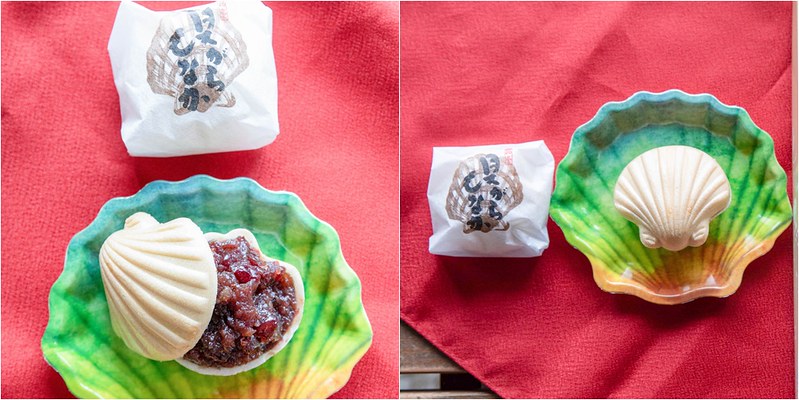
When visiting Hamamura Onsen, stop by Okashidokoro Fune. Its shell-shaped monaka, made for 55 years, is a local souvenir with a strong sense of place.
Okashidokoro Fune (
official website
): 442-11 Hamamura, Ketaka-cho, Tottori City, Tottori Prefecture. Tel: . Hours: 8:00 a.m.-6:00 p.m. (closed on the 1st, 11th, and 21st of every month)
Whenever we travel, we want to bring home souvenirs and gifts for our family and friends. In Japan, what I actually love buying most is wagashi, especially monaka and sakura mochi. Tottori has quite a few long-established confectioners like this one. Besides consulting this article on
Tottori souvenirs,
seven recommendations, I personally highly recommend the 120-year-old shop whose sweets have even been enjoyed by the emperor,
Ishitani Seikado's Utsubuki Koen Dango,
as well as the shell-shaped monaka from a 55-year-old shop that I am sharing today. I often take both back to Taiwan as gifts. However, since these last two products contain no additives, they generally keep for only three to five days, so I suggest buying them near the end of your trip.
Monaka is said to have originated as a confection served at the imperial court during moon-viewing parties in the Heian period. Eating sweets while admiring the moon is rather like eating mooncakes during the Mid-Autumn Festival. The name “monaka” comes from the closing words, “monaka narikeru,” of a poem by the poet Minamoto no Shitago. Monaka refers to the full moon, or the moon at its roundest, so the earliest monaka were round like a full moon. Over time, confectioners across Japan began creating different shapes inspired by local people, history, and tourism. One example is Seishodo, a long-established wagashi shop in Shimbashi, Tokyo, which developed Seppuku Monaka. It is now known as a gift to take along when apologizing for a mistake. Personally, my favorites include the Choshi Electric Railway treat from Chiba made by
Ryusendo in the shape of Inubosaki Lighthouse,
a
monaka (left); the thatched-house monaka from Heike Monaka in Yunishigawa,
Nikko City, Tochigi Prefecture;
(right); and the Tottori shell monaka featured today. I consider these my three favorite monaka in Japan.
The 55-year-old Okashidokoro Fune is located in Ketaka-cho on Tottori's Sea of Japan coast. Its signature product is Kaigara Monaka, inspired by the local Kaigara-bushi folk song and festival. Nearby is Hot Air, the only Michelin-listed ramen shop in the Sanin region. Hamamura Onsen in this area also has a history of around 500 years, while Tatsumidai and Uomidai are well-known local viewpoints overlooking the Sea of Japan.
Even the manhole covers around here feature shell designs, echoing the famous Kaigara-bushi tradition of Ketaka-cho's Sea of Japan coast. At the Uomidai observation deck, visitors can also find the locally beloved Kaigara-bushi song. For some reason, it reminded me of the shrimp-scooping dance in the 2023 historical drama What Will You Do, Ieyasu? The Kaigara-bushi Festival (official website), held from late July to early August each year, is the most important festival in Ketaka-cho, Tottori. Its origins are unknown, but the event centered on the folk song began in 1934. It now has more than 90 years of history and is one of the best-known festivals along the Sea of Japan coast.
The woman who saw us off at the entrance was the proprietress of Okashidokoro Fune. When she was young, she taught Japanese in Changhua, Taiwan, and married a Taiwanese man. She later returned to Tottori and took over this wagashi shop. Of course, her Chinese is still fluent, so speaking Chinese here is perfectly all right.
The shop is not very different from the old-fashioned confectionery stores found throughout Japan. It is small, but has the warmth of a long-established country shop. A painting related to the Kaigara-bushi folk song hangs on the wall and is quite charming.
Only after chatting did I learn that Okashidokoro Fune did not originally have its present signature product, Kaigara Monaka. The confectionery models in the glass case represent the sweets for which the shop was first known. They reminded me a little of the tools once seen in traditional Taiwanese bakeries for making festive cakes such as red tortoise cakes. The shop reportedly began making Kaigara Monaka more than 30 years ago. It became a runaway success and has since turned into an authentic local specialty and representative souvenir.
The shop now carries more products than I expected. Its official website lists nearly ten varieties; see it for details.
The shop also has products handed down since its founding. These keep longer, including peanut puffed-rice snacks and small rice crackers in assorted flavors.
It even makes traditional Tottori rice cakes and mochi for New Year and celebratory occasions, and can customize them into seasonal gifts according to a customer's needs.
Gift boxes come in different sizes and packaging for ordinary gifts and celebrations. Naturally, boxes in Japan usually cost extra. Incidentally, Japan rarely offers a discount such as six 100-yen items for less than 600 yen. The total remains 600 yen, and even the box may cost extra. This is one cultural difference between Japan and Taiwan.
One thoughtful feature is that, regardless of the box size, customers can combine their favorite flavors. A box of six, eight, or ten does not have to contain a single flavor. There is also a ten-piece manager's-choice assorted set containing several different sweets.
After everyone bought two or three boxes, we immediately began taking photos inside the shop. The proprietress even brought out shell-shaped plates and a red tablecloth for us to use as props. =)
First, of course, came the signature of all signature products, Kaigara Monaka. Its shell shape is extremely cute and appealing. It is crisp, with a delicate crunch during the first second in your mouth. The wafer is understated, leaving only a faint, fleeting aroma. Inside is a generous amount of red-bean paste, but it differs slightly from the filling in imagawayaki or taiyaki. It has a subtly glazed texture, yet is surprisingly neither overly sweet nor cloying. The contrasting textures inside and out make it ridiculously delicious.
The ginger curry manju sounded so unusual that I naturally had to try one. Both the ginger and curry seemed to appear mainly in the aroma of the outer dough, along with a very mild heat whose source was hard to distinguish. Inside was slightly sweet white-bean paste. Perhaps the fragrance and mild spice of the curry and ginger offset some of the sweetness, because it became more enjoyable with every bite.
Another signature item is the brown-sugar manju. Its texture is comparatively firm and a little dry, but it has an appealing caramelized brown-sugar fragrance. The smooth red-bean filling is mostly a fine paste and is somewhat sweet, making this a better snack to enjoy with tea.
This roll cake is shaped to resemble the waves of the Sea of Japan. It has moist sponge cake on the outside and a somewhat different red-bean filling inside, closer to the filling in imagawayaki. I thought the one I tried was quite good, so I later bought a whole box to take back to Taiwan. My family liked it too.
):
442-11 Hamamura, Ketaka-cho, Tottori City, Tottori Prefecture. Tel: . Hours:
8:00 a.m.-6:00 p.m. (closed on the
1st, 11th, and 21st of every month)
Source: 小虎食夢網 | Original URL: https://www.foodtigertw.com/blog/posts/3050694028
Where would you stay for this story?
This is a stay-recommendation demo. Partner links will be enabled after confirmation.
Kaike Onsen and Tottori stays
Choose an onsen inn, city hotel or stay area that fits the article context.