
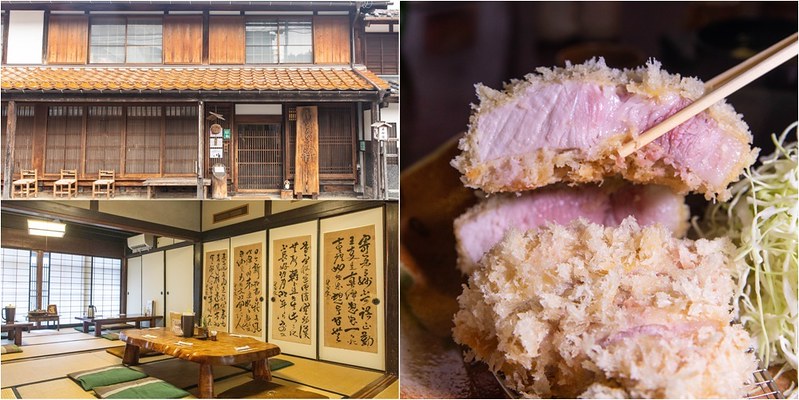
Tonkatsu Shin in Wakasa is tucked inside a century-old traditional house. Its pork cutlet uses local Yoshikawa pork, pairing historic atmosphere with local ingredients.
Tonkatsu Shin (
Official website
): 298 Wakasa, Wakasa-cho, Yazu District, Tottori Prefecture. Tel: 0858-71-0002. Hours: 11:30–14:00 (until 15:00 on holidays; closed Mondays).
At some point, I gradually lost interest in ramen among Japan’s culinary attractions and became increasingly fascinated by tonkatsu instead. A while ago, I saw someone on
Toripy Guides You Around Tottori
share Wakasa’s famous specialty—the cherry-blossom destination’s
Yoshikawa Pork at Tonkatsu Shin
. The beautiful pink color of the pork cutlet genuinely made my mouth water. I rushed there last November, only to find it sold out. Refusing to give up, I planned another trip on the Wakasa Railway this February. One taste was indeed astonishing, so I immediately added it to the itinerary for this April’s
小虎吃貨團
second Tottori Michelin and cherry-blossom tour.
Japanese railway fans describe the Wakasa Line as a hidden gem that must be ridden, especially when cherry blossoms are fluttering through the air. Opened in Showa 5 (1930), it has operated between Wakasa and Koge for nearly a century. There is much I want to write about the Wakasa Railway. I hope our 小虎吃貨團 trip in April can photograph spectacular scenes of the cherry trees in full bloom so I can share everything together. Today, I will start with my favorite among Wakasa’s restaurants and old establishments:
.
Wakasa Station, the terminus of the Wakasa Line, still retains its entirely wooden exterior and is registered as a Tangible Cultural Property. Its interior and the Wakasa Showa train were renovated in 2018, filling the place with an antique atmosphere and nostalgic design. Through the wooden station’s windows, you see Wakasa’s simple rural character, while cherry-blossom season brings its famous flurries of petals. The station also serves Wakasa Coffee, now popular across western Japan. We will save all of that for a later installment of “One Station, One Cup of Coffee—Japan.” This time, Uncle Tiger is hungry. Thump, thump, thump.
Four hundred years ago during the Warring States period, Wakasa was the castle town below Wakasa Onigajo. Its streets still preserve the character of an Edo-period castle town, but because two major fires struck during the Meiji era, the old buildings restored today mostly date from after Meiji 18 (1886).
When I visited last November, I photographed the hidden autumn foliage at Wakasa Shrine. Given the opportunity, I will properly share the beauty of Wakasa’s four seasons.
Wakasa is not large, but it has a remarkable number of venerable and excellent shops. Small yet complete, it is an old town well worth exploring slowly. Based on my current progress, I could probably write another five or six articles beyond this tonkatsu restaurant. If I include places I want to revisit, such as Wakasa Onigajo and the three great Fudo Myoo temples, producing ten articles should not be difficult.
For example, I also love the seared mackerel chirashi-sushi box, a Wakasa specialty at Yamaneya in front of the station. Then there is URUWASHI JAPANESETEA’s matcha latte, nearly the best I have personally had in Japan. I will introduce them one by one.
Tonkatsu Shin has an exterior full of the atmosphere of an old Edo-style Japanese house. The building once served as a kimono shop and a hospital, and parts of it burned in two major fires during the Showa era. After several renovations, it became Wakasa’s Rest and Exchange Center, open free of charge for visitors to take a break.
Today it is a revitalized traditional-house restaurant occupied by Tonkatsu Shin, founded in Heisei 24 (2013).
Tonkatsu Shin uses an on-site reservation list, opening registration to visitors at around 10:30. It accepts at most six parties every half hour, but may close early if everything sells out. If possible, eat early—the first arrivals win.
The front section serves as a free rest area for visitors.
Inside is a tatami dining space even more antique and atmospheric than the exterior, and I absolutely loved it. Fortunately, we registered as the first party to enter. With the restaurant’s permission, and on condition that we not photograph other customers, we were able to take pictures of the empty room. Anyone wanting interior photographs should register early and enter at an early time.
Wakasa is a well-known scenic area not only in Tottori but across the entire San’in region, so many television programs and celebrities have visited for reports. At the lower right is a flyer for the program broadcast by Taiwan’s GoldSun TV as Touring All of San’in GO!, now titled Nama Tamago Bang. When I came last autumn, I happened to encounter the crew filming here and even ended up in their footage.
As its name suggests, Tonkatsu Shin specializes in pork cutlets, which are almost its only main-course option. Besides tonkatsu set meals, it offers lacquered-box meals and katsudon. Usually—and I mean usually—I go straight for the most expensive item. Next time I want to buy a tonkatsu bento.
The restaurant also serves local sake centered on Tottori and Wakasa. The most famous brewery in Wakasa is naturally the century-old
Ota Shuzo
, founded in the town in Meiji 42 (1909). Its label Benten Musume is famous not only in San’in but throughout Japan. This particular bottle is even more special because its logo depicts Wakasa Onigajo, one of Japan’s Continued Top 100 Castles in Wakasa. Later, we also
bought a bottle as a souvenir. Naturally, the sake was delicious. Ota Shuzo is even one of my three favorite breweries in Tottori.
The thick-cut pork-loin set costs 2,680 yen. The plate is enormous, and the breadcrumb coating is rather pale and light, with individual crumbs clearly visible.
It comes with rice, cabbage, soup, side dishes, and three dipping sauces. Salad dressing, tonkatsu sauce, salt, and other seasonings are available on the table. The rice, pickles, and soup were all delicious too, but I was completely captivated by the pork cutlet and forgot to take photos.
“Yoshikawa Pork, I will remember you.” That was my reaction when I took the first bite. I then used every adjective I knew to describe delicious food, including my usual expression, “absurdly delicious,” and even something a level beyond that. Wearing the same enraptured expression, my companion asked whether it was the best tonkatsu I had eaten in Japan. I searched my memories of Marugo, which had once electrified me just as powerfully, and awarded them equal scores. If we compare only the coating, Marugo may be very slightly better. That takes nothing away from Tonkatsu Shin’s similarly crackling crunch. If forced to distinguish them, I would point only to the fragrance of the frying oil. Yet perhaps because the coating’s aroma does not demand all the attention, the incredibly pink Yoshikawa pork displays an intoxicating sweetness. The fatty edges in particular briefly made me think it was unbeatable. Every bite filled me with happiness. It was outrageously delicious. Even after finishing one large cutlet, I still wanted more and wished I had ordered another. Next time, I will definitely add extra meat.
Before this, the best tonkatsu in my heart was
【One of Tokyo’s Michelin-Recommended Tonkatsu Restaurants】Marugo: One of Tokyo’s Five Great Pork Cutlets
The pork box costs 1,580 yen, or 1,780 yen for extra large. It was actually very good, but its misfortune was that I had eaten the thick-cut loin first, leaving these bites feeling slightly underwhelming. Even so, the blend of sauce and rice was undeniably delicious. Still, as I always say, go straight for the top. You are in rural Japan, after all, and once you leave this village, there is no telling when you will have another chance to visit this restaurant.
I ordered a braised pork-toro rice bowl after the official website described it as a rare cut. The sauce leaned sweet, with a mild saltiness that cut through the richness. The cubed pork belly carried abundant fat and melted in the mouth, making it very tasty. I thought this meat would be wonderful in a gua bao. Eaten on its own, however, having too much inevitably becomes a little rich.
Source: 小虎食夢網 | Original URL: https://www.foodtigertw.com/blog/posts/3050775184
Where would you stay for this story?
This is a stay-recommendation demo. Partner links will be enabled after confirmation.
Kaike Onsen and Tottori stays
Choose an onsen inn, city hotel or stay area that fits the article context.