
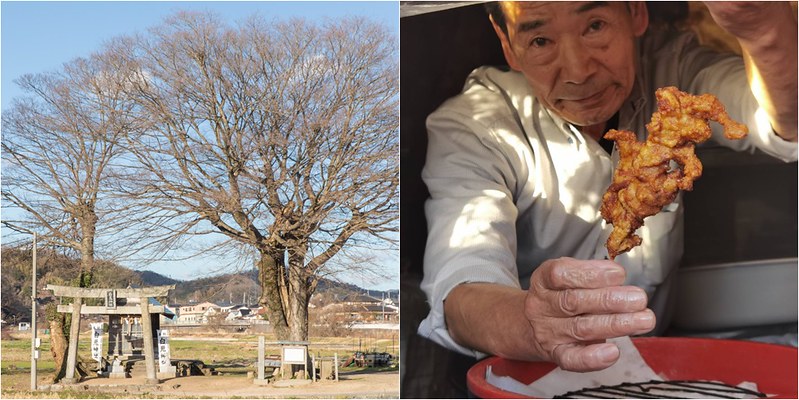
Plan a short walk around Koge Station: pick up 100-yen fried chicken at Shoryuken, then visit Fukumoto Hakuto Shrine, home to another version of the White Rabbit legend.
Shoryuken: 662 Koge, Yazu-cho, Yazu-gun, Tottori Prefecture (in front of Koge Station). Hours: 3:00 p.m.-8:00 p.m. (closed Mondays)
I suppose I am the kind of traveler who does not enjoy doing much homework. Sometimes I like traveling without too many fixed objectives, and I can always have fun even when I follow my whims and change the itinerary at any moment. On my recent four-day, three-night trip, my twelfth visit to Tottori, I made a simple itinerary because I was bringing some fellow bloggers along. In the end, however, we did not follow most of it.... Koge Station had never been part of my plans, and I had never imagined getting off there, yet I ultimately encountered two Tottori legends. Tottori always has people, events, and things you could never anticipate. Or perhaps no amount of research can equal even one ten-thousandth of what you witness with your own eyes. Is that the true meaning of travel? Right or wrong, how about a skewer of fried chicken that draws a line and costs 100 yen?
Koge Station is the first major station after leaving Tottori Station on the Chizu Line, and it is also the starting point of the Wakasa Railway. Our original plan that day was to visit Wakasa during the day and Kawahara Castle in the afternoon. We had so much fun in Wakasa that we ran late, but it was still a little too early to return to Tottori, so we made a last-minute decision to get off at Koge Station for a one-hour whirlwind visit. That was how the two legends began to unfold.....
For the return trip that day, we rode the Hayabusa train, a collaboration between the Wakasa Railway and Suzuki Motor Corporation. Please allow me to keep the details of the Wakasa Railway a secret for just a little longer..........
After getting off, we found that the station was not large, but it was very attractive and comfortable. On the second floor was an observation area resembling a small library, with a view of the distant mountains and the tracks nearby. It was quite soothing.
"Hakuto Shrine?" my friend asked. "Isn't that near the Tottori Sand Dunes?" That was what I thought too, since I had been there three or four times...... Yet this station also sold White Rabbit rice and had a varied, plentiful selection of White Rabbit souvenirs. The wall even called the area the home of the White Rabbit legend. I suddenly wondered whether this might be the true birthplace of the myth. Out of curiosity, I looked it up, and what I discovered turned everything upside down....
It turns out that Tottori has many different "White Rabbit legends," and even the great deity in each story is different. Only the matchmaker is always a white rabbit, while the general plots are similar. This aroused my curiosity. After all, I had visited Tottori twelve times without knowing even this, and I might be laughed at in the future.....
Yazupyon is Yazu Town's rabbit tourism ambassador. Hayabusa Station in the town is a popular sacred destination for motorcyclists, so Yazupyon wears a motorcycle racer's suit. We will save that story for the next installment too....
After leaving the station, I checked and found that the local White Rabbit shrine was about a fifteen-minute walk away. Only then did I learn that it had its own name: Fukumoto Hakuto Shrine.
Tottori has no World Heritage Sites, but it does have four Japan Heritage designations. Unlike World Heritage, Japan Heritage uses stories to connect cultural properties and the people, events, and things of historical, cultural, and inherited significance in different places. The story that includes the Kirin Lion Dance is titled "Stunning Scenery and Hidden Places Born of the Sea Winds: Inaba and Tajima, the Land Where the Kirin, a Sacred Beast That Brings Happiness, Dances." Like World Heritage Sites, Japan Heritage stories can cross prefectural borders. The Japan Heritage area known as Kirin no Machi covers eastern Tottori Prefecture (Tottori City, Iwami, Wakasa, Chizu, and Yazu) and parts of Hyogo Prefecture (Kami and Shinonsen). The Kirin Lion Dance is an important folk cultural property passed down in this region, and the area inhabited by the sacred kirin is known as the Kirin no Machi region. That is enough of this good story for now; the rest can wait until next time....
Yoshimi Furui was a prominent politician born and raised in Yazu District who made major contributions to both national and local government. He received the Grand Cordon of the Order of the Rising Sun in 1982 and was named an Honorary Citizen of Tokyo in 1993. He died in 1995 at the age of ninety-two, and the bronze statue in front of the station was erected five years after his death.
The white rabbit in front of the station looks a little different from the one at the Hakuto Shrine most people know.
For the more widely visited Hakuto Shrine, please see the article I shared in 2017:
[Tottori Attraction] Give Your Love Life a Helping Hand! Hakuto Shrine, with Bus Transportation Guide, and a Souvenir Guide to the Mythical Village of the White Rabbit Roadside Station
Just as we were following Google Maps and about to cross the road, we saw several people packed together in a line outside a tiny building in front of the station, less than one tsubo in size. We went over out of curiosity and were suddenly surrounded by the aroma of fried food. Clearly something special was happening, but the sun looked eager to clock out, so we decided to try it if the shop was still open when we came back.
"Surely the heavenly immortals were wildly drunk, shredding the white clouds to pieces." My love of watching clouds may have begun with this line from Li Bai's poem Qing Ping Yue. Country mountains and white clouds in particular compose a piece of music without sound.
Fukumoto Hakuto Shrine stands on an almost deserted riverbank. There is only a little bridge over flowing water and field after field of harvested rice paddies. One breath of the fresh air seems able to extend your life by a year, like Sun Wukong greedily eating the Queen Mother of the West's peaches of immortality.
Beside the shrine is a stone monument whose writing has become almost illegible. Only the two characters for "white rabbit" can faintly be seen, and it looks very old. According to the sign next to it, the monument is an artifact from around the ninth century (a stone monument from when a shrine was founded around 840, during the reign of Emperor Ninmyo). It was unearthed among nearby kofun burial mounds. Many other artifacts were discovered at the same time, supporting the local White Rabbit legend. There are three White Rabbit shrines around Koge, collectively known as the Yagami White Rabbit Shrines.
Only after looking more deeply did I learn that Yazu Town has not just one White Rabbit shrine, but more than ten....... Each shrine even has its own distinctive rabbit. In simple terms, the familiar Hakuto Shrine tells the myth of a white rabbit bringing together the deity Okuninushi and the beautiful Princess Yagami. The White Rabbit shrines here, however, tell of the descent of the sun goddess Amaterasu. While she was troubled over where to find a temporary palace, a white rabbit appeared and guided her here.... In that case, though, these White Rabbit shrines do not seem to have much to do with romance...... The more I investigated, the more confusing it became. In any event, Japan has many legends about white rabbits. They are not limited to Tottori, but also appear elsewhere. The best known is the "Rabbit and Waves" motif passed down since the mid-Edo period, and it even appears in songs.
What sort of story might belong to the tiny shrine beside Hakuto Shrine?
I could not find this shrine's offering box, but unexpectedly spotted a wooden tray piled with coins behind a cracked glass window. It brought an involuntary smile to my face.
I hope I will have another opportunity to dig into more of Tottori's White Rabbit legends and share them with everyone.
It was close to five in the afternoon when we returned to Koge Station. I later asked the owner and learned that the stall stays open until eight, although it closes early if everything sells out.
After reading one news report and looking up more stories online, I learned that this fried-chicken grandpa was not only a legendary local celebrity, but had also appeared in quite a few newspapers and magazines.
These three characters form the shop's name, Shoryuken, though I could not read them at all.... According to reports, the old gentleman had spent more than twenty years selling just one item, always for 100 yen without ever raising the price. So what was it?
The menu board says "Nani kore!" Literally, that means "What's this?" Besides being a joke, Japanese people may also say "Nani kore!" with a surprised expression and tone after tasting something delicious. It is like saying in Chinese, "What is this, and why is it so good?" If you often watch Japanese food and travel programs, you are probably familiar with the expression. All right, then what had this stall been selling for twenty-two years...?
Karaage. For more than twenty years, this small stall has sold only fried chicken. Its version is a little unusual because it comes on bamboo skewers. Until the day before our visit, every skewer had always cost just 100 yen. From February 27, 2024, the day we arrived, the price became 150 yen per skewer, but there was still a long line...because 150 yen is still cheap.
Japanese karaage is usually cut into chunks, but this man's chicken is shaped more like the fried chicken fillets found in Taiwan. He marinates it with his own method, coats it in flour, threads it onto a bamboo skewer, and then lowers it into the fryer.
Once fried, the skewers are placed on a tray like this to drain off a little oil. The fragrance fills the entire area, and someone on the spot bought twenty skewers at once.........
As I recall, he sprinkled on three powders altogether: pepper first, curry powder second, and a third seasoning that probably contained salt.
Here is a video that went viral online. Supposedly, on one occasion the old man was afraid that some students would be late for class, so he reached straight into the hot oil with his bare hand to grab their fried chicken.... After the story spread online, many media outlets asked him to demonstrate his "Iron Sand Palm" skill........ That day, when we told him we came from Taiwan, he immediately rolled up the clear plastic curtain and showed us his astonishing bare-handed dip into the fryer. Sadly, we were too shocked to record it, but fortunately there is an interview video from a media outlet online. I laughed so hard.....
As for whether it tastes good, honestly, it is delicious. It is inevitably a little oily, but eating one or two skewers should be perfectly fine. The curry powder and other seasonings also give it plenty of flavor. A Tottori friend told me that many people drive over specially from Tottori City to buy it as a snack with drinks at home. They say it is vastly better than the chicken at supermarkets and convenience stores; after all, it is freshly fried. Speaking of which, on April's
Little Tiger Foodies Tour,
if time permits, I will bring everyone here to see the old man's Iron Sand Palm too....
The old man said he would close the stall when he turned seventy, but I forgot to ask how old he is now.
Shoryuken: 662 Koge, Yazu-cho, Yazu-gun, Tottori Prefecture (in front of Koge Station). Hours: 3:00 p.m.-8:00 p.m. (closed Mondays)
Source: 小虎食夢網 | Original URL: https://www.foodtigertw.com/blog/posts/3050785128
Where would you stay for this story?
This is a stay-recommendation demo. Partner links will be enabled after confirmation.
Kaike Onsen and Tottori stays
Choose an onsen inn, city hotel or stay area that fits the article context.