
Yakiniku Gyuoh Tottori Main Store focuses on A5 Inaba Manyo beef, with thick-cut beef tongue as another signature. Wagyu lovers should put it high on the list.
Yakiniku Gyuo Tottori Main Store (
Official website
): 1-180 Imamachi, Tottori City, Tottori Prefecture. Tel: 050-5868-6179. Hours:
11:30 a.m.–2:00 p.m.,
5:00 p.m.–10:00 p.m.
When people talk about Tottori cuisine, its crab is naturally the most famous. For someone as obsessed with beef as I am, however, Tottori beef is another choice I never miss whenever I visit. Among the many varieties, my personal favorite is Inaba Manyo beef. Last time I introduced the culprit responsible for making me fall in love with Manyo beef, (
Sumibiyaki Fukufuku
). On my twelfth visit, I took the opportunity to find another restaurant specializing in Manyo beef: Yakiniku Gyuo. Its signature Manyo Beef Negi-Wrapped Beef Tongue is a particular favorite among gourmets who love tongue. Reservations are a little difficult to secure, though, so if you want the negi-wrapped tongue, your best bet is to arrive right when the restaurant opens.
My fondness for Tottori beef easily places it among my top three. Beyond being delicious without excessive greasiness, the biggest point is that compared with the branded beef familiar to Taiwanese diners, Tottori beef is remarkably affordable. At an ordinary yakiniku restaurant, 3,000 yen per person is enough for a very satisfying meal. Even with the highest-grade Manyo beef, around 5,000 yen per person including alcohol can leave you too full to stand. Yakiniku Gyuo has long attracted plenty of discussion in the Facebook group (
Toripy Takes You Around Tottori
), although people from Tottori think it is a little expensive, ha. It is in the prime area around Tottori Station, and the walk from nearby hotels should take no more than ten minutes. We arrived at around 6:30 that evening, but there were no seats, so we waited roughly half an hour. On our way out, we met some Chinese friends who insisted that we had to eat the (
Manyo Beef
Negi-Wrapped Beef Tongue. In her words, it was “a taste of heaven.” She said she had eaten it more than ten times but still wanted it every night. There really are quite a few Chinese people in Tottori, especially people from Hong Kong.
Like other prefectures famous for wagyu, Tottori has an umbrella term for beef named after the prefecture, Tottori beef, and naturally also has local brands such as Inpaku beef, Tohaku beef, Manyo beef, and Hakusha beef. Another personal favorite is (
Daisen Kuroushi-dokoro Kyoshotei
), Tottori's only Michelin-listed yakiniku restaurant, which became popular enough to open a Hong Kong branch. Besides these two restaurants, I have probably eaten yakiniku at about ten places in Tottori, and virtually none disappointed. The main difference is simply a price gap of 2,000 to 3,000 yen. (
Yakiniku Masashige
) is among the better-value options. Perhaps I will have a chance to write a complete guide to yakiniku in Tottori, ha.
There is a saying in Japan that all wagyu arose through crossbreeding with Tajima cattle. Ketaka-go, considered in Tottori to be one of the founding animals of Japan's first wagyu line and said to have sired more than 9,000 offspring, was a Japanese Black carrying Tajima blood. Every Manyo animal served at this restaurant comes with complete identification showing its sire and dam, the farm where it was raised, the name of its breeder, and more.
The dining room mainly has four-person tables, about eight in total across both sides. Each one is separated by a black fabric curtain, creating something like a private booth. However, the staff kept raising and lowering the curtain whenever they brought an order. I do not know why, but compared with simply closing a door, it felt rather... For me, perhaps it would be better not to lower the black curtain at all.
You order by scanning the QR code on the table with your phone. In addition to the soy-based sauce and sesame oil provided, the table has rose salt, matcha salt, and minced garlic. Although I rarely dip the meat in much, the matcha salt is genuinely excellent. When eating a lot inevitably starts to feel greasy, the minced garlic is also a visually vivid lifesaver.
Yakiniku absolutely requires two things: white rice and draft beer. Since falling in love with sake, however, my second drink is usually a local brew. Naturally, this place offers many excellent Tottori sakes, all under 1,000 yen. Drinking sake in Japan is truly good value, especially in a more rural place like Tottori. That day, we ordered Takaisami, brewed from Tottori's Goriki sake rice by Otani Shuzo, my favorite brewery in the prefecture.
Detailed menu
Drinks menu
Article about the actual visit:
Japan, Tottori – Food and Local Sake: Otani Shuzo (Takaisami), 150 Years of Tradition, a Prime Minister, Shohei Ohtani, and Hidetoshi Nakata
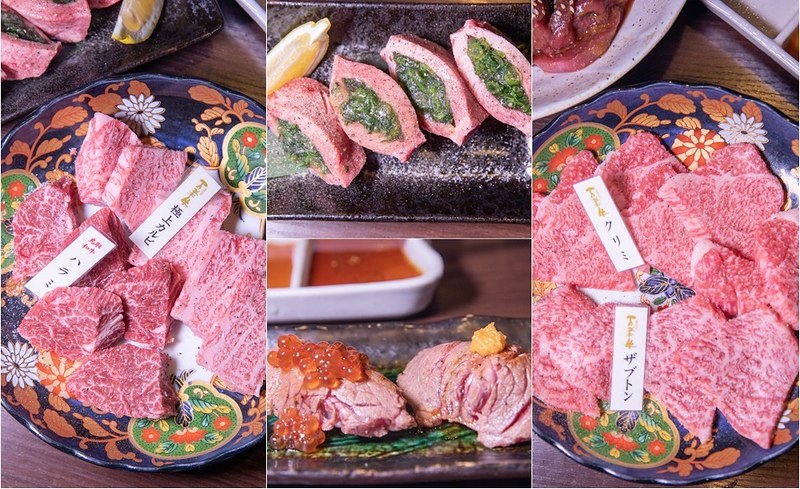
Besides yakiniku, the restaurant's wagyu nigiri is also quite popular, so we ordered one combination with salmon roe and another with sea urchin. The conclusion: they were delicious, but the beef alone would probably have been delicious enough. With combinations like these, I sometimes feel that the visual impact exceeds the flavor, yet seeing them still makes them irresistible to order.
After ordering the signature Manyo Beef Negi-Wrapped Beef Tongue shown above, a server soon came over to tell us it was sold out. We therefore ordered the second most popular beef-tongue dish. All right, this one was also meat wrapped with tongue, just not quite as cute. Only later did we discover that it was more expensive because the tongue was cut thicker. Honestly, this tongue ranks among the three most satisfying I have ever eaten, both visually and in flavor. Stuffing salted scallions inside a thick, split piece of tongue creates an entirely different sense of fullness in the mouth. The tongue's snap, the fat released toward the end of each chew, and its sweet aroma all become more dimensional. The packed chopped scallions seemed to have been dressed with a little sesame oil, slightly easing the richness while bringing out the complete finish of tongue with salted scallions. I could eat five or six pieces by myself.
To begin, we ordered the premium Manyo beef kalbi, the restaurant's signature heavily marbled cut, and thick-cut Tottori wagyu harami, or diaphragm, to try.
The premium Manyo beef kalbi has ample fat and excellent sweetness. It does not vanish the moment it enters the mouth; instead, it slowly melts, slowly grows rich, and slowly turns sweet in a wonderful rhythm. Calling it insanely delicious is entirely justified. With ordinary wagyu, fatty cuts such as kalbi usually shrink considerably as fat renders during grilling, but this seems less obvious with Manyo beef, almost as though you are getting a bargain. I wonder whether this relates to Olein 55, highlighted in recent promotions for Tottori wagyu: 55 percent oleic acid, said to be easier for the body to digest and less likely to be excessively stored as fat.
The thick-cut Tottori wagyu harami is diaphragm. Japanese yakiniku generally separates the diaphragm into inner and outer portions, and harami usually refers to the side closer to the organs. It has a subtly appealing, deep offal sweetness, one of the main reasons I love it. It is unusual, however, to see the cut this thick. Harami can have a resilient texture that demands some chewing, but this piece had no such problem. Even at this thickness it was as soft and tender as loin. Seasoned only lightly with salt and pepper, it grilled into a surprisingly wonderful texture and flavor. I adored it.
Next came two more Manyo beef cuts: premium zabuton shoulder and kurimi from the upper foreleg. These are more finely divided cuts that vary by restaurant and do not appear at every yakiniku place. Both have evenly distributed fat, delivering its aroma without cloying sweetness. Comparatively, kurimi has finer marbling and more tender meat, but both were undeniably, outrageously delicious.
Besides Tottori wagyu, one thing I never miss in Tottori is Daisen chicken. It is said that Daisen chicken's reputation in Japan far exceeds that of Tottori beef and is not at all overshadowed by Tottori crab. It is one of Japan's representative premium local chickens. This time we ordered thigh meat. Although cut into cubes, it was not at all awkward to eat. It was not overly fatty, yet its sweetness lasted. The tender qualities of Daisen chicken came through in every bite.
For horumon, or offal, we ordered a five-item assortment: shimacho large intestine, marucho small intestine, teppo rectum, mame beef kidney, and reba beef liver.
The shimacho large intestine was extremely fatty, immediately sending flames flying when it hit the grill. Its compelling aroma and rich, mouth-coating fat made it very delicious. The marucho was a little thick and somewhat difficult to bite through.
The mame beef kidney was similarly a little too tough to chew, and its flavor was rather strong. I truly could not handle it, hiding my face. The reba beef liver, on the other hand, was extremely, exceptionally tender. I liked it.
Source: 小虎食夢網 | Original URL: https://www.foodtigertw.com/blog/posts/3050786280
Where would you stay for this story?
This is a stay-recommendation demo. Partner links will be enabled after confirmation.
Kaike Onsen and Tottori stays
Choose an onsen inn, city hotel or stay area that fits the article context.