
URUWASHI JAPANESE TEA, tucked in the mountains of Wakasa, serves freshly whisked matcha, grilled monaka, and dango. It makes an ideal afternoon stop.
URUWASHI JAPANESETEA (
Instagram fan page
): 379 Wakasa, Wakasa-cho, Yazu District, Tottori Prefecture. Tel: 070-2361-0369. Hours: 10:00 a.m.-5:00 p.m. (closed Mondays and Tuesdays)
If I had to recommend one place in Tottori besides its three major cities, Tottori City, Kurayoshi, and Yonago, and Kitaro's Sakaiminato, I would of course choose Wakasa. I might even choose the entire Wakasa Railway line. Although I have visited only twice, given another chance I would explore the whole line from end to end and eat my way along it too. This is the third installment in my Wakasa food series, following
Tonkatsu Shin
, home to Tottori's best fried Yoshikawa pork cutlet, and Yamaneya, which specializes in yakisaba-ju, a Wakasa specialty and one of Tottori's three great mackerel dishes. I personally rank this among the top three matcha teahouses in Tottori, perhaps even in all of Japan. Call it a teahouse or cafe as you like. Its Japanese sweets, made fresh to order, are also excellent.
The Wakasa Railway opened in Showa 5 (1930) and now has nearly a century of history. It is one of Tottori's lesser-known cherry blossom destinations. I expect to write five or six features on the small town of Wakasa alone. After taking the
Little Tiger Foodie Tour
there to see the blossoms in April, I also plan to write an overall guide. And that covers only Wakasa itself. The Wakasa Railway has nine stations in total, and I want to find time to explore the entire route properly. Hayabusa, for example, is described as a pilgrimage stop for Japanese motorcycle enthusiasts. Koge, the starting point of the Wakasa Railway and the setting of another Tottori white-rabbit legend, is also a small town that deserves a deeper visit.
Wakasa was once one of Inaba's three renowned castle towns, built below the 800-year-old Wakasa Onigajo Castle, which dates to 1200. It still retains Edo-period streets and numerous old buildings renovated repeatedly during the Taisho and Showa eras. Wakasa became an administrative town when the municipal system took effect in 1889. I will save the many details of this charming little town for a dedicated article later.
URUWASHI JAPANESETEA was enthusiastically recommended by my Tottori friend Mr. Ishida when he learned I was going to Wakasa. He said that every visit to Wakasa was for
"
" and that he would always stop here for matcha or coffee and a Japanese sweet. Afterward, he would go to Ota Sake Brewery to buy a bottle of Wakasa's Benten Musume sake, then purchase a Benten manju from Benten Manju Honpo, another century-old Wakasa institution. I followed exactly the same routine on both of my trips to Wakasa. I will be writing about those two places in future installments of the Wakasa food series.
The shop is not large. The counter to the left of the entrance seats about five or six people and gives them a close view of the surprisingly young owner whisking tea with style. Farther inside is a tiny seating area with two chairs. It is the only choice for an undisturbed conversation, although it is a little cramped.
Besides the fine tea served in the shop, customers can buy tea from different parts of Japan to take home. There are even Chinese and Taiwanese teas. The miso, soy sauce, and other ingredients used in the shop appear to be regional specialties, while the owner's preferences and standards extend to cups, plates, and other vessels. Curious, I chatted with him. If I understood correctly, he is also from Wakasa. After returning home, he wanted to establish a local Wakasa tea brand and do something for his hometown.
Over the following years, even the pandemic could not bring the shop down. It gradually made a name for itself, attracting media from around the San'in region and television crews from much farther away. It has become one of the businesses representing Wakasa food and tourism. The touching part came when I brought friends on my second visit: the owner actually remembered me. The moment I walked in, he said in Japanese, "This is your second visit, right?"
By coincidence, my first visit took place while a program translated in Taiwan as "Travel All Around San'in GO!" and now called
Nama Tamago Bang
was filming there. That episode was hosted by Shinji Yamane, and I unexpectedly ended up in the shoot. I do not know whether I was cut from the final program (laughs). As a fan of the show, I naturally asked if we could take a photo together.
The menu is basically two sheets, one for drinks and the other for Japanese sweets. The ingredients are all good, so the prices may be slightly high by Tottori and Wakasa standards.
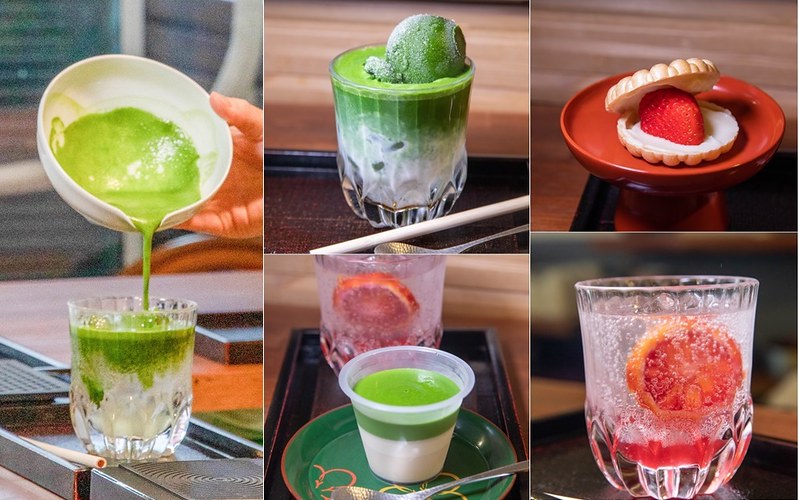
This iced matcha latte was made by the owner for Shinji Yamane during my first visit. The price differs according to the matcha powder used.
On that first visit I ordered a matcha beer, the drink that drew me into the shop. The owner did not begin whisking the matcha with hot water until after I placed the order, then poured it into the beer. The beer had the mild bitterness of hops, while the freshly whisked matcha was full of its own bitter fragrance. Put together, the two bitter flavors became a layered bitterness that changed from the first taste through the finish. One was cold and the other hot, and their aromas were different too. Their interaction in my mouth was unmistakably intriguing. I nodded slightly as I drank, so visibly satisfied that the owner kept smiling at me.
On my second visit I ordered a matcha latte. The owner first poured fresh milk from Mount Daisen in Tottori into a glass filled with ice.
Then he whisked the matcha by hand. On my second visit, I felt that I knew the owner better. I asked to record him and he readily agreed, giving me a video of the tea being whisked to order. Honestly, the fragrance filled the whole room while he worked.
He poured the whisked matcha into the Daisen milk, then placed a large scoop of matcha ice cream on top.
The matcha ice cream was a little firm but exceptionally rich, with a faint bitterness and astringency that tasted wonderful. The matcha latte itself was just as deep and full-bodied. The richness of Daisen milk added a slight sweetness that softened the bitterness. Almost every sip made me shout silently, "This is absurdly good." The ice melted as I drank, and so did the matcha ice cream on top, keeping the drink just as fragrant from the first sip to the last. If I called it the best matcha latte I have ever had, I could not readily think of a second cup to challenge it.
With a matcha latte that good, the matcha panna cotta was naturally no lightweight. I ordered it on both visits, and it was just as delicious each time. Matcha lovers need to try it......
On the second visit, my friend ordered a Shiranui citrus soda. A little jam at the bottom added flavor. The citrus aroma was refreshing and the bubbles pleasant. It would be a good choice for someone who dislikes coffee and cannot drink much tea.
I ordered grilled dango during my first visit. These too were grilled to order. The soy sauce was slightly sweet and a little thick, while the dango had been grilled until lightly charred and was exceptionally chewy. They were apparently made with glutinous rice from Wakasa. Both the flavor and texture were satisfying.
On the second visit, I ordered a strawberry monaka. Even its wafers were toasted in front of the customer. Watching the owner's eyes stay fixed on the heat was a pleasure in itself.
Anyone who has visited Japan knows the quality of Japanese strawberries, so I will say no more about that. The filling underneath was the buttercream often used in traditional wagashi, but it tasted more refreshing, and there seemed to be a little dried fruit inside. The freshly toasted monaka wafer was the remarkable part. It was unbelievably crisp and still carried the warm aroma of the grill. I had never encountered that at any of the more than one hundred monaka shops I have tried.... It was astonishing, and so delicious.
Next I ordered isobeyaki, also called isobe mochi. Many people now translate this as soy-grilled rice cake wrapped in seaweed. As far as I know, however, it can be translated as grilled rice cake only when mochi appears in the name, as in isobe mochi. Isobeyaki by itself refers broadly to any food wrapped in seaweed. The item here was clearly
isobe mochi. Both the nori and rectangular rice cake were toasted by the hearth after the order was placed, then assembled.
Perhaps because the nori was freshly toasted, its presence was stronger when eaten. It was crisp, and its aroma stood out without losing at all to the soy sauce. The grilled rice cake was crisp outside, soft and chewy inside, with a slightly sticky bite. The salty fragrance of the soy sauce was the heart of the dish, and it smelled incredible.
When I praised the aroma of the soy sauce, the young owner made a point of showing me the bottle he used. I knew nothing about it at the time, so I looked it up. Yuasa in Kishu, Wakayama, is said to be the birthplace of Japanese soy sauce. The name Rosanjin refers to the sauce favored by Kitaoji Fusajiro, better known as Rosanjin, a famous Japanese cook and gourmet. Its standing is comparable to Kinzanji miso or wasanbon sugar. Since 2012, Marushin Honke of Yuasa Soy Sauce has released a special Rosanjin Soy Sauce every year to commemorate Rosanjin, whose love of soy sauce was legendary.
): 379 Wakasa, Wakasa-cho, Yazu District, Tottori Prefecture. Telephone:
070-2361-0369.
Hours: 10:00 a.m.-5:00 p.m. (closed Mondays and Tuesdays)
Source: 小虎食夢網 | Original URL: https://www.foodtigertw.com/blog/posts/3050789044
Where would you stay for this story?
This is a stay-recommendation demo. Partner links will be enabled after confirmation.
Kaike Onsen and Tottori stays
Choose an onsen inn, city hotel or stay area that fits the article context.