
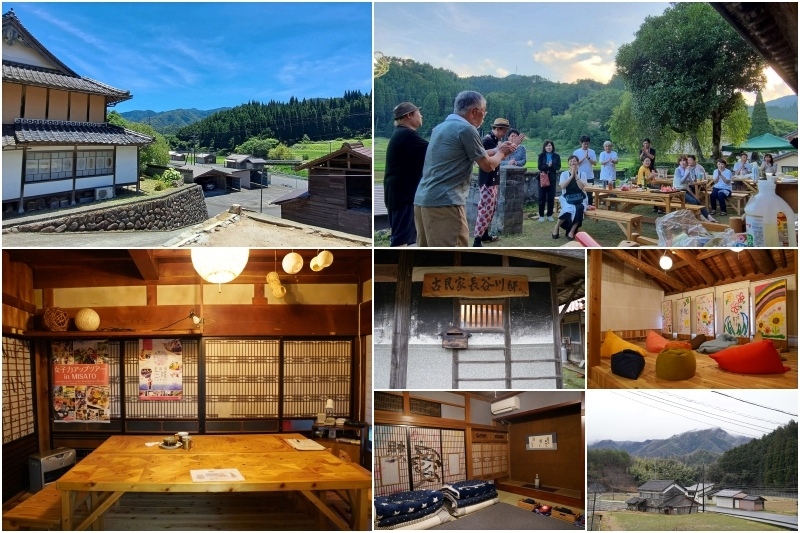
Hasegawa Residence in Mochigase was built in 1936 and restored over 10 years by many hands. It is a good place to experience Tottori's quiet rural life.
Mar
Mon
Japan Accommodation | Tottori: Kominka Hasegawa-tei—spending a night in rural Mochigase in a simple old folk house restored over ten years through everyone's combined efforts
"I'm home."
The moment Mr. Yasuzumi slid open the front door, warm yellow light welcomed us. I could not help saying in my heart, "Tadaima—I'm home!"
Of all the programs on Japanese television, my favorites are shows about spending a night in the countryside or living self-sufficiently. Rural Japan is the scenery I love most, and being able to live there for a while would be one of my greatest wishes in life.
So, when I set foot in Japan again after more than three years, I chose to begin my trip with a stay in the Tottori countryside.
After leaving Okayama Momotaro Airport, going to Okayama Station, making transfer after transfer, and passing unmanned stations along the way, I finally arrived at
"Kominka Hasegawa-tei."
That night felt like visiting Grandma's house in the countryside. Even in the chilly six-degree weather, I happily ate a crab bento and a Momotaro bento. My first day in Tottori was wonderful!
Mr. Yasuzumi, who welcomed us, was truly adorable. Sweating profusely, he asked a Chinese-speaking woman living in Korea to interpret online, all so we could understand every part of the house more clearly. If I fall in love with Tottori, he will certainly be the first reason why!
Kominka Hasegawa-tei
278 Yazu, Mochigase-cho, Tottori City, Tottori Prefecture, Japan
Fan page
Reservations: official website
View a larger map
Revitalizing the community and giving an old house new life!
Kominka Hasegawa-tei stands in the hilly countryside of Mochigase, Tottori Prefecture. It is a traditional Japanese house built in 1936. It was originally the home of a man in his nineties. Because the house was large and he could no longer care for such a big property in his old age, he asked Kazuhiro Toritani, a professional hairstylist, to help give the old residence a new life.
(Image /
Courtesy of
Kominka Hasegawa-tei)
Warmhearted Mr. Toritani gathered a group of like-minded partners and spent ten years renovating the house. He then carefully planned kimono experiences, hairstyling shows by professional stylists, concerts, and other distinctive events held from time to time, such as making dolls for the nagashibina floating-doll ceremony.
(Note)
Every year on the third day of the third lunar month, the Mochigase area observes the custom of nagashibina. Dolls are floated down the Sendai River to pray for freedom from illness and misfortune, happiness, and joy throughout the year.
More videos about the old folk house
Click here (video source /
Tour Tottori with Toripy
https://www.facebook.com/watch/?v=998261620804961
▲On the left, the person in the floral
trousers is Mr. Toritani,
and the man in yellow shoes is Mr. Yasuzumi.
(Photo /
Kominka Hasegawa-tei in a purely Japanese style.
NPO Green Tourism Mochigase also spares no effort in protecting the environment,
carefully maintaining and looking after every brick and tile.
In the latest update,
the tree in front of the house—
a weeping plum—was blooming as spring approached.
It is truly exciting to anticipate scenery like this.
To reach
the property, driving is more convenient.
By public transportation, get off at Inabasha Station on the JR Inbi Line, then transfer to a bus for about 15 minutes.
▲The shelter with the white roof
and blue color scheme is the bus stop.
Accommodation at Kominka Hasegawa-tei can be booked as a six- or twelve-hour whole-house rental, or charged by the person. There were two of us on this visit. It was 8,600 yen per person, or 17,200
yen in total (about NT$3,600),
paid in cash.
*Accommodation for elementary-school-aged children and younger is discounted by 1,000 yen.
*Up to six people can stay. For groups of seven or more, please contact the representative, Mr. Kazuhiro Toritani.
*The country-cuisine plan and girls' night-out plan are not currently available.
A kitchen and refrigerator are provided.
Guests are welcome to bring food and enjoy a picnic.
For safety reasons, cooking over a flame is not permitted.
The rural scenery of Tottori is truly beautiful!
▲It was already night when we arrived on the first day, so we could not see the surroundings. At a little after six the next morning, I woke naturally without an alarm. Every minute here felt precious.
I first soaked in a hot bath to warm up, then went to the river just across the road
to watch the water surging after the heavy rain.
The morning after the downpour,
the chill of the rainwater traveled from my fingertips to my brain. Ah, this really was not a dream. After a good night's sleep, everything before me suddenly came into focus. I truly was in Mochigase.
Lush green mountains rose in layer after layer.
The mist over them was as beautiful as an ink-wash painting, while a stream murmured before my eyes... With every breath, it felt as though I could hear my lungs cheering loudly, "The air is so fresh—it feels wonderful!"
The bracing air
made every breath feel comfortable,
but I still wanted to soak in a hot bath first to warm up
and prepare for
my second day in Mochigase.
▲Climbing the stone steps, I found an impressive wooden sign ahead, while the long row of eaves and corridors was especially eye-catching. I imagined how pleasant it would be to sit here on a clear night, watching the stars and fireflies, having an outdoor barbecue, and sipping a drink!
Yet the entrance uses a state-of-the-art keypad lock. The contrast between old and new is genuinely fun, and, most importantly, highly practical and secure.
The old folk house, past and present
The old residence before me brings together history and culture, craftsmanship and architecture,
aesthetics and ecology. It is nothing less than my dream home.
In the center of the picture is a wall made of straw mixed with earth, with wood beneath it. You can examine the details of Japanese craftsmanship up close.
More than eighty years of accumulated time
After the heavy rain, the distinctive stillness of the old house was especially pronounced. Entering through the foyer, warm yellow light created the feeling of home. Beyond the comfortable tatami room was the living room, with the guest room at the back and the kitchen and dining room to the left.
On the night we arrived,
we ate our bentos in this dining room,
drank hot tea,
and settled both body and mind.
▲The sliding doors in the living room.
Artwork by children with Down syndrome was specially selected and made into shoji screens. Displayed along the side corridor, they make it the best place in the old house from which to enjoy the view.
Every picture has meaning.
The toilet is on the other side of the entrance, while the changing area and bathroom require walking around the outside of the house. I imagine this arrangement also helps protect the century-old wooden building.
Before entering the bathroom,
which has both a shower and a bathtub,
you pass through a changing area
equipped with an electric heater.
If you plan to bathe,
remember to bring the yukata and towel from your room.
▲Upstairs is another open space. Massive wooden beams, wood floors, and large beanbag chairs make it especially relaxing. A projector and other equipment are also provided to facilitate events.
▲Despite the six-degree temperature that night, my travel companion and I slept soundly. The quilt was thick enough, but even more credit goes to the electric blanket underneath. Warmth rose from our feet, making it hard to leave once we stepped onto it; during the night, I even felt hot enough to kick off the quilt.
▲Two souvenirs from this Tottori trip left an especially deep impression on me. The emotion they stirred could never be measured in money.
On a pouring, four-degree morning, a lightly dressed woman from the neighborhood came by unexpectedly. From what my very limited Japanese allowed me to understand, the lodging's host had told her, "Two women from Taiwan chose to make the long journey here," leaving everyone both surprised and delighted.
She brought a small gift filled with a spirit of welcome. My father taught me from childhood not to accept rewards I had not earned, but how could I refuse someone whose face was full of smiles and who simply wished to express a sincere welcome?
The other gift was
a pound cake prepared for us. Both the orange and chocolate flavors were delicious.
Eating the gifts felt like tasting kohakuto candy: brilliantly colored and translucent, with a texture that surprises you when it enters your mouth—crisp at first, then soft, crunching with the gleeful sensation of breaking something. It was like the four days I spent traveling in Tottori, when I constantly felt the pleasure of stepping outside my usual routine.
If you, too, want a memorable journey through Tottori, to experience the sincerest hospitality, to draw close to this old folk house, the greenery and stream amid the mountains and water, and the man who helps others without asking for anything in return,
Mr. Toritani
(whom we could not meet on this trip because, as a professional hairstylist, he had
gone to Laos to give children free haircuts), then especially as spring approaches
and the weeping plum in front of the house gradually comes into bloom, an unimaginably beautiful view awaits visitors. Kominka Hasegawa-tei is unquestionably worth a visit.
(Second image /
Courtesy of
Mr. Kazuhiro Toritani)
▲After a restful night, we left Kominka Hasegawa-tei with full hearts and continued on to Mochigase.
More Tottori information
Kao Tottori - Kao Life (btplays.com)
Click the image below
Source: 龜毛麗的美食誌 | Original URL: https://grace540102.pixnet.net/blog/posts/4045593612
Where would you stay for this story?
This is a stay-recommendation demo. Partner links will be enabled after confirmation.
Kaike Onsen and Tottori stays
Choose an onsen inn, city hotel or stay area that fits the article context.