
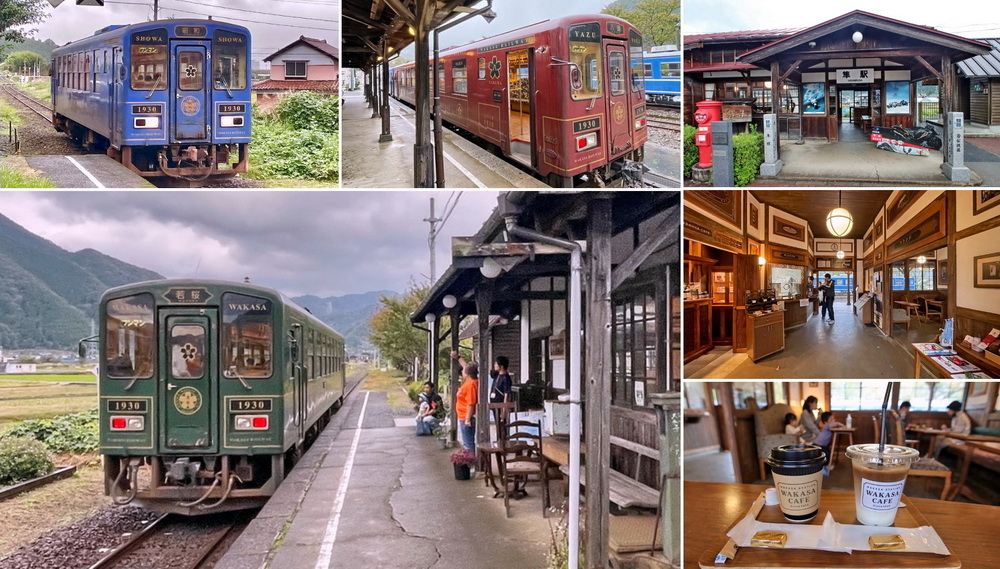
The Wakasa Railway runs retro Showa-style single-car trains through rural scenery, with sights at Koge, Hayabusa, and Wakasa stations. A one-day pass costs 760 yen.
Oct
Thu
Tottori, Japan: Wakasa Railway | A Showa-Style Single-Car Train Racing Through Rural Fields, Visiting Three Major Stations and Station Cafes
#TottoriJapanTravel #JapanRailTravel #ShowaStyleLocalTrain #WakasaRailwayOneDayPass #InbiLine #KogeStation #WakasaStation #HayabusaStation #WakasaRailwayTimetable
Tottori Prefecture has a small railway that opened in 1930 and still preserves the character of the Showa era: the Wakasa Railway. Its one- or two-car trains run through rural fields between Koge and Wakasa, serving nine small stations. Of the nine, only Koge, Yazu-Kokomae, and Tokumaru do not have wooden station buildings. All the others are old wooden stations rich in Showa atmosphere, making this a distinctively nostalgic railway.
Cherry trees are planted extensively along both sides of the Wakasa Railway, and it is easy to imagine the spectacular scenery during blossom season. Yet even outside peak bloom, as when I visited in mid-October, the wooden stations, old streets, mountain cafe, and station cafes at Hayabusa and Wakasa still exude limitless nostalgia and relaxation. The terminal, Wakasa Station, also became a sister station to Neiwan Station on Taiwan Railways' Neiwan Line on January 16, 2020, adding a welcome sense of familiarity to its rustic charm.
▲ A Wakasa Railway train waiting to depart from Tottori Station.
▲ The Wakasa Railway starts at Koge and ends at Wakasa, with nine stations in all. Some services share the JR
Inbi Line tracks and continue to Tottori Station.
▲ Wakasa Railway route map. The yellow section is shared with the JR Inbi Line and has fewer services. Source:
Wakasa Railway Co., Ltd. official website
▲ Wakasa Railway's 2024 timetable. Times shown in italic within a thick black border indicate trains that do not operate on holidays.
▲ Wakasa Railway's 2024 fare table. Source:
Wakasa Railway Co., Ltd. official website
▲ Wakasa Railway one-day pass. I strongly recommend buying one because it can save a great deal of money.
▲ Wakasa Station became a sister station to Neiwan Station on Taiwan Railways' Neiwan Line on January 16, 2020. This poster is displayed by the Wakasa Station exit.
The Wakasa Railway is about 19.2 kilometers long. Its starting point is not Tottori Station but Koge Station, three stops away, although some trains can be boarded directly at Tottori because they share the JR Inbi Line.
One important tip is to buy the Wakasa Railway one-day pass for 760 yen. A one-way trip from Tottori Station to the terminal at Wakasa alone costs 680 yen, so the pass saves a lot. However, Tottori Station sells neither the Wakasa Line one-day pass nor a ticket all the way from Tottori to Wakasa. You can only buy a ticket from Tottori to Koge there.
When departing from Tottori, the least expensive way to experience the line is to first buy a ticket to Koge. Travelers holding a three-day Tottori-Matsue JR PSSS pass for 4,000 yen can ride the JR Inbi Line from Tottori to Koge without buying another ticket and purchase the Wakasa Line one-day pass at Koge. Otherwise, the next opportunity to buy it is at the Wakasa terminal. Some people online say the one-day pass can also be bought aboard a Wakasa Railway train, where ticket staff walk through the cars to check fares, but I am not certain. I bought mine at the Koge Station tourist information center.
▲ The JR Inbi Line at Tottori Station also uses a single-car train. We first rode to Koge and changed there to the Wakasa Railway.
▲ The JR Inbi Line train we boarded at Tottori had blue fabric seats facing one another.
▲ A fried curry bun bought from VIE DE FRANCE on the first floor of Tottori Station for breakfast on the train. The crust was extremely crisp, and the beef-curry filling was fragrant and smooth. Highly recommended.
▲ We rode three stops from Tottori to Koge on the JR Inbi Line. With a little over twenty minutes before our Wakasa Line connection, we could buy the day pass and look around the station.
▲ Koge Station's exterior resembles an American country cabin. It was rebuilt in its present form in 2013.
▲ The wooden interior of Koge Station. Its lobby sells a range of distinctive local farm products and handmade goods. If we had not had more plans that day, I would have started shopping.
▲ Honey, jam, pickles, locally harvested new rice, and handmade items are all produced by small farms around Koge Station. They were very tempting.
▲ I nearly forgot that I had come to buy the one-day pass. It is sold at this tourist information center.
▲ In addition to the Inbi and Wakasa lines, some JR limited-express trains stop at Koge. The green vehicle is the little Wakasa Railway train we were about to board.
The Wakasa Railway has four types of train: the blue Showa, red Yazu, green Wakasa, and the Hayabusa wrapping train decorated with a large motorcycle and the word Hayabusa. The official website does not specify which train operates at which time. We rode the blue, red, and green trains on this trip, but only saw the Hayabusa wrapping train from a distance at Wakasa terminal, which was a pity.
The interiors of the blue, red, and green trains are very similar. They have wooden floors and luggage racks, even wooden hand straps, while colorful paintings hang along the walls. Pairs of differently colored fabric seats face one another across a wooden table, with long fabric benches at the front and rear. The entire space feels thoroughly nostalgic. When we rode on October 19, 2024, the red Yazu and green Wakasa had air conditioning, while the blue Showa did not. I do not know whether it lacks air conditioning or it was simply turned off that day.
▲ The Wakasa Railway has four train types. This is the green Wakasa.
▲ The blue Showa.
▲ The red Yazu.
▲ The Hayabusa wrapping train, decorated with a large motorcycle and the word Hayabusa.
▲ The blue, red, and green trains have nearly identical interiors. This is the red Yazu.
▲ All three use pairs of fabric seats facing each other with a wooden table between them. This photograph shows the green Wakasa.
▲ Although it was not cherry-blossom season, the passing mountain, river, and farmland scenery remained endlessly picturesque.
▲ The driver's cab on a Wakasa Railway train has a charmingly old-fashioned, period feel.
Tottori, Japan: Hayabusa Lab. & Cafe & Dining San | A Heartwarming Restaurant Beside Hayabusa Station on the Wakasa Railway
When the Wakasa Railway first opened in January 1930, the wooden Hayabusa Station was its terminal. The line was extended to Wakasa in December of the same year, making Hayabusa an intermediate stop; it is now unstaffed. Because Hayabusa Station shares its name with Suzuki's Hayabusa superbike, riders regard it as sacred ground. Hayabusa motorcycle signs stand outside the station, and flags fly everywhere.
On the first Sunday of every August, more than 2,000 Hayabusa motorcycles from across Japan gather in front of the station for the Hayabusa Station Festival (
Hayabusa Station Festival
). The Hayabusa wrapping train, one of the four Wakasa Railway vehicles mentioned above, was specially created in March 2016 through a collaboration between Suzuki, Wakasa Railway, and the local community.
▲ Hayabusa Station, sacred ground for Hayabusa riders, was built when the Wakasa Railway opened in January 1930 and was the line's terminal at the time.
▲ Hayabusa Station has a station cafe converted from the stationmaster's office, which also sells a few souvenirs.
▲ Hayabusa Station is smaller than Wakasa Station, but its wooden space and nostalgia have a character all their own.
▲ The station is sacred ground for motorcycle enthusiasts, especially Suzuki Hayabusa fans. Hayabusa standees, posters, and flags can be seen by the entrance.
▲ Hayabusa-related flags fly everywhere along the street outside the station.
▲ Hayabusa Lab. is about 210 meters on foot from the station. Cafe & Dining San occupies part of this former elementary school.
▲ Continuing from Hayabusa toward Wakasa, this is Hatto Station along the route.
Wakasa Station, the Wakasa Railway terminal, became a sister station to Neiwan Station on Taiwan Railways' Neiwan Line on January 16, 2020. The mountain town around this wooden station has old streets, shrines, a craft museum, a preservation district of traditional buildings, numerous restaurants and cafes, and even an S Mart supermarket in front of the station. A bus ride of just over ten minutes also reaches Fudoin Iwayado, one of Japan's three great cliff temples. With careful attention to departure times, visitors can easily spend more than half a day here.
Completed in December 1930, the wooden Wakasa Station is an attraction in its own right. Soft pendant lights, decorative wall carvings, and old photographs create an atmosphere both nostalgic and stately, with the flavor of Japan's Showa era everywhere. The station alone can hold your attention for a long time. It also contains a wonderfully atmospheric cafe where you can linger over coffee and immerse yourself in the Showa setting.
▲ Wakasa Station is much larger than Hayabusa Station and is more carefully maintained, with an air both nostalgic and grand.
▲ The station also has various commemorative stamps for visitors.
▲ The ticket window is filled with the Showa-era character of blended Japanese and Western design.
Wakasa Cafe Retro, created from the waiting room and other parts of Wakasa Station, is open 09:00-18:00 and closed Tuesdays. Seeming to merge completely with the station's atmosphere, it opened during the pandemic in March 2020. The ordering counter is beside the station ticket window, while the seating area is opposite. Unusually, the seating is divided into a general area and a library section where guests are asked to remain quiet. Both are warm and nostalgic.
▲ The Wakasa Cafe Retro ordering counter is beside the station ticket window. After ordering, find a seat in the area opposite.
▲ The cafe converted from the waiting room is exceptionally comfortable and nostalgic, while the scenery passing outside the train windows conveys a strong sense of place.
▲ There are two seating areas. This separated section is the library, whose shelves include some children's books.
▲ Old-fashioned Wakasa Station has a strong local identity, and rainy days give it an atmosphere of their own. If you have an opportunity to visit Tottori, I recommend taking the little train to explore it.
For more up-to-date food and travel information, please join us at:
Source: 齊哥的食旅探go | Original URL: https://paulchi543.pixnet.net/blog/posts/15346816569
Where would you stay for this story?
This is a stay-recommendation demo. Partner links will be enabled after confirmation.
Kaike Onsen and Tottori stays
Choose an onsen inn, city hotel or stay area that fits the article context.