
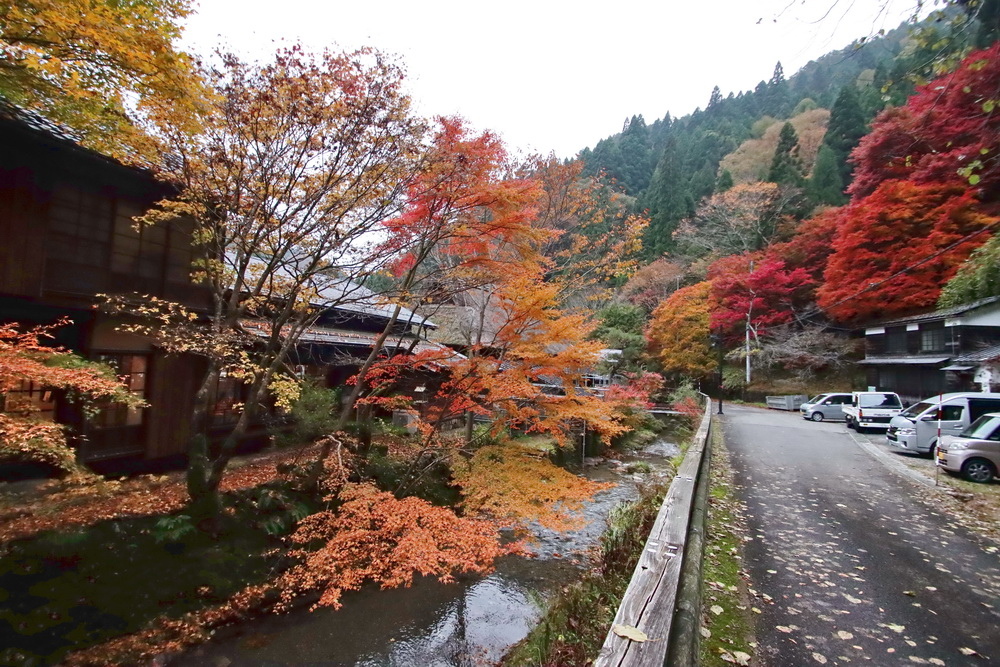
Itaihara Village preserves the atmosphere of a mountain hamlet from the 1950s. It is about five kilometers from Chizu Station with no bus service, so booking a taxi in advance is recommended.
Nov
Wed
Itaihara Settlement, Tottori, Japan | A fall-foliage destination in Chizu resembling the secluded mountain village in Wood Job!
#MustVisitTottoriJapan #SecludedJapaneseMountainVillage #ItaiharaSettlement #Chizu #MountainHideaway #TottoriFallFoliage
Itaihara Settlement, Chizu
Access: Take the JR Inbi Line from Tottori Station to Chizu Station. Itaihara Settlement is about five kilometers from the station along mountain roads. There is no local bus, so reserve a Chizu taxi in advance (Chizu Tourism Association: 0858-76-1111). For taxi information,
click this link.
View a larger map
Does anyone remember the film Wood Job!? Itaihara Settlement in Chizu, Tottori, which we visited on this trip, feels just like the village in the movie. It lies deep in a mountain forest with no bus service. If you arrive by train, you must transfer to a taxi at the small Chizu Station, follow a winding road through cedar forest, and finally pass through the long Itaihara Tunnel before reaching the village. According to the introduction, cars could not enter the settlement before the tunnel opened in 1962; the only way to reach it was on foot.
This tiny mountain settlement retains the traditional appearance of the late 1950s and early 1960s, with thatched houses, homes whose walls are made from earth over woven bamboo, a small shrine, and a clear stream flowing slowly around the village. More than twenty households once lived here. Because of the inconvenient access, however, residents gradually moved away until only a scattered few remained and the settlement was close to abandonment. It now attracts young people who open cafes, guest houses, and craft workshops. In late fall, foliage covers the mountains with limitless tranquility and nostalgia. Drinking hot coffee at a cafe by the stream while watching the leaves outside the window makes time disappear in the mountains. It is a wonderfully indulgent feeling.
▲ Broad swaths of fall color are visible from the Itaihara Settlement parking lot. The house beside the stream in the picture has been converted into Nodoka Cafe.
▲ To enter Itaihara Settlement, cross this little bridge over the stream, which is hidden by the foliage. Before entering the village, visit Mukoyama Shrine on the left side of the picture to admire the leaves.
As soon as we arrived at Itaihara Settlement, the bright red maples at Mukoyama Shrine caught our attention from the parking lot. The shrine stands beside the small bridge at the entrance to the village. A short flight of stone steps leads through the torii gate to the shrine.
Mukoyama Shrine consists of two small, rustic wooden buildings surrounded by maple trees. In late fall, from mid- to late November, brilliant foliage envelops the shrine, making it especially vivid and enchanting. Parts of the village can also be seen in the distance from here, giving us a wonderful surprise before we even entered.
▲ Mukoyama Shrine stands beside the little bridge leading into the village. After climbing a short flight of stone steps, visitors are rewarded with an abundance of fall color.
▲ Stone steps, a torii gate, stone lanterns, and accents of red foliage fill Mukoyama Shrine with seasonal character and a Zen-like atmosphere.
▲ Mukoyama Shrine is very small and essentially consists of these two wooden buildings.
▲ From Mukoyama Shrine, Itaihara Settlement can be seen in the distance, framed in the foreground by fall foliage.
We descended from Mukoyama Shrine, crossed the little bridge over the stream, and entered Itaihara Settlement. The village has only one fairly short dirt path, with more than ten timeworn houses scattered along its two sides. Although we visited on a holiday, there were few tourists. The village was quiet and full of historic charm.
Itaihara's origins can be traced back to the Heian period, so it is believed to have been a hidden village where defeated members of the Taira clan took refuge from pursuit. The village contains the Fujiwara family residence, a thatched house built in 1899 that is closed to visitors, as well as a group of old houses constructed more than fifty years ago. These include a number of increasingly rare homes with earthen walls built over woven bamboo. Many old houses are crumbling and unoccupied, but others have been converted into cafes, guest houses, and craft workshops. There is also a museum displaying numerous historical photographs and old implements.
In 2004, Itaihara Settlement was designated a Tottori Prefecture Preservation District for Groups of Traditional Buildings.
▲ Cross the small bridge on the left side of the picture from the parking lot to enter Itaihara Settlement proper.
▲ This dirt path is the main road through the settlement. Timeworn buildings line both sides, including houses with earthen walls built over woven bamboo.
▲ Earthen walls over woven bamboo are made using a traditional technique that combines soil, rice husks, bamboo strips, and other materials.
▲ The Fujiwara family residence has a thatched main house built in 1899. The interior appears not to have been renovated, and the building looks somewhat dilapidated.
▲ Brilliant fall foliage beside the thatched Fujiwara family residence.
▲ This is Itaihara Settlement's only lodging, Kikori Guest House.
▲ Admission to the Itaihara Settlement museum is free. The building is small, with a first and second floor. Exhibits describe the area's development and include numerous old photographs and objects preserved from earlier times.
My favorite corner of Itaihara Settlement is Nodoka, currently the village's only cafe. It is open from 10:00 a.m. to 6:00 p.m. and closed Tuesdays and Wednesdays. Converted from an old house, it has its own garden and the atmosphere of a Kyoto townhouse cafe. The traditional Japanese wooden interior has floorboards that creak underfoot, along with an irori hearth and tatami seating. Seats beside the window overlook the murmuring stream and red leaves, creating an exceptionally quiet and rustic space.
At lunchtime, Nodoka offers a lunch set for 1,500 yen. In the afternoon, only coffee and juice are served, along with homemade desserts; the menu appears in a picture below. If you have the chance to visit Itaihara Settlement, I strongly recommend stopping at this cafe.
▲ Nodoka Cafe has a garden in front and a stream behind, giving it a wonderfully rustic and elegant setting.
▲ On entering, visitors see old objects hanging on the walls, along with decorations that appear to include mounted heads of animals once caught locally.
▲ The November 2024 menu.
▲ Immediately inside the entrance is this seating area around an irori hearth.
▲ The cafe also has a tatami seating area.
▲ This intimate seating area for two overlooks Nodoka's beautiful garden.
▲ A handicrafts section inside the shop displays and sells hand-knitted bags and other items.
▲ I loved this window counter overlooking the fall foliage and stream. Sipping coffee and daydreaming while gazing at the beautiful view outside was pure pleasure.
For more up-to-date food and travel information, you are welcome to join:
Source: 齊哥的食旅探go | Original URL: https://paulchi543.pixnet.net/blog/posts/15346947253
Where would you stay for this story?
This is a stay-recommendation demo. Partner links will be enabled after confirmation.
Kaike Onsen and Tottori stays
Choose an onsen inn, city hotel or stay area that fits the article context.