
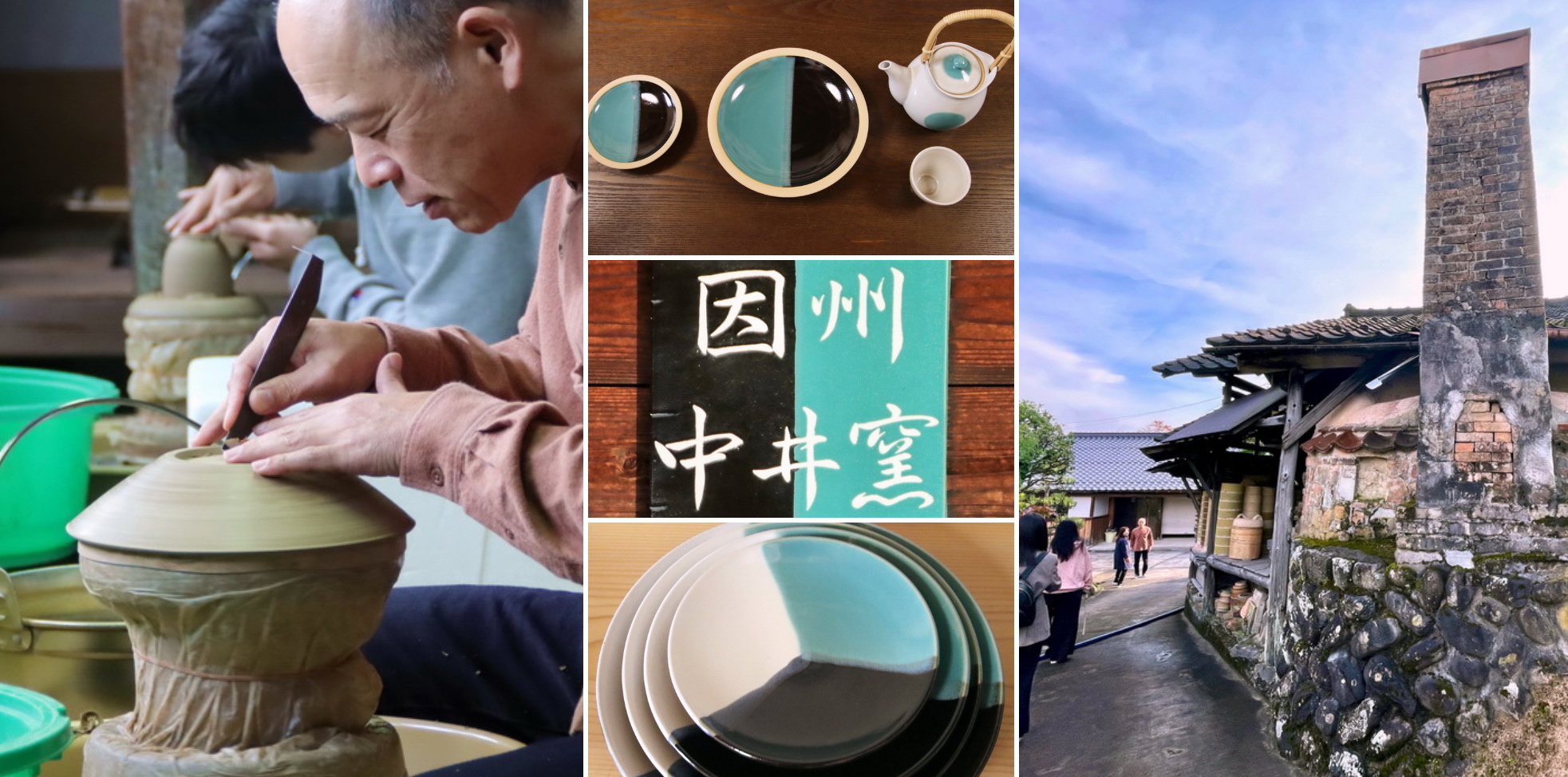
Visit Inshu Nakai Kiln in Kawahara, Tottori City, to see its green, white and black plates and the series guided by Sori Yanagi. Visits require advance reservation.
Dec
Tue
Tottori, Japan: Inshu Nakai Kiln, Nationally Famous for Three-Color Glazed Plates and Its Sori Yanagi-Directed Series
#TravelInJapansSaninRegion #RecommendedTottoriAttractions #MustVisitJapaneseKilnsAndPottery #InshuNakaiKiln #SaneoSakamoto #SoriYanagi #JapaneseCraftsmanship
Tottori: Inshu Nakai Kiln
Address: 243-5 Nakai, Kawaharamachi, Tottori City, Tottori Prefecture
Tel: +81 858 85 0239
Hours: 9:00 a.m.–5:00 p.m.
Transportation: From Tottori Station, take bus 91, 92, 93, or 94 and get off at Kawaharaguchi. Transfer to the K1 Saigo Line bus and get off at Nakaibashi. Consult the
local bus operator's official website
for details.
Note: Reservations are required to visit. Tours are available, but there are no hands-on classes.
View larger map
Tottori has numerous attractions and foods, and pottery kilns are another of its defining features. The prefecture contains more than 20 wood-fired kilns, large and small. The best known include Akihiro Maeta, a potter at Yanase Kiln and a Japanese Living National Treasure who in 2013 became the first person in Tottori Prefecture recognized as a holder of the nationally designated Important Intangible Cultural Property of white porcelain. There are also two well-known and relatively “approachable” wood-fired kilns: Inshu Nakai Kiln in Kawaharamachi, Tottori City, and
Iwai Kiln
in Iwami Town.
This article first introduces Inshu Nakai Kiln, established in Showa 20 (1945). It is also a wood-fired kiln that has collaborated with master Japanese industrial designer Sori Yanagi from 2000 to the present.
▲This is third-generation potter Akira Sakamoto with the “Sori Yanagi-Directed Series,” or Yanagi Direction, created through collaboration with Sori Yanagi beginning in 2000.
Although its address is in Tottori City, Inshu Nakai Kiln, founded in 1945, sits in an extremely secluded rural location surrounded by rice paddies. No train reaches it, and transportation is not very convenient. Yet a kiln that blends into pastoral scenery like this made us yearn to visit all the more. It would be even better if there were a cafe inside, ha, but unfortunately there is not.
The moment you enter Inshu Nakai Kiln, you see a historic-looking, wood-fired climbing kiln with a tall chimney at the gate. Partly finished pottery and neatly split firewood are arranged on wooden racks alongside it. Continue farther in and you will also find a stroll garden centered on a pond. Nakai Kiln's most recognizable works are its three-color glazed plates, divided into green, white, and black sections. Besides decorating the sign at the entrance, the pottery is used as handles on the sliding doors of the workshop and showroom. Some larger objects are simply placed beside outdoor tables as decoration, or perhaps as umbrella stands. Their restrained, Zen-like elegance displays the kiln's identity to the fullest.
▲The wood-fired climbing kiln at the entrance has a rustic, antiquated charm. Green trees planted beside it create an especially refined scene.
▲When the wood-fired kiln is not operating, visitors can approach it closely. The mouth is covered by boards, however, so the interior cannot be seen.
▲The large ceramic plates arranged neatly one after another might be partly finished pieces, or completed but unglazed objects intended for another purpose.
▲These two expensive-looking ceramic jars stand beside the workshop's main entrance as decoration, or perhaps as umbrella stands. Can one call that extravagantly casual?
▲The sliding-door handle at upper left is also made from a three-color glazed plate.
The current head of Inshu Nakai Kiln is third-generation potter Akira Sakamoto, born in 1965. At his invitation, we entered the workshop. The space beneath a timber-framed roof, with solid-wood beams and pillars, was spotless. Akira Sakamoto and fourth-generation potter Muneyuki Sakamoto, who joined the pottery work in 2018, sat at their respective wheel-throwing stations. Father and son each concentrated on their own work. Every movement revealed the meticulous, uncompromising care they gave the pottery before them. The quiet room filled with laughter and the warmth of everyday life only when Muneyuki Sakamoto's young daughter, the fifth generation, came inside.
Akira Sakamoto told us that, when young, he loved fine art rather than pottery. At the time, he wanted only to devote himself to art and had no plans to inherit the kiln. After encountering pottery at age 30, he gradually came to love it. He also guided Nakai Kiln's transition from folk-art objects to practical tableware for daily life. The clay and glaze used here have been sourced from around the kiln ever since it opened. Suitable clay is collected from the local mountains. For glaze, rice straw gathered nearby is burned to ash, water is filtered through it to extract lye, and the ingredients are then blended. It takes two to three years from the beginning of production until the material can be used.
▲The workshop of third-generation Akira Sakamoto and fourth-generation Muneyuki Sakamoto is rustic, nostalgic, and spotlessly clean.
▲The previously quiet, focused space suddenly filled with laughter because Muneyuki Sakamoto's young daughter, the fifth generation, had come to explore the grand garden.
▲Every cut expresses exacting care for the work. Focus is apparent in every movement.
▲One corner of the workshop holds various partly finished pieces drying in the shade. All are practical ceramics for everyday use.
▲Glazed pieces waiting to enter the kiln. “Blue” and “black” are written below in chalk.
▲This glass cabinet is so full that nothing else will fit. I could take every piece inside home with me, ha.
Inshu Nakai Kiln's pottery is instantly recognizable by its glaze. Its signature is the three-color glazed plate, divided into green, white, and black: green represents nature, white the sky, and black the earth. In recent years, Akira Sakamoto has gradually introduced an elegant, pale sky-blue palette and changed the original dark forest green to light green. These additions bring brighter, fresher variation to glazes that once looked heavier and make the pieces more suitable for modern life. One reason for these changes was the inspiration of master Japanese industrial designer Sori Yanagi.
In 2000, Akira Sakamoto collaborated with Sori Yanagi to release the “Sori Yanagi-Directed Series,” or Yanagi Direction. The series combines Yanagi's modern design philosophy with Inshu Nakai Kiln's traditional techniques and its method of applying separate glaze colors. Besides emphasizing natural materials and the texture of handwork, the pieces follow specific approaches to color and pattern. Circular glazed motifs and unglazed negative space, for example, create a modern, minimalist aesthetic that remains pleasing over time and practical in use. The collaboration between Sakamoto and Yanagi not only elevated the quality and visibility of Inshu Nakai pottery but also allowed Yanagi's design spirit to continue through another field, becoming a celebrated story in Japan's folk-craft community.
The evolution of Inshu Nakai Kiln's pottery and use of color can be seen at a glance in its exhibition space.
▲Inshu Nakai Kiln's exhibition and sales space. The Sori Yanagi-Directed Series, however, is not offered for sale.
▲Akira Sakamoto poured us sencha using teaware from the Sori Yanagi-Directed Series and spoke at length about his creative journey. The round plate on the table is also from the series.
The thoughtfully arranged exhibition space combines pale wooden shelves with dark furniture and cabinets. Neatly displayed on them are classic vessels using the traditional green, black, and white glazes, as well as sky-blue folk crafts added in recent years. Bowls, plates, cups, vases, chopstick rests, and even ceramic door handles are all represented, and their uses of color vary. Some works are for display only, while others are for sale. Regrettably, the Sori Yanagi-Directed Series is not sold here.
Every piece here tells a story of the pottery traditions that Nakai Kiln has carried forward in the Inshu region and of its innovative spirit. Whether you come to look or to buy, if you have an opportunity to visit Tottori, I recommend touring the kiln to learn about Japanese folk craft. It is well worth the trip.
▲These two folk-craft pieces are new expressions created by Akira Sakamoto through changes to the traditional glaze colors. The narrow-necked vase on the right also incorporates variations in crackle patterns.
▲This coffee-cup set grows cuter the longer I look at it. I regret not buying it and taking it home at the time.
▲The three pieces on the wall can be used as door handles or fastened to a wall to hang clothes and other items.
▲The small chopstick rests also use green, white, and black. Their bow-tie shape is extremely cute.
For more real-time food and travel information, you are welcome to join:
Source: 齊哥的食旅探go | Original URL: https://paulchi543.pixnet.net/blog/posts/15347056033
Where would you stay for this story?
This is a stay-recommendation demo. Partner links will be enabled after confirmation.
Kaike Onsen and Tottori stays
Choose an onsen inn, city hotel or stay area that fits the article context.