
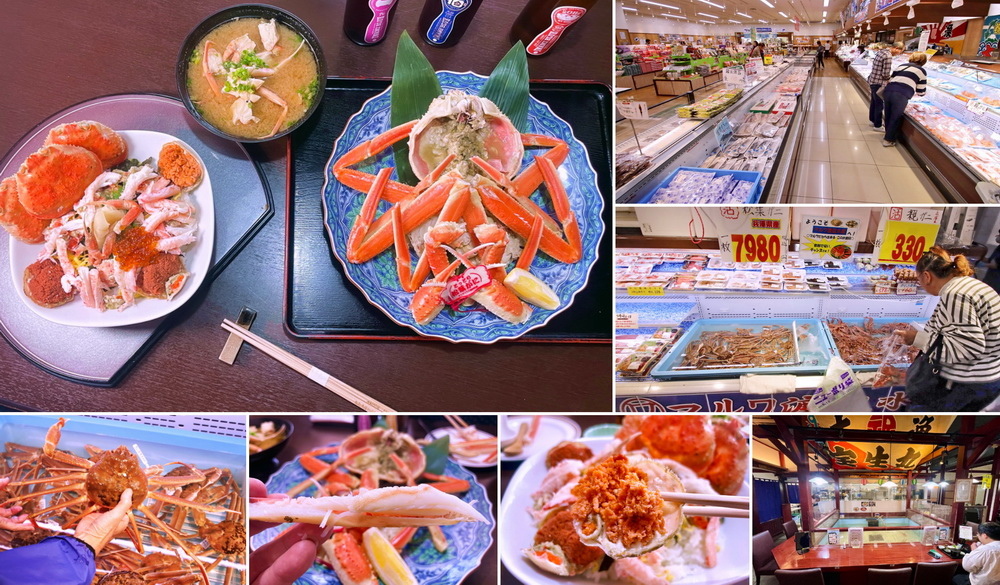
Roadside Station Kinnanshe Iwami brings together local seafood, produce and souvenirs. In Matsuba crab season, you can choose male crab or female oyagani, then enjoy the catch at the adjoining restaurant.
Jan
Sat
Tottori, Japan: Roadside Station in Iwami—a great place to browse, shop, and eat. Feast on delicious fresh Matsuba snow crab and female snow crab
#TravelInJapansSaninRegion #RecommendedSpotsInTottoriJapan #IwamiRoadsideStation #RoadsideStationKinanseIwami #JapansTopMatsubaCrabCatch #FemaleSnowCrab #LargeTottoriSupermarket #MurakamiSuisanKaiyotei
Roadside Station Kinanse Iwami, Iwami Town
Address: 337-4 Nii, Iwami-cho, Iwami-gun, Tottori Prefecture
Telephone: 0857-73-5155
Hours: 09:00–19:00
View a larger map
Iwami in Tottori Prefecture is known for the spectacular rock formations of the Uradome Coast, and it also lands more Matsuba snow crab each year than anywhere else in Japan. If you want to taste fresh, seasonal Matsuba crab (males) and female snow crab, Roadside Station Kinanse Iwami in the producing region is highly recommended. “Kinanse” means “please come in.”
This roadside station in Iwami has been jointly managed and operated by the local agricultural association, fisheries cooperative, chamber of commerce, tourism association, and other organizations since January 2015. In addition to a large supermarket selling Tottori’s seasonal seafood, agricultural specialties, newly harvested rice, Tottori-exclusive gifts, local products, and household goods, the station contains several restaurants, including Murakami Suisan Kaiyotei, known for its seafood set meals. Shopping, dining, and seeing row after row of lively Matsuba and female snow crab can all be done in one stop.
▲ A giant Matsuba crab stands at the station’s main entrance, announcing that Iwami has Japan’s largest Matsuba crab catch.
▲ The large supermarket has every kind of seafood, agricultural specialty, and locally exclusive gift, more than enough to satisfy visitors’ urge to shop.
▲ The supermarket also has a gift section devoted to cookies made in Tottori Prefecture and boxed Japanese and Western-style sweets.
▲ Local sake, ginjo sake, fruit juices, and much more are all available.
(Do not drink and drive; safety comes first.)
▲ Processed foods, snacks, seasonings, and other items made from local farm produce and fruit are good both as gifts and for yourself.
▲ Tottori Nijisseiki pear juice, ¥560 per bottle.
▲ Tottori Nijisseiki pear juice, ¥540 per pack.
▲ The locally famous red and blue coffee pouches are a must-buy for many people visiting Roadside Station Kinanse Iwami.
As mentioned above, Iwami boasts Japan’s largest catch of Matsuba crab. Just inside the supermarket at this roadside station is an area devoted to seasonal seafood. We visited in mid-November, right in the fishing season for local Matsuba crab (males) and female snow crab. The most prominent part of the seafood section was filled with lively Matsuba and female snow crab, along with relatively inexpensive chilled, cooked crab and other seafood.
Male and female crabs differ greatly in size and also have different textures. Depending on a male crab’s size, the number of black spots on its shell (the spots are crab-leech egg cases; more is considered better because it indicates the crab grew in an environment rich in seaweed and food), and whether it is missing any legs, one crab may cost from around ¥5,000–6,000 to ¥10,000–20,000. Most females cost ¥300, ¥330, or ¥350 each.
Japan imposes strict rules on fishing for Matsuba and female snow crab. Matsuba crab may be caught only from November 6 through March 20 of the following year. The female-crab season is even shorter, from November 6 through December 31 each year.
In addition to the restricted season, a male crab may be caught only if its carapace is at least nine centimeters wide and it weighs at least 700 grams. The size and weight thresholds for females are comparatively lower.
▲ The black spots on a Matsuba crab’s shell are crab-leech egg cases. More spots indicate better quality and show that the crab grew in an environment rich in seaweed and other food.
▲ This live Matsuba crab has no missing legs—all ten, including its claws—and costs ¥7,980, which is considered inexpensive in Japan.
▲ As the photograph above shows, prices differ enormously between live Matsuba crab (males) and female snow crab.
▲ A Matsuba crab missing a leg tastes no different but costs far less than an intact one. Compare it with the photograph below.
▲ A bag of three chilled, cooked female snow crabs costs ¥1,050. Local people often buy them to take home and make miso soup.
After seeing so many Matsuba and female snow crabs, tasting them was naturally the main objective. Murakami Suisan Kaiyotei’s Iwami branch inside the roadside station is one of the company’s many locations in Tottori. One of its distinctive features is a section of dining seats arranged around a large tank, where seasonal Matsuba crab and white squid are displayed and sold—evidence that the restaurant’s ingredients are as fresh as can be.
The menu consists almost entirely of set meals made with local seasonal seafood. On this trip in mid-November, for example, we ate a large live Matsuba crab (reservations required; ours cost ¥20,000) and a female snow crab rice bowl (¥4,400). The full menu appears at the end of the article.
Murakami Suisan Kaiyotei, Iwami Branch
Telephone: +81 857 73 1115
Hours: 10:30–14:30 and 17:00–20:00; closed Wednesdays
▲ One of Kaiyotei’s distinctive features is a section of seating arranged around a large tank, where seasonal Matsuba crab, white squid, and other seafood can be seen.
▲ These were the foods we enjoyed most that day. On the left is the female snow crab set meal (¥4,400); on the right is a large live Matsuba crab (reservations required; ours cost ¥20,000).
First, take a look at this very expensive but impressively large Matsuba crab. Its shell appeared to be about 13 centimeters wide, and it weighed more than one kilogram. It had all ten legs, a generous amount of crab tomalley, and a “Kanitoriken” tag signifying high quality.
The legs were packed with meat that was delicate and tender yet springy. Their sweet, gently salty, savory flavor left a lingering impression. The greenish-brown tomalley was rich and silky on the tongue and full of intense ocean flavor. It was unbelievably delicious.
▲ The legs are the most delicious part of a Matsuba crab. Every one was full of delicate, tender, springy meat.
▲ The Matsuba crab we ate had plenty of tomalley. It was rich and silky in the mouth, with a strong ocean savor—absolutely delicious.
The photograph below shows the female snow crab rice bowl (¥4,400). It used three females full of roe and was covered with crab-leg meat, Matsuba crab tomalley, salmon roe, and more. Served with a bowl of female snow crab miso soup, it was a large, satisfying, luxurious set meal.
Female snow crab leg meat is firm and even a little coarse. It is not as tender and springy as Matsuba crab, but it is exceptionally fresh and sweet. Mixing the generous portion of meat into the sushi rice and taking a big bite was deeply satisfying. The orange-red roe was crunchy and popped in the mouth, with a distinctive texture and plenty of salty ocean flavor. The miso soup was outstanding: savory and salty with the crab’s gentle sweetness. The body meat in the soup was abundant and plump as well. It was superb.
▲ Although the female snow crab rice bowl costs ¥4,400, it uses three crabs along with Matsuba crab tomalley, salmon roe, and other toppings, and comes with female snow crab miso soup. It offers good value for money.
▲ Finding Matsuba crab tomalley hidden among the female crab leg meat was an unexpected surprise, and it made the rice bowl taste even richer.
▲ The extremely crunchy female crab roe popped in the mouth and had a very unusual texture.
▲ Female snow crab leg meat is not as tender and springy as Matsuba crab, but it is exceptionally fresh and sweet.
▲ After finishing the female snow crab rice bowl, the thing that unexpectedly stayed with me most was this bowl of female snow crab miso soup.
▲ This is the Motto Yokubari Set, or “Even Greedier Set” (¥2,900). It includes two large fried shrimp, fried oysters, five kinds of sashimi, and a piece of fried white fish with firm, springy flesh. This one is also recommended.
▲ The complete menu at Murakami Suisan Kaiyotei’s Iwami branch.
齊哥的食旅探go
齊哥的食旅探go
Posted by 齊哥的食旅探go
Popularity (
International Travel
[Asia] Japan
Source: 齊哥的食旅探go | Original URL: https://paulchi543.pixnet.net/blog/posts/15347115365
Where would you stay for this story?
This is a stay-recommendation demo. Partner links will be enabled after confirmation.
Kaike Onsen and Tottori stays
Choose an onsen inn, city hotel or stay area that fits the article context.