
Next to Karo Fishing Port, Karo Market lets you browse both the fresh fish market and the Wattaina farmers' market in one stop. It is about 30 minutes from Tottori Station by buses 48 or 49.
Feb
Wed
Tottori, Japan: Karo Market | A Distribution Market Packed with Seafood, an Agricultural-Specialty Supermarket, and Restaurants—Feasting on a Matsuba Crab Rice Bowl at a Popular Restaurant
#TravelInJapansSaninRegion #RecommendedAttractionsInTottoriJapan #TottoriPortKaroPort #KaroSeafoodMarket #JapansLargestMatsubaCrabCatch #OyakaniFemaleCrab #WakabayashiShoten #MustEatSeafoodRiceBowl
Tottori Port: Karo Market
Address: 3 Chome-27-1 Karocho Nishi, Tottori, Tottori Prefecture
Telephone: 0857-38-8866
Business hours: 09:00–17:00
Official website:
Wattaina Agricultural-Specialty Supermarket
Fresh Fish Market
View Larger Map
Visiting a large supermarket is probably an activity that everyone enjoys—and looks forward to—when traveling in Japan. Karo Market in Tottori City is a comprehensive market beside Karo Fishing Port. It includes a large supermarket, the Wattaina agricultural-specialty store, a fresh fish market, and a concentration of restaurants serving all kinds of food. Whether you want to see auctions of seafood such as piles of crabs, buy distinctive souvenirs and agricultural specialties, or eat sashimi, sushi, yakiniku, ramen, and all kinds of seasonal fruit, you can find it all here.
Karo Market is about two kilometers from Tottori Sand Dunes Conan Airport and approximately 7.5 kilometers from Tottori Station. If traveling by bus, take
the Hinomaru Bus Karo Loop route number 48 or 49
from Tottori Station and get off at Kanikkokan-mae. The ride takes around 30 minutes. If you are driving, there are a great many parking spaces, much like at a roadside station on a national highway.
Let us begin by taking a look around the fresh fish market.
▲ This warehouse-like building is the fresh fish market at Karo Market. The Wattaina agricultural-specialty supermarket is directly opposite it.
▲ A floor plan of the fresh fish market. Image source:
Official website of the Tottori Karo Port Fresh Fish Market
The floor plan of the Karo Port Fresh Fish Market alone shows only nine stores, but each one is divided into numerous stalls, and some also have restaurants. The market is still very large overall.
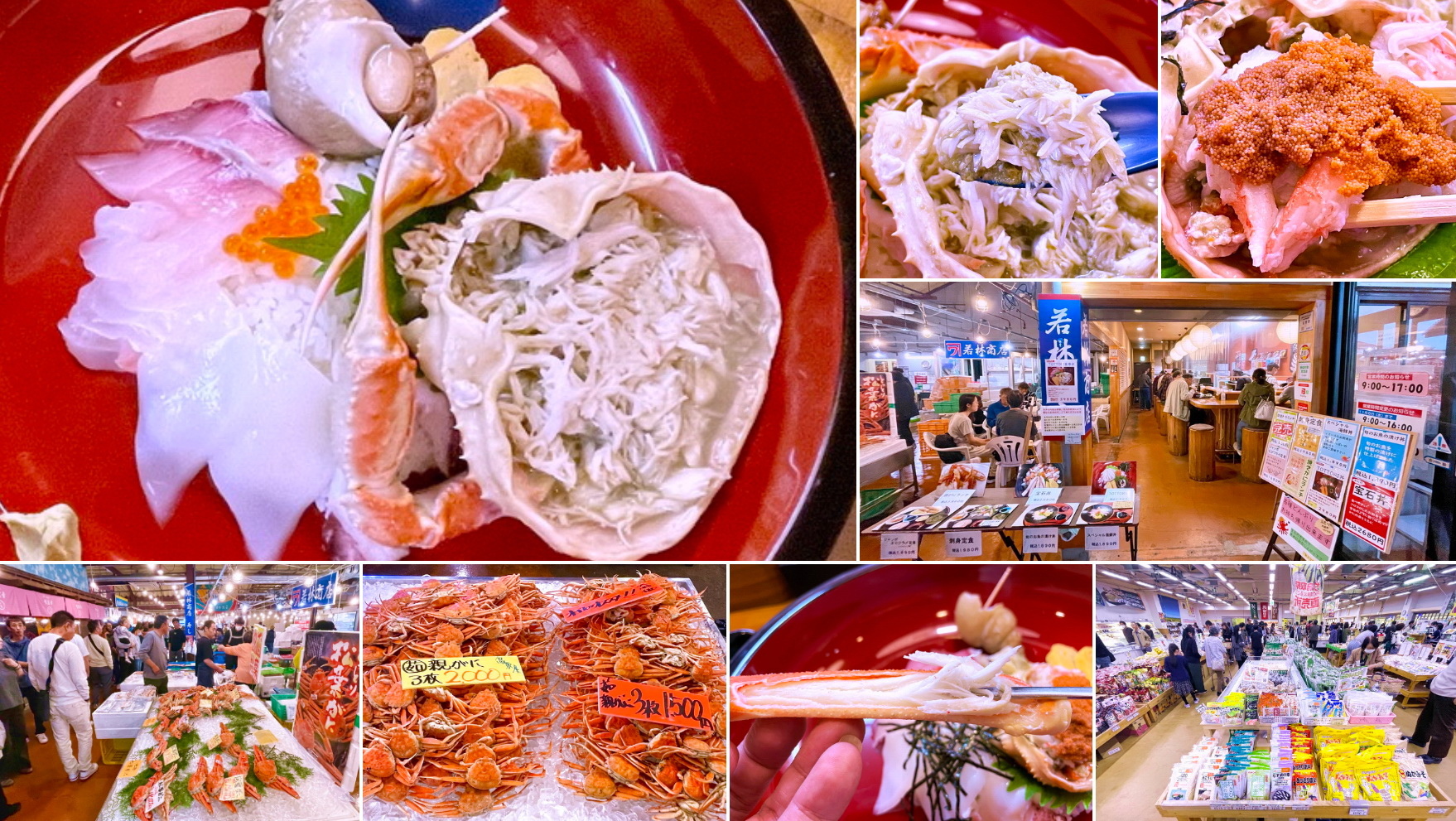
The fresh fish market sells far more than fish. It offers every kind of seasonal seafood. Major catches include sea bream and horse mackerel from March through May, Tottori white squid from June through August, babachan deep-sea fish and mackerel from September through November, and Matsuba crab and oyakani female crab from November through February. In addition to all kinds of live seafood, vendors sell prepared seafood such as crabmeat and crab innards that can be eaten immediately. There are around five or six restaurants serving sashimi, rice bowls, nigiri sushi, and more. When we visited before noon on a Saturday, every restaurant had a waiting list and was bustling with customers.
▲ We visited in mid-November. Most of the fresh fish market was selling freshly caught Matsuba and oyakani crabs, making the entire place glow red.
Here is some background. Matsuba crab, which is male, and oyakani crab, which is female, differ greatly in size and also have different textures. Depending on a male crab's size, the number of black marks on its shell—the marks are crab-leech eggs and more are generally considered better, indicating that the crab grew in an environment rich in seaweed—and whether it is missing any legs, prices range from roughly ¥5,000–6,000 to ¥10,000–20,000 each. Female crabs generally cost ¥300–350 each, or about ¥500–600 for a larger one.
Fishing for Matsuba and oyakani crabs is strictly regulated. Matsuba crab may be caught only from November 6 through March 20 of the following year. The season for oyakani is even shorter, running from November 6 through December 31 each year. In addition to the limited seasons, male crabs must have shells at least nine centimeters wide and weigh at least 700 grams before they may be caught. The size and weight thresholds for females are relatively lower.
▲ Oyakani crab has a fishing season of less than two months and is very inexpensive. Local families mainly use it in miso soup.
▲ A Matsuba crab's price is affected not only by its size but also by the number of black marks on its shell—more are considered better—and whether any legs are missing.
Red snow crab is another of Tottori's three major crabs. Its fishing season is longer, running from September 1 through the end of June the following year, and it is more affordable than Matsuba crab.
▲ Red snow crab (left) and oyakani crab (right).
▲ Ready-to-eat crab innards are also available at the stalls, though at this price they probably were not from Matsuba crab.
▲ Seafood products such as nori and dried seaweed are available in every variety as well.
There are too many restaurants to count throughout Karo Market. The fresh fish market alone has about five or six where visitors can enjoy assorted sashimi, rice bowls, set meals, nigiri sushi, and more. Our target on this trip was Wakabayashi Shoten, an extremely popular seafood-bowl specialist with ten counter seats and three four-person tables. We waited about 30 to 40 minutes at lunchtime on Saturday before we could sit down.
Wakabayashi Shoten is known for its seafood rice bowls and set meals, especially those featuring crab, seasonal fish, and shellfish. The four of us ordered a Jewel Bowl (¥2,630), a TOTTORI Bowl (¥2,980), a TOTTORI Deluxe Bowl (¥3,980), and the Grilled Crab Lunch Set (¥3,860). The ingredients were plentiful and fresh, and the rice bowls came in lacquerware vessels as large as washbasins, making the meal truly impressive.
Wakabayashi Shoten
Address: 1-7-26 Karocho Kita, Tottori, Tottori Prefecture
Telephone: 0857-31-1178
Business hours: Weekdays 11:00–14:00 and 17:00–21:00; holidays 11:00–21:00
▲ Wakabayashi Shoten's menu is displayed in photographs in front of the restaurant, making everything clear at a glance.
▲ This is the TOTTORI Deluxe Bowl (¥3,980) ordered by a friend. The crab shell contains Matsuba crabmeat and crab innards, accompanied by two crab claws, one piece of whelk meat, two kinds of sashimi, rolled omelet, salmon roe, and more.
▲ The crab shell in the Deluxe Bowl is packed with Matsuba crab innards and meat. Mixing them together produces a fresh, sweet, delicate, and creamy flavor with an intense taste of the sea.
▲ This is the TOTTORI Bowl (¥2,980) I ordered that day. Unlike the Deluxe Bowl shown above, its crab shell contains oyakani crabmeat and roe.
▲ Oyakani roe is crisp and pops in your mouth, creating a very distinctive texture. The leg meat was exceptionally fresh and sweet too.
▲ The whelk meat in the bowl was thick and firm. Although I do not know what kind of sea snail it was, it was crisp, sweet, and absolutely excellent.
▲▼ Both the TOTTORI Bowl and Deluxe Bowl include sea bream sashimi and white squid. They were sweet and had excellent textures, adding greatly to the meal.
▲ The Grilled Crab Lunch Set (¥3,860) includes grilled Matsuba crab legs as its centerpiece, along with half a braised fish, Matsuba crab innards with miso, three kinds of sashimi, and more.
▲▼ The set includes three grilled Matsuba crab legs. The meat is plump, sweet, delicate, tender, and soft while remaining springy.
▲ The Jewel Bowl (¥2,630) comes with crab-leg meat—which seemed like red snow crab—and a rice bowl topped with diced pieces of four kinds of sashimi. It truly is as colorful as a jewel.
After finishing lunch in the fresh fish market, you absolutely must visit the large supermarket in the neighboring building, the Wattaina agricultural-specialty supermarket, before leaving. It is a fantastic place to shop.
The enormous Wattaina is divided into three main sections: a fruit specialty area, a central-corridor market, and a large supermarket. The fruit area carries seasonal produce grown in the prefecture, including Tottori watermelons, Shinkansen pears, Nijisseiki pears, melons, and more. The central-corridor market is arranged like a collection of stalls, bringing together vegetables and fruit from small farms as well as snack vendors. The large supermarket stocks locally produced beer and sake, newly harvested rice, bread, prepared foods, snacks, seasonings, household goods, and practically everything else. Conan and Kitaro merchandise is available too. Once you enter, spending money is inevitable; the only real worries are whether your suitcase will become overweight and whether it has enough room.
▲ This is the fruit specialty area. When we visited in mid-November, most of the fruit consisted of pears that were in season.
▲ This is the central-corridor market, arranged like a collection of vendor stalls where vegetables and fruit from small farmers and various snack stands come together.
▲▼ The photographs below show the Wattaina agricultural-specialty supermarket. It is spacious and carries so many products, making it an excellent place to browse and shop.
▲ All kinds of souvenirs in Conan packaging are available. If you did not buy enough in Conan Town, you can buy more here.
▲ On this Tottori trip, we made a special visit to Hirao Tofu Shop in Kawahara. I never expected that, in addition to the tofu soft serve, all its other related products could be purchased here.
▲ If you enjoy cooking, the famous seasonings, jams, honey, and other products from throughout Japan will guarantee a difficult choice.
▲ This local specialty salt-seasoned ponzu (¥594), which we bought in the Daisenji shopping street in the eastern area, is also sold at the supermarket.
▲ There are more than a dozen varieties of newly harvested local rice, including the well-known Hoshizora Mai brand, in every kind of package and weight.
▲ Looking at the price on this photograph of Tottori wagyu, all we could do was enjoy it with our eyes.
For more real-time food and travel information, you are welcome to join:
Qi Ge's Food and Travel Exploration Go
Source: 齊哥的食旅探go | Original URL: https://paulchi543.pixnet.net/blog/posts/15347124017
Where would you stay for this story?
This is a stay-recommendation demo. Partner links will be enabled after confirmation.
Kaike Onsen and Tottori stays
Choose an onsen inn, city hotel or stay area that fits the article context.