
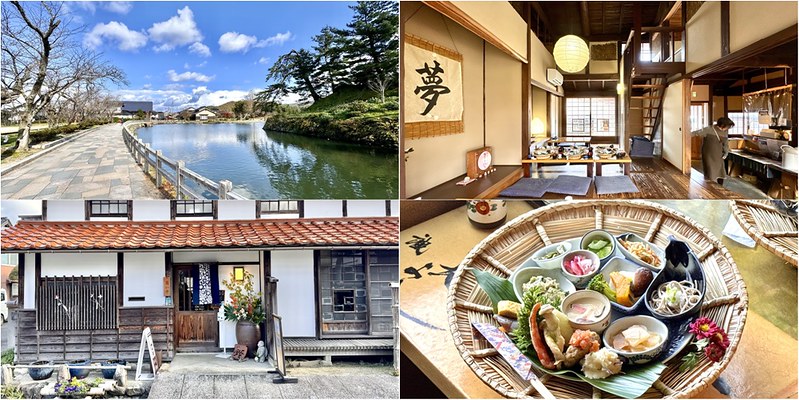
Yume Komichi in the Shikano castle town is a 33-year-old local cuisine restaurant. Its signature sugegasa set meal carries a century-old tradition and pairs well with a stroll through the historic streets.
Yume Komichi (
official Instagram
): 1237-2 Shikano, Shikano-cho, Tottori City, Tottori Prefecture. Tel: +81 857-38-0001. Hours: 11:30 a.m.-2:00 p.m. (open Fridays, Saturdays, and Sundays only)
A while ago, I made my 15th and 16th consecutive visits to Tottori while scouting for our third Tottori Michelin tour, planned for August 2025. Tottori is a rural Japanese prefecture that I like more with every trip. The main purpose, of course, was to look into restaurants and sights that many Taiwanese visitors do not yet know. We have already run the tour twice, and Tottori has only six Michelin-starred restaurants. Apart from Kaniyoshi, where we could not secure a reservation, members of our
Little Tiger Foodie Tour
have eaten at all of them, some more than once. The previously featured
Cafe Bramley
and
Sushi Yoshiki
(Michelin-listed), along with Yume Komichi in this article, are Tottori-only restaurants we may include in the next tour, if we can get reservations. The short verdict: the sugegasa set meal is charming and delicious, with a story and local culture behind it. The restaurant occupies a century-old renovated home and is run by several friendly, delightful grandmothers. The ruins of Shikano Castle also have the slightly out-of-the-way quality I enjoy. This is nearly my perfect restaurant. Among my Tottori favorites, it ranks second only to:
Japan, Tottori Michelin Series No. 7: Mitakien in Chizu, a poetic hidden garden and mountain-village restaurant built by a 77-year-old grandmother over 50 years
.
Unless you visit Tottori often, the name Shikano will probably be unfamiliar. You might know it if you are utterly devoted to Japanese castles or have come during cherry blossom season; this is one of Tottori's noted blossom spots, with more than 500 Somei Yoshino trees. Otherwise, you would be unlikely to put this small town on your itinerary. It lies at the far edge of Tottori City, roughly between Tottori and Kurayoshi. The name Shikano comes from Shikano Castle, built in 1581, and the castle town that grew around it.
A closer look at Google Maps shows that the two closest JR stations to the Shikano Castle ruins are Hamamura and Hogi. A connecting bus runs from Hamamura. If, like me, you plan a trip around food, I can offer another reason to come besides Yume Komichi: Hot Air, the only Michelin-recognized ramen shop in the San'in region:
Japan, Tottori Michelin: Eating Michelin ramen made with local ingredients in a 500-year-old hot-spring village in rural Tottori
. When you are tired from walking and eating, there are also two or three free footbaths around Hamamura Station. Another nearby attraction that many influencers have visited lately is Tatsumidai, which I may write about another time. For a local gift, I recommend Fune's shell-shaped monaka, a Tottori specialty:
Fune
.
If you are driving, you will usually park in the lot beside Shikano Castle Ruins Park. As soon as you step out, you can see the most beautiful stretch of the ruins, with stone walls and a moat. During cherry blossom season, 500 Yoshino cherry trees along the riverbank welcome visitors.
Shikano today still has many century-old buildings inherited from the Edo period. The nearby Shikano Castle Town Tourist Information Center, Doriimu, has plenty of information about places to explore in the area.
The information center staff recommended
Cafe Shikano Kokoro
, which has a wonderful wooden-cabin atmosphere inside and out. Alongside coffee, its specialty is Shikano-gayu, a rice porridge commonly eaten for breakfast by local residents. It comes in egg, kimchi, and cheese flavors. Unfortunately, it seemed to have sold out by the time we arrived. Nearby is another well-known Shikano shop,
Pan Isshin-an
, a bakery whose bread is sold in many places around Tottori.
Besides the castle ruins and cherry blossoms, Shikano's old castle town has another famous sight: Koseiji Temple. Fans of Japan's Sengoku history will probably recognize the name. When the tourist information staff recommended it, all I heard was something that sounded like the Chinese words huo shao zhu tou repeated over and over. A quick search confirmed it was connected to the familiar Yamanaka Shikanosuke Yukimori. He was Yamanaka Shikanosuke, one of the Amago Ten Braves often portrayed in Japanese Sengoku novels, and was known for his antlered helmet. In 1566, when Amago Yoshihisa surrendered to the Mori army, Yamanaka refused to submit and fled to northern Kyushu. Hoping to restore the Amago clan, he prayed to the moon to be granted the seven hardships and eight sufferings of Buddhist teaching in exchange for the clan's revival. The famous phrase "seven hardships and eight sufferings" is said to come from this vow. In Japan, he became known as one of the Sengoku period's emblematic loyal warriors, and his story even appeared in fifth-grade textbooks. One account places him alongside Japan's three famous tragic heroes: Minamoto no Yoshitsune, Kusunoki Masashige, and Sanada Yukimura (Nobushige). Koseiji, his family temple, contains Yamanaka Shikanosuke's grave as well as that of Yokomichi Hyogonosuke, another of the Amago Ten Braves. The temple also has a ginkgo tree more than 450 years old, which many photographers regard as one of Tottori's celebrated ginkgo trees.
Yume Komichi's exterior retains the look of a Taisho-era traditional home. I especially liked the row of wooden benches by the entrance. Sitting there in spring or autumn with a cup of tea and some sunshine would be lovely. For some reason, I pictured Chibi Maruko-chan rolling back and forth across them.
Yume Komichi is one of the representative restaurants of the Shikano castle town, and many television programs have filmed there. Plenty of visitors come from outside the prefecture after hearing of it, although most of the guests I saw were older. Our Tottori friend who brought us said that young people do not want to visit rural places like this. The staff are all grandmothers from the neighborhood, and most customers are regulars, so the restaurant opens only on Friday, Saturday, and Sunday.
The interior retains the structure of the century-old house. The moment you enter, the smell of wood eases the traveler's body and mind. There is also a touch of the warmth of coming home, matching the gentle winter sunlight outside.
Beyond the tatami area on the first floor, a small loft lies hidden at the top of a wooden ladder. Looking down gives another view of the old home, while looking up reveals the wooden beams and earthen walls.
The Japanese garden behind the house is small, but it suggests that the original owner was probably fairly well-off.
After the kind grandmother had shown us around, she learned that we were from Taiwan. Worried that sitting cross-legged on tatami might be uncomfortable for us, she thoughtfully seated us at one of the restaurant's only two tables with chairs.
The sugegasa set meal is Yume Komichi's signature dish. Almost every first-time guest orders it. The menu also has udon, sweet red-bean soup, matcha, coffee, ice cream, and other items.
Before eating the sugegasa meal, I should explain what a sugegasa is. Simply put, it is the conical field hat familiar to us. In recent history, the sugegasa has been a traditional Shikano handicraft that some people still use today. Looking back more than 400 years, Kamei Korenori, the first lord of Shikano Castle, promoted the hat to encourage farming. It protected farmers from sun and rain while they worked.
The sugegasa set meal costs 1,500 yen and is limited to 20 servings a day. It places all of Shikano's local dishes on top of a sugegasa. According to the grandmother, the set has been served since the restaurant opened 33 years ago, while the meal itself has at least 50 or 60 years of history. The custom apparently began during breaks in the busy farming season. To make food easier to carry out to people still working in the fields, family members put rice balls, pickled plums, and other small side dishes on an upturned sugegasa. Over time this became one of Shikano's customs, and Yume Komichi has kept the tradition alive.
The hat holds more than ten local Shikano dishes, most made with vegetables grown in Shikano. Visually, the spread stands up well beside a formal kaiseki meal.
Along with a hamburger patty, the meal includes San'in soba, a regional specialty. My favorite little item was the vegetable tempura, which was exceptionally crisp and fragrant.
The pickles, mainly chayote, were lightly sweet, refreshing, and fresh. I particularly liked the vegetables dressed in sesame sauce and the pleasantly crunchy chayote.
In addition to the many local dishes, the meal comes with white rice, soup, and a berry-like jelly. Honestly, none of the individual dishes looks especially impressive. Afterward I could not remember many of the ingredients or cooking methods, either. Yet every bite tasted absurdly good. Maybe this is the out-of-the-way country flavor I love.
Yume Komichi: 1237-2 Shikano, Shikano-cho, Tottori City, Tottori Prefecture. Tel: +81 857-38-0001. Hours: 11:30 a.m.-2:00 p.m. (open Fridays, Saturdays, and Sundays only)
More than 500 listings for Tottori food, sights, and accommodation are available in the database:
Living in Tottori
.
If you enjoy Japanese food, join the 300,000-member
Japanese Food and Travel Map
group to discuss and share food discoveries from around Japan.
Source: 小虎食夢網 | Original URL: https://www.foodtigertw.com/blog/posts/3051016680
Where would you stay for this story?
This is a stay-recommendation demo. Partner links will be enabled after confirmation.
Kaike Onsen and Tottori stays
Choose an onsen inn, city hotel or stay area that fits the article context.