
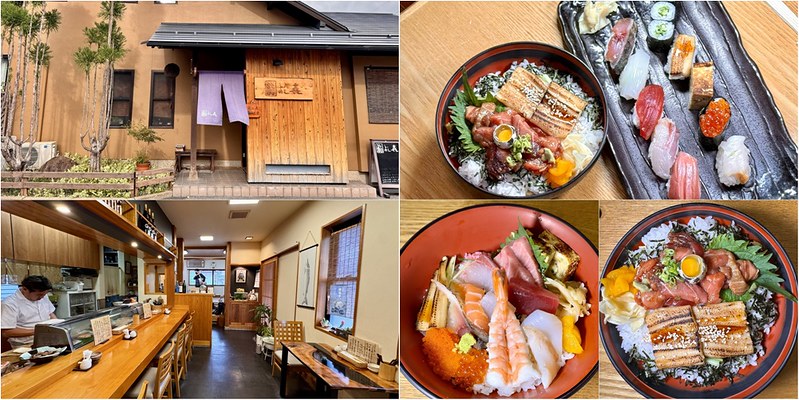
Sushi Yoshiki in Yonago offers sushi at approachable prices. A special set of nine pieces plus a roll is 1,700 yen, and the specialty marinated anago bowl is also just 1,400 yen.
Sushi Yoshiki (
Facebook fan page
): 4-12-15 Doshomachi, Yonago, Tottori Prefecture; telephone: +81 859-21-5728; hours: 11:30 a.m.-1:30 p.m. and 6:00-10:00 p.m. (closed Sundays)
Japanese cuisine naturally makes up the majority of Japan's Michelin-starred restaurants, and within Japanese cuisine, sushi, or "sushi" written with the character meaning refined sushi, is especially prevalent. The same is true in Taiwan. Yet in rural Tottori Prefecture, not one starred restaurant specializes in sushi. Its six starred establishments instead serve kaiseki, dishes with sake, izakaya fare, or kappo cuisine. Today, then, I will share a Michelin-recommended restaurant in Yonago specializing in sushi and seafood donburi. Although it opened only 13 years ago, its popularity is booming. Reservations are advisable, especially if you want to eat there on a holiday. The nine-piece and twelve-piece nigiri sets proved not only delicious but astonishingly good value, with the former costing 1,700 yen. The signature marinated-tuna-and-conger-eel donburi is also only 1,400 yen.
Sushi Yoshiki is behind Yonago Station, not far from Sushi Benkei, the popular conveyor-belt sushi restaurant in Yonago whose queues I shared earlier. See:
[Yonago Food in Tottori, Japan] Sushi Benkei: Hugely Popular Conveyor-Belt Sushi with Lines; White Shrimp from 120 Yen; Excellent-Value Three-Piece Sets; Tuna Trio, Seared Trio, and Crab-and-Shrimp Trio from 400 Yen
The area behind Yonago Station is part of the city's old downtown. There are ordinarily few tourists, and most people here are locals. If you prefer somewhere quieter, consider exploring this district in search of scenery and food. You just might find more excellent restaurants like Sushi Yoshiki. Meido Elementary School and Yonago Minami High School are both nearby.
Because it is Michelin-recommended and my Yonago friends described it as popular, the restaurant looked like a long-established shop when I reached it. I was surprised to learn that it had opened only 13 years earlier. The owner and sushi chef had previously worked at a famous sushi restaurant, however, so the shop attracted the attention of many gourmets as soon as it opened and naturally made it into Michelin.
In addition to the standard counter found in a sushi restaurant, the dining area has a shared space with about three tables for four. It can be rearranged for kaiseki dining or groups.
Many autographs from celebrities and media figures hang on the wall. Unfortunately, even after staring at them for quite a while, I did not recognize a single person xd
The lunch choices are relatively simple: nine pieces of nigiri for 1,700 yen or twelve for 2,000 yen. The other options are the signature conger-eel donburi, marinated-tuna donburi, and a bowl combining the two, all at the remarkably kind price of 1,400 yen. That price is especially precious at a Michelin-listed restaurant.
The drinks list includes sake and shochu. Nonalcoholic choices are oolong tea, cola, and orange juice.
The restaurant uses Tottori-grown Kinumusume rice, a variety developed by crossing Kinuhikari with Aichi No. 92. In addition to Hoshizora Mai, which Tottori has vigorously promoted in recent years, this is one of my personal favorite Tottori rice varieties.
The signature marinated-tuna-and-conger-eel donburi costs 1,400 yen. I originally thought it meant marinated conger eel, but it was actually a combination bowl of seared conger eel and marinated tuna. Another distinctive feature here is the egg served with it. Marinated tuna ordinarily uses lean meat, but this version even included belly. Although these were leftover edge pieces, the generosity was evident and the flavor was abundant.
The special seafood donburi costs 2,000 yen and contains twelve kinds of seafood, including conger eel. The ingredients are much the same as those in the nigiri set, so I will not introduce every item again.
The nine-piece assorted nigiri set, plus three small cucumber rolls, costs 1,700 yen. At this price it even includes medium-fatty tuna, making the ingredients an exceptionally good value. We have Tottori's affordable tuna to thank for that.
Generally, I am not very fond of shellfish, yet many sushi restaurants insist on putting it first xd. I had no problem with this restaurant's piece, however. It was moist and crisp, without the fishy shellfish smell that I dislike. Incidentally, the restaurant's vinegared rice is slightly tart and gently warm. I also prefer this sort of understated sushi rice.
Tottori's white squid has always been a favorite of mine. It is exceptionally crisp yet soft, with the melt-in-the-mouth quality I like as well. It was wonderfully delicious.
The salmon roe was standard, but at least it did not have the fish-liver-oil taste that I hate....
The conger eel was so tender that my chopsticks could barely hold it. As expected of a Yonago specialty, it was outrageously delicious. It had merely been lightly seared and brushed with so little sauce that the glaze was almost invisible, yet it tasted superb. The sauce seemed a little different from the one used on the conger-eel donburi.
This piece of amberjack was cut somewhat thick, concealing its fat beautifully. The instant it entered my mouth, that fat melted away to the ends of the earth. Together with the vinegared rice it was impossibly fresh and sweet, so good that I wanted to order another piece xd
Mackerel is another Tottori specialty. Only because it is fresh can it be thickly sliced and presented as the direct, unadorned challenge of nigiri. The seared skin is very fragrant and slightly crisp at first bite. No excessive sauce interferes; what you taste is the genuine quality of mackerel from Yonago, Tottori. If you are afraid to eat mackerel, I recommend trying it when you visit Tottori. Perhaps, like me, you will gradually accept it and even come to like it.
Many people may not know that Tottori ranks among Japan's leaders in tuna catches. Consequently, Tottori tuna, like its crab, is both excellent and affordable. That is what makes it possible to include tuna in a nine-piece sushi set costing 1,700 yen. At an ordinary sushi restaurant, a single piece of medium-fatty tuna might cost more than 1,000 yen. Even at a conveyor-belt sushi restaurant, a piece this large would probably cost at least 400 or 500 yen, would it not?
Because it is thickly sliced and large, it fills your mouth with a deeply satisfying bite and melts at an extraordinary rate. The fat dissolves, making it unbelievably sweet. With fish this delicious, I recommend using only a tiny dab of sauce. Better-quality salt would also work very well.
The lean tuna had none of the rusty iron taste I dislike. Although it lacked the fatty sweetness of medium-fatty tuna, it was equally full of flavor.
The many-layered rolled omelet had a gently refreshing sweetness and a rich egg aroma. The light browning on the outside was especially captivating.
More Michelin dining in Tottori:
[Michelin in Tottori, Japan] Hot Air: Visit a 500-Year-Old Hot-Spring Village in Rural Tottori for Michelin Ramen Made with Local Ingredients, Then Enjoy Three Free Footbaths
[Tottori Michelin Series 2] Jun: Japanese Cuisine with Tottori Ingredients, Including Tottori Horsehair Crab, Mosa Shrimp, and Exquisite White Squid; the Least Expensive Michelin One-Star Japanese Restaurant?
[Tottori Michelin Series 3, Japan] Michelin-Recommended Ajidokoro Shin in Kurayoshi: Bounty of the Sea of Japan, Gifts from the Mountains, and a Tottori Local-Cuisine Izakaya
[Tottori Michelin Series 4, Japan] Daisen Kuroushi-dokoro Kyoshotei: Michelin-Recommended Yakiniku, Tottori's Highest-Rated Yakiniku on Tabelog, and So Popular It Opened a Tokyo Branch
[Tottori Michelin Series 5] Michelin Plate Ajidokoro Misa: Red Snow Crab Kaiseki Lunch for 3,300 Yen, Affordable and Delicious
[Tottori Michelin Series 6, Japan] Shusai Kikyouya: A Modern Izakaya in Yonago Packed with Tottori Ingredients; Michelin-Starred Dining for Just 7,700 Yen at Dinner
[Tottori Michelin Series 7, Japan] Mitakien in Chizu: A 77-Year-Old Grandmother Spent 50 Years Creating This Picturesque, Hidden Japanese Garden and Mountain-Village Cuisine; Lunch Only
[小虎吃貨團 Michelin Star Tour of Japan 8: Tottori Food] Mitsuki: One of Only Two Michelin Two-Star Restaurants in Tottori and Tottori's Sole Selection Among Tabelog's Top 100 Restaurants
[小虎吃貨團 Michelin Star Tour of Japan 9: Yonago Food in Tottori] Hakushu Suzunoki: Michelin One-Star Dining, Ingredients from Tottori's Hakushu Region, and Hidden Traditional Kaiseki Cuisine of San'in
[Tottori Michelin Series 10, Japan] Ichishiro Kawaguchi: A Michelin-Recommended Restaurant in a Renovated Old House Serving an Omakase Meal of Soba and Tempura
[Tottori Michelin Series 11, Japan] Oenosato Noodle Shop: Tottori Udon, Broth, and Tenbiran Eggs in a Perfect Three-Part Harmony; Michelin-Listed Dining from Just 640 Yen
You are welcome to join
小虎吃貨團
and eat your way around the world with us.
You are also welcome to join
靠米其林生活
and share your Michelin experiences.
Source: 小虎食夢網 | Original URL: https://www.foodtigertw.com/blog/posts/3051006988
Where would you stay for this story?
This is a stay-recommendation demo. Partner links will be enabled after confirmation.
Kaike Onsen and Tottori stays
Choose an onsen inn, city hotel or stay area that fits the article context.