
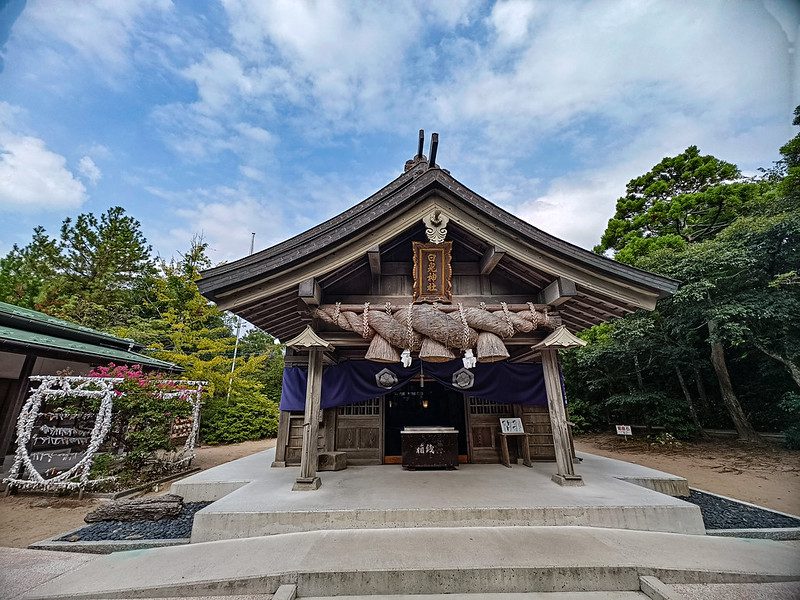
Hakuto Shrine is tied to the myth of Okuninushi and the White Rabbit of Inaba, making it one of Tottori’s best-known spots for matchmaking wishes. Pick up a white stone marked with the character for “bond” and take in the coast and the Kojiki legend.
Tottori’s Hakuto Shrine, a Place for Finding Love: The Story of Okuninushi and the White Rabbit of Inaba in the Kojiki
Featured Fun
鄉民食堂
When people hear that they can visit Tottori, many think of seeing Conan or Kitaro. For me, however, the places I most wanted to see were Hakuto Shrine and the Inaba Coast.
The reason is the story of Okuninushi and the White Rabbit of Inaba in the Kojiki.
Tottori Station — Hakuto Shrine (Fukumoto, Yazu Town) — Seiryuji Temple — Hakuto Coast and Hakuto Shrine — Tottori Station.
Hakuto Shrine is said to govern romance, so people who want to find a girlfriend or get married come to worship here.
Another story says that if you buy a white stone engraved with the character for “fate” at the shrine shop, throw it at the torii, and successfully land it on top, your romance will come true.
It is also said that people with skin conditions and similar problems can come here to pray for a connection and will recover.
How to Get There
Tottori Tourist Taxi for Foreign Visitors, 4,000 yen
Visit the Tottori Tourist Information Center for Foreign Visitors and confirm your route; they will then arrange a car. Pay the driver before getting out at the end of the trip.
Okuninushi and the White Rabbit of Inaba in the Kojiki
Here is a brief version of the story.
Okuninushi-no-Mikoto had eighty older brothers (or siblings). One day, they decided to court the beautiful Princess Yagami-hime of Inaba Province’s Inaba area, now part of Tottori Prefecture.
Okuninushi went with them, but because they bullied him, he was ordered to carry their luggage at the very back.
As they passed the Keta Coast—the famous Hakuto Beach—they saw a rabbit whose skin had been stripped off. The eighty brothers deliberately tormented the rabbit, telling it to wash in seawater and then dry itself in the wind on high ground to heal.
Of course, it could hardly have done anything but cause excruciating pain.
Kindhearted Okuninushi then asked the white rabbit what had happened. It replied: “I wanted to cross here from Oki Island, so I tricked the wani of the sea by saying, ‘Let us compare whether there are more wani or rabbits. All of you line up across the sea as far as the Keta Coast. I will walk over you one by one and count, and then we will know which clan is larger.’ They truly lined up and let me step over them all the way to the Keta Coast. But I became too pleased with myself and cried, ‘You fools!’ The last wani in the line tore all the skin from my body. Later I met the eighty deities. They told me to wash in the sea and dry myself on high ground, but that only left my entire body in unbearable pain!”
Okuninushi told the white rabbit to wash its body clean in river water and apply cattail pollen from the riverbank; it would then heal. (That location is the “Pond That Neither Rises nor Falls” at Hakuto Shrine.)
The grateful rabbit told him that Princess Yagami-hime of Inaba would choose Okuninushi, rather than any of his eighty brothers, as her husband.
Okuninushi later won the beauty’s hand and eventually became the deity Okuninushi, ruler of Ashihara no Nakatsukuni.
That is the story in the Kojiki. Many people will surely want to point out its oddities, but it is a myth.
Strange Points in the Story of Okuninushi and the White Rabbit of Inaba
First, the eighty deities—eighty brothers—are rather incredible. How did Susanoo father that many children...?
Then there is the fact that Okuninushi’s wife was actually Suseri-bime-no-Mikoto. (Worse still, the records say that Suseri was also Susanoo’s daughter.) Susanoo’s conditions for handing the land to Okuninushi were that he ambush the eighty brothers and
drive them onto the beach. He would then have to marry Suseri, build a palace, and erect tall crossed timbers reaching into the clouds... (It feels like he was really saying, “Get out and build a new country. Once you have a beautiful house, I will let you marry my daughter.”) (But according to one account, the two were brother and sister? This “German orthopedics” situation started remarkably early.)
After Okuninushi founded his country and married Suseri, he then married Yagami-hime from “The White Rabbit of Inaba.”
Perhaps the two had a good relationship and were engaged first? But he became engaged and then married Suseri before her...
Yagami-hime did marry Okuninushi, but she feared the domineering and intensely jealous Suseri. After bearing Okuninushi a child, she hung the child in a tree and fled...
Th-th-th-this... All right. Let us simply believe in the beautiful love story...
Yasuhiko Yoshikazu’s Version of Okuninushi
I actually read Yasuhiko Yoshikazu’s manga Okuninushi first, and only later read the Kojiki. (I had only just started my first year of high school then; there was no way I could understand the difficult original Kojiki.)
Yasuhiko Yoshikazu is a renowned Japanese manga artist with many works. He is particularly famous for designing the characters of the original Mobile Suit Gundam. Yes, he drew the original forms of characters such as Amuro and Char, whom people so often discuss.
In that manga, the story unfolds like this.
Okuninushi, an abandoned child, is a refugee who may have crossed over from Korea. Princess Suseri takes a liking to him and makes him her groom. Suseri is Susanoo’s treasured daughter: willful, tsundere, extremely beautiful, and wild in temperament. Later,
during an event to capture wild horses, Emishi attack them and her horse is shot dead with an arrow. The abandoned boy rescues her and then does OO with her, after which Suseri falls in love with him.
Suseri’s brothers dislike this lowly abandoned boy. They cannot accept that a common slave could possibly be worthy of their beloved aristocratic princess of a sister. Taking advantage of a campaign against the Emishi in Inaba Province’s Inaba area, now Tottori Prefecture, they make the abandoned boy a porter and plan to have him killed in the war.
Some readers may now say, “Weren’t the Emishi in Hokkaido? How could Tottori have been Emishi territory? You are lying.”
To explain, the manga’s afterword is clearer: to ancient Japanese people, “Emishi” simply referred to barbarians in the northeast. It was rather like early Han settlers in Taiwan indiscriminately calling Indigenous people fanren. I will leave it at that brief explanation here.
So Okuninushi becomes a porter, corresponding to the Kojiki passage in which he carries the luggage, and the army fights the Emishi along the way.
When the battle subsides, the abandoned boy sees a beautiful woman on the beach whose clothes have been stripped off and who is being forcibly O’d by the soldiers. This is the rabbit.
The abandoned boy rescues her. She says nothing. (Thus, there is no passage in which the rabbit promises to help him marry Yagami-hime.)
According to the manga’s plot, this rabbit is probably Yagami-hime herself. She is not merely a princess, but may be the highest-ranking shamaness of her people. She later helps Okuninushi in many ways, including with founding the nation, until Okuninushi says that he loves Suseri more, at which point she gives up and leaves.
Sea serpents and similar things are also manifestations of her power. (One theory says the sea wani were sea serpents.) In this version, Yagami-hime neither bears Okuninushi a child nor formally marries him.
This plot is more logical. Yet why would a White Rabbit woman with such immense power be OO’d by others? Perhaps she wanted to test the abandoned boy... (Though that is still quite difficult to explain.)
And so, carrying the basic understanding of Yasuhiko Yoshikazu’s Okuninushi that I gained in high school—and the Kojiki that I finished in university—I spent years without an opportunity to see the actual places.
Until this trip to Tottori.
Hakuto Shrine (Fukumoto, Yazu Town)
This tiny shrine stands amid rice fields. If you take the Wakasa Railway, get off at Koge Station and walk about 15 minutes.
We used the tourist taxi for foreign visitors, of course, so it took us directly alongside the shrine.
Tottori actually has many, many shrines named Hakuto Shrine.
This is one of the better-known ones.
History of Hakuto Shrine (Fukumoto)
The torii and shrine
The two white rabbits at the entrance have different poses.
The shrine’s sacred object was in fact moved away and is now at Seiryuji Temple.
The next stop on our matchmaking route was therefore Naritasan Seiryuji Temple.
Naritasan Seiryuji Temple
46 Shimomonoo, Yazu Town, Yazu District, Tottori Prefecture 680-0421
The temple is quite remote and is normally reached by car.
Cars can only be parked at the foot of the mountain.
Only after walking slowly uphill do you see the temple entrance.
The hand-washing basin
Continue upward here to reach the place relocated from Hakuto Shrine, although there is not much up there.
Cute ema plaques
The principal deity here is Fudo Myoo. You may remove your shoes and enter the rear hall, but photography is prohibited.
Inside is a statue of ocean waves and a white rabbit. Since photographs are not allowed, I cannot show it to everyone.
The white rabbit here is said to be the one that guided Amaterasu when she descended several hundred years ago.
Hakuto Shrine
When people speak of the largest Hakuto Shrine, they generally mean this one.
We first went to see the Hakuto Coast.
The sea is quite beautiful.
Here is the main highlight.
The torii on a small island in the sea is very famous.
It was so tiny that I strained to take one telephoto picture.
This sales center is also a place everyone visits.
It has many Tottori specialties.
If you like buying souvenirs, have a look.
This rabbit stationmaster is also famous, and everyone comes to see it.
A sacred place for lovers.
(I cannot help wanting to say: why do you never show the heroine? Could it be that you truly agree with Yasuhiko Yoshikazu’s version in which the rabbit is the heroine?)
The trees here.
Every rabbit has a stone placed on its head.
The determination to find a lover truly runs deep.
It seems Tottori simply has to have a sand sculpture.
At last, the heroine appears.
The legend as I originally heard it says you should throw a stone onto the torii.
But with it completely covered like this...
Would fulfilling your own romantic destiny require knocking somebody else’s stone down...? (That almost makes sense.)
Enter the shrine and wash your hands.
Incidentally, a torii is the gate between the human world and the realm of the gods.
After passing through it, show the gods greater respect and do not fool around.
Yet it still cannot avoid having stones placed upon it...
A close-up makes it clearer.
This is where the rabbit washed its body in the legend.
The shrine building
The story of Okuninushi
The worship procedure differs from that at an ordinary shrine, so pay special attention.
The place to tie your fortune slip after drawing it
Please use this as a reference.
Kikuza-ishi stones
Many shrines in Tottori also have a higher rear sanctuary.
I bought a cute rabbit and an amulet.
5/5 - (1 vote)
1 online user voted and commented
How many stars would you give the businesses, products, attractions, issues, and methods discussed in this article?
Click the stars and join the rating!
Yuai-tei Ramen in Osaka|Tabelog 3.69 and a Top 100 Restaurant; Recommended Shoyu Ramen in Nipponbashi
Taoyuan’s Most Recommended Shopping Center! Inside MetroWalk: Spring–Summer 2026 Art Installations + Must-Try Honolulu Food + a Major Renovation and Grand Return!
Auntie A-Gui’s Original Pork Rib Soup|A 50-Year Stall at Cisheng Temple in Dadaocheng; Light, Sweet Rib Soup for NT$90 with Free Refills, 2026
Alleyway Food by Nanjing Fuxing Station: Jin Yu Man Tang Taro Dumpling and Wonton Noodles
Must-Try Curry in Osaka Nipponbashi|Curry-ya Madras Main Shop: An Inexpensive and Delicious Tabelog Top 100 Restaurant
Kumamoto Independent-Travel Accommodation: DOMO HOTEL Ozu|By JR Higo-Ozu Station, with a Black Silica Public Bath and Spacious Tatami Room
Asakusa Food on a Tokyo Trip|MISOJYU, a Popular Queue-Worthy Traditional Japanese Breakfast Hidden in an Alley
Kumamoto Ozu Food: NIU Taiwanese Beef Noodles, a Rich Taiwanese-Japanese Broth Made Generously with Aso Akaushi Beef
Posted in
Featured Fun
About Us
“Helping good restaurants succeed is the mission of 鄉民食堂.”
We hope to bring restaurants many customers who visit specifically for them, generating foot traffic and revenue and becoming their best online marketing partner.
Contact us:
[email protected]
Recommended Food in Taipei’s Da’an District|A Review of Si Wei Xuan Taiwanese Cuisine, Lobster Sandwich and Hand-Dripped Mapo Tofu, with an Assessment of Its Creative Taiwanese Dishes (Online: 5)
Yilan Temple-Entrance Red-Fermented Squid: Yilan Food, a 60-Year Temple-Entrance Favorite That Grew from a Cart into a Store; Expensive but Always Tempting (Online: 5)
Han Tian Ge, Food by MRT Gongguan Station: Delicious, Inexpensive Korean Food Beside Gongguan Night Market, Beloved by Students (Online: 4)
Andong Street’s Old Beef-Noodle Shop|Wang Ji Beef Noodle King, with a Complete Introduction to Steamed Pork Ribs and Braised Beef-Tendon Noodles (Online: 3)
【Selected Guide to Taipei Hong Kong-Style Dim Sum in 2025】鄉民食堂 Recommends Taipei’s Eight Best Dim Sum Restaurants! (Online: 2)
Xin Dong Yang Lamb Cuisine, Food by MRT Zhongshan Junior High School Station: A Giant Mount Fuji-Sized Inexpensive Fried-Noodle Dish, a Must-Try Stir-Fry Near the Station (Views: 45,625)
Longjiang 35 Goose / Stir-Fries / Barbecue / Live Seafood, Food by Nanjing Fuxing Station, with Exceptional Goose and a Secret Goose-Oil Black-Vinegar Noodle Dish (Views: 38,388)
Yuanlai Fresh-Pork Xiaolongbao, Yilan Food: Large, Thin-Skinned Dumplings Packed with Filling and Scallions, Just NT$65 a Basket (Views: 33,798)
【Selected Guide to Hidden Must-Try Food at Taipei’s Dongmen Market in 2025】鄉民食堂 Recommends Eight Essential Dongmen Market Foods in Taipei (Views: 31,814)
Aburi-an Steak, Taipei Minquan Branch, Food by Zhongshan Junior High School Station: Tender Sous-Vide Japanese-Style Steak with Unlimited Rice, Miso Soup, Drinks, and Soft-Serve Ice Cream (Views: 27,901)
Recent Articles
Koufu Southeast Asian Flavors, Food by MRT Nanshijiao Station: Hugely Popular Southeast Asian Food and a Must-Try on Huaxin Street
Recommended Food in Taipei’s Da’an District|A Review of Si Wei Xuan Taiwanese Cuisine, Lobster Sandwich and Hand-Dripped Mapo Tofu, with an Assessment of Its Creative Taiwanese Dishes
Gangdu Stir-Fry Minsheng East Flagship Store Menu and Prices 2026|A Famous Stir-Fry Restaurant in Zhongshan District with Unlimited Rice and Ice Cream
Hidden Food by Taipower Building Station|Yi Pin Xiang Fish-Ball Rice-Noodle Soup, with a Complete Introduction to This Traditional Longquan Market Snack
Long Xian Seafood’s Fresh-Cut Sashimi|Limited to Longquan Market’s Weekend Morning Market, a Great Place for Salmon Run by a Fisherman
Ludian Su Lai Chuan (Su Family Ba-wan and Fried Rice Cake), Food by MRT Longshan Temple Station: 70 Years of Heritage; a Relocated Old Shop with Clean New Decor
Expand All
Collapse All
Traffic Statistics
Best Daily Traffic: 136,777
Cumulative Traffic: 24,076,045
GA4 Page Views
Boston Theme by
FameThemes
Source: 鄉民食堂 | Original URL: https://goodeat.tw/funplay/hakuto-shrine/
Where would you stay for this story?
This is a stay-recommendation demo. Partner links will be enabled after confirmation.
Kaike Onsen and Tottori stays
Choose an onsen inn, city hotel or stay area that fits the article context.