
Iwai Onsen has a history of more than 1,200 years. Akashiya Ryokan, founded in 1615, has men’s and women’s baths plus a garden mixed-gender open-air bath, and day bathing is also available.
Mar
Tue
Iwai Onsen, Tottori, Japan: Over 1,200 Years of History, the Oldest and Most Famous Hot Spring in the San'in Region; Akashiya, Founded in 1615, Is a Historic Inn Loved by Locals and Even Has a Very Daring Mixed-Gender Bath
When visiting Tottori Prefecture in Japan, you absolutely should not miss Iwai Onsen. With more than 1,200 years of history, it is said to have existed as early as 794 during Japan's Heian period, making it the oldest and most famous hot spring in the San'in region. Akashiya at Iwai Onsen was founded in 1615 and is a historic inn where locals love to bathe. Akashiya even has a mixed-gender bath that sends the embarrassment meter through the roof.
It may look as though you need to drive to reach Iwai Onsen, but Tottori actually has buses running to and from the hot spring every 30 to 45 minutes.
There are 20 services each day, so getting to Iwai Onsen is not difficult at all.
Iwai Onsen has a long history and a distinctive bathing custom: people strike the hot-spring water with a ladle while singing the Yukamuri song. Scenes of this local tradition have almost disappeared and can now be seen only among the very oldest generation of Japanese residents. Iwai Onsen is a sulfate spring,
and it is particularly effective at relieving
muscle aches. Akashiya is well known at Iwai Onsen. In addition to lodging and meals, it also welcomes day visitors who simply want a bath. Alongside separate men's and women's baths, there is a mixed-gender bath. Isn't that unusual? The streets of Iwai Onsen are lined with atmospheric old wooden houses. Suddenly, I felt as though I were Hiroshi Abe in the film Thermae Romae, traveling through time to Iwai a century ago.
Iwai Onsen, Tottori, Japan
Website 1:
http://yukamuri.net/
Website 2:
https://www.tottori-tour.jp/zh-tw/sightseeing/121/
Tottori transportation information:
http://www.nihonkotsu.co.jp/bus/limousine_route/route_tottori.html
Bus transportation to Iwai Onsen
Timetable from Iwami to Iwai Onsen
Timetable from Iwai Onsen back to Iwami
(We recommend taking JR from Tottori Station to Iwami Station, about 23 minutes, then taking a bus from Iwami Station to Iwai Onsen, about 8 minutes.)
I have always felt that if I travel to Japan without setting aside a day or two to soak in a hot spring, it does not really feel like a trip to Japan. In Tottori, I highly recommend the Kansuitei hot-spring hotel near Tottori Station, but I also suggest taking a bath at Iwai Onsen. In 1973, the Japanese government designated Iwai Onsen as a National Hot Spring Health Resort. That designation means it is considered a healthful hot spring whose waters are good for you. Ha, Japanese people really are interesting; they classify and rank everything.
As you can see, hardly any visitors from outside the area come to Iwai Onsen, but it has therefore preserved a very simple local character. The gateway bearing the words “Iwai Onsen” seems to freeze time several centuries in the past. At the end of the road stands a mountain of lush green mixed with red maple foliage, just like the countryside in a Japanese television drama.
Iwai Onsen has several hot-spring inns and places to bathe. On this day, we also encountered an elementary-school field trip visiting this facility in Iwai Onsen,
Yukamuri Onsen,
for a bath in its public bathhouse. Isn't that a little too luxurious? It is one of the great benefits of being a student who lives near Iwai Onsen. The children were happily chattering away. Soaking in a hot spring is certainly a joyful thing.
One legend about Iwai Onsen tells of a Fujiwara warrior suffering from a skin disease. One day, a goddess instructed him to dig here and draw out a spring. After bathing in it, his skin disease miraculously disappeared. This legend helped spread Iwai Onsen's fame far and wide. I wonder whether the white statue of a woman on the left depicts that goddess.
The geology around Iwai Onsen consists mainly of granite, quartz greenstone, and fragmented rock layers. Faults created the never-ending flow of hot-spring water. Local bathers have a custom of wrapping a towel around the head, using a ladle to pour water over it, and then striking the hot-spring water with the ladle. This bathing practice is also an important symbol of Iwai Onsen.
At Iwai Onsen you can also find the remains of a place called the Goseifuda notice board. It seems to have been where laws and official orders were posted. I think that is right, but please correct me if I am mistaken.
This wonderfully Japanese-style building is the Akashiya inn. Even the great Japanese writer Toson Shimazaki was deeply attached to it.
Stepping into Akashiya, you can feel a simple, old-fashioned atmosphere, yet the interior remains remarkably fresh and well maintained. That is something I admire about Japanese inns. The Japanese screens feature several designs, and you can also see an unpainted umbrella used in Tottori's Inaba Umbrella Dance.
Akashiya was founded in 1615 and now has more than 300 years of history. I do not think the building itself is more than three centuries old, however; it was probably renovated or rebuilt at some point, although I do not know the details. A poster for Iwai Onsen can also be seen at the front desk, and it is thoroughly enticing.
Akashiya also has a shop area. You can see colorful wooden carvings of the twelve zodiac animals, which are playful and adorable, as well as figures of men and women in yukata. These souvenirs are all distinctive.
Akashiya's landscaped garden looks like a painting and never grows tiring. Before or after a bath, even simply sitting absentmindedly on a sofa, you can become completely absorbed in its beauty.
The flourishing green plants instantly fill you with energy. This garden is also the outdoor view from the men's public bath, with the Gentlemen's Bath at the other end.
Inside Akashiya you can see old photographs and artifacts, as well as a vintage telephone that still works. The photographs also show Akashiya's appearance during the Taisho era, which does not look very similar to the building today.
Akashiya has five baths in total: the private open-air bath “Mori no Hakobune,” the private open-air bath “Tsuki no Shizuku,” the Gentlemen's Bath, the Ladies' Bath, and the Garden Open-Air Bath. Among them, I suddenly noticed
that “mixed bathing” was written in parentheses beside Garden Open-Air Bath. How cool is that? Ha, I absolutely had to go in and take a look later. To be honest, I have always been curious about Japan's mixed-bathing culture. If someone really were bathing there, I do not know whether I could calmly face them in the nude. Ha.
The washing area in the hot-spring bath is neat and clean, with every amenity needed for greater comfort. There are baskets on the other side for bags and other belongings, while the restroom is in the corridor outside the bathing area.
This pool is
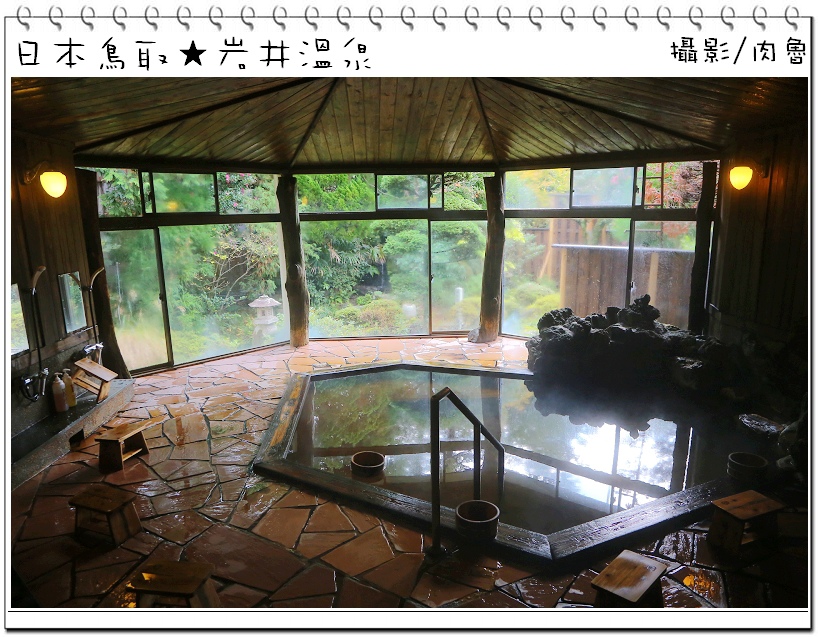
the Gentlemen's Bath, reserved for men. Its hot-spring pool is built from natural stone, with a large decorative rockery beside it. Three walls of floor-to-ceiling windows offer expansive views of lush greenery. This garden connects to the outdoor garden beside Akashiya's lobby. Remember not to get so carried away bathing that you wander in front of the windows, or you may accidentally give everyone in the lobby a full view. Heh. Iwai Onsen has just the right water temperature, so you can soak comfortably for a long time. The scene of curling steam is dreamlike; no wonder Akashiya is also known as the Bath of Romance.
The Gentlemen's Bath even contains a delightfully vintage thermometer. Soaking in a hot spring is one of the greatest pleasures of visiting Japan. Do not feel embarrassed about taking off everything. All the Japanese bathers are naked too, and you cannot understand what they are saying anyway, so relax completely and go down to compare sizes. Ah, I mean go down into the hot spring.
After leaving
the Gentlemen's Bath, I quietly slipped over to inspect the mixed-gender pool. Large amounts of Saji stone were used around the bath, creating the sensation of soaking in a forest. Several maple trees grow above it, and their leaves flutter down whenever the wind blows. It truly is the Bath of Romance.
Iwai Onsen is used almost entirely by local residents, so the chance of meeting a young woman in the mixed bath is probably extremely slim. Ha. Still, if I ever get the opportunity, I definitely want to experience mixed bathing at a Japanese hot spring. (Clenches fist…
Continuing farther inside, you can see a cute image of Fugaku on the wall; I think it refers to Mount Fuji. This room is the Ladies'
Bath, reserved for women.
The Ladies' Bath has no windows facing outside, unlike the Gentlemen's
Bath, which is completely different.
The Ladies' Bath uses a great deal of chestnut wood, so a pleasant woody fragrance greets you when you enter. It almost makes me want to disguise myself as a woman and sneak in for a soak. Ha.
In addition to the open-air baths, Akashiya's guest rooms each have their own private open-air bath. I really like the tatami-floored Japanese rooms. A table and chairs beside the floor-to-ceiling windows offer a place to sit and daydream.
Step outside the guest room and there is a bathing pool all to yourself. It is truly wonderful. If I get the chance, I must stay here and have dinner too.
I fell deeply in love with Iwai the moment I saw its old streets, and I fell deeply in love with the quality of its water the moment I soaked in Iwai Onsen. It is fantastic. When you visit Japan, you must enjoy a hot spring; when you visit Tottori, you must soak at Iwai Onsen. I guarantee you will not want to leave.
Here is also a photograph of me bathing with Japanese men in the Gentlemen's
Bath. Ha, how embarrassing.
The Tottori Sand Dunes, Japan: An Incredible, Fantastical Hidden Landscape Formed by 100,000 Years of Natural Forces, Offering the Magical Feeling of Roaming the Sahara and Even Camel Rides Across the Dunes (About 2.5 Hours from Osaka to Tottori Station and 0.5 Hours from Tottori Station to the Dunes)
Takumi Kappo, Japan: Exquisite Tottori Wagyu with Evenly Distributed Marbling That Melts in Your Mouth, a Comfortable Wooden Japanese Tatami Setting, and Delicious Wagyu Shabu-Shabu You Must Eat in Tottori at the Birthplace of Japanese Shabu-Shabu
Hakuto Shrine, Tottori, Japan: Japan's Cutest Rabbit Charms, Irresistibly Adorable Rabbit Souvenirs, the Myth of the White Rabbit of Inaba, a Deity of Matchmaking and Prayers for Good Relationships, and the Lovers' Sanctuary at Hakuto Coast
Japan: Make the Most of Tottori's 1,000-Yen Taxi Transportation Offer, a Sightseeing Service Available Only to Foreign Visitors and Usable Even by One Person. The Car Has a Japanese-Chinese Translation System, So Communication Is Easy Without Knowing Japanese. Each Ride Can Be Used for a Full Three Hours. For the Tottori Sand Dunes, Hakuto Shrine, Hakuto Coast, Uradome Coast, Tottori Castle Ruins, or Amedaki Falls, the 1,000-Yen Sightseeing Taxi Is the Right Choice
Bus times from Iwami Station to Iwai Onsen:
Iwai Onsen
Iwami Station bus
Times:
Walk around attractions near Iwai Onsen:
[Map Sight 1] Oguraya [Map Sight 2] Midori Osaki Museum (Yukamuri Gallery) [Map Sight 3] Former Iwai Elementary School
[Map Sight 4] Birthplace of Midori Osaki and Saihoji Temple [Map Sight 5] Miyu Shrine [Map Sight 6]
Ito Isshindo—Iwai Onsen specialty confection “Oni no Wan”
[Map Sight 7] Craft Hall and Iwai Kiln [Map Sight 8] Mana Kairo no Sato [Map Sight 9] Yukamuri Bridge
[Map Activity 1] Iwai Ground Golf Course [Map Activity 2] Iwami Municipal Iwai Sports Facility—Tennis Courts
[Map Activity 3] Nakajima Liquor Store [Map Activity 4] Sapporo Ramen Dosanko Iwai Branch [Map Activity 5] Iwai Waterside Park
Iwai Onsen 2016 Retro Bus Tour
Official website:
http://www.iwamikanko.org/articles/view/263
Iwai Onsen, Tottori, Japan
Website 1:
http://yukamuri.net/
Website 2:
https://www.tottori-tour.jp/zh-tw/sightseeing/121/
Tottori transportation information:
http://www.nihonkotsu.co.jp/bus/limousine_route/route_tottori.html
Bus transportation to Iwai Onsen
Timetable from Iwami to Iwai Onsen
Timetable from Iwai Onsen back to Iwami
(We recommend taking JR from Tottori Station to Iwami Station, about 23 minutes, then taking a bus from Iwami Station to Iwai Onsen, about 8 minutes.)
Iwai Onsen—Akashiya
Website:
http://www.akashiya.to/
Address: 536 Iwai, Iwami-cho, Iwami-gun, Tottori Prefecture
Telephone: 0857-72-1515
Fax: 0857-72-1518
Fee: About 800 yen per person for the public bath
Rou Lu: Traveling Taiwan's Hidden Places and Exploring Beautiful Scenery in Japan and Korea
Posted by Rou Lu in
Popular (
Overseas Travel
Japan Travel
Source: 肉魯 走遍全台灣●環遊全世界 | Original URL: https://damon624.pixnet.net/blog/posts/43519298
Where would you stay for this story?
This is a stay-recommendation demo. Partner links will be enabled after confirmation.
Kaike Onsen and Tottori stays
Choose an onsen inn, city hotel or stay area that fits the article context.