
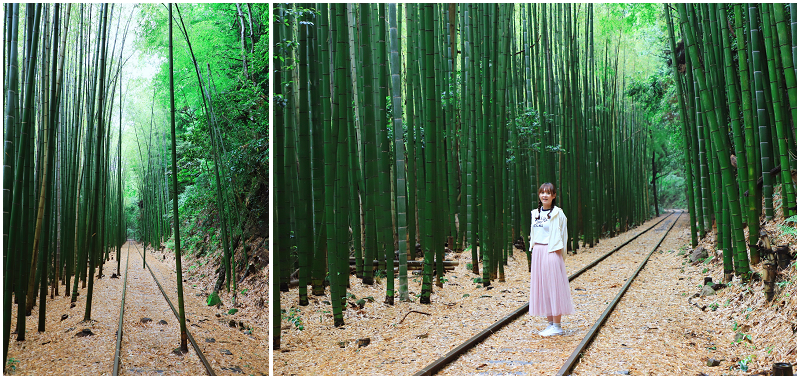
The former Japanese National Railways Kurayoshi Line tracks run through about 100 meters of bamboo forest. It is a little over 10 minutes on foot from the tourist information center, but if taking a bus, note that direct services to Taikyuji-iriguchi are limited.
Jun
Thu
Tottori, Japan Attraction! Former JNR Kurayoshi Line! A Dreamlike Secret Bamboo Grove on the Railway! Named Japan’s Most Beautiful Abandoned Railway by Japanese Internet Users! Complete Bus Directions Included!
Tottori, Japan Attraction! Former JNR Kurayoshi Line! A Dreamlike Secret Bamboo Grove on the Railway! Named Japan’s Most Beautiful Abandoned Railway by Japanese Internet Users! Complete Bus Directions Included!
When traveling in Tottori, Japan, I strongly recommend visiting the former JNR Kurayoshi Line, praised by Japanese internet users as the country’s most beautiful abandoned railway. A lush bamboo grove grows over the disused tracks, creating a perfectly harmonious scene that feels like passing through a tunnel in time. Walking along the railway is reminiscent of the Mianyue Line in Alishan. Even without a car, you can take a bus from Kurayoshi Station and easily reach the secret bamboo-grove railway on the former JNR Kurayoshi Line. Tigerair Taiwan now flies directly to Tottori’s Yonago Kitaro Airport, making travel in Tottori even more convenient! Map of the former JNR Kurayoshi Line:
Click here to download
Former JNR Kurayoshi Line—Secret Bamboo Grove: Driving and Public Transportation Directions
Public transportation: The bus stop in front of the Former JNR Kurayoshi Line Tourist Information Center is called Taikyuji-iriguchi. Only five buses on the Sekigane Line from Kurayoshi Station reach Taikyuji-iriguchi, making round-trip timing difficult. Fortunately, the Sekigane Line itself departs once an hour, and most services terminate at Sekigane Chosha-mae. The alternative is therefore to ride to Sekigane Chosha-mae and walk to the tourist information center. The walk follows about 1.8 kilometers of rural industrial road, allowing you to complete a relaxed and easy visit to the former Kurayoshi Line’s secret bamboo grove.
Official Kurayoshi Tourism Information website:
Click here to view
Kurayoshi–Sekigane Line timetable (departing Kurayoshi Station):
Click here to view
Kurayoshi–Sekigane Line timetable (returning to Kurayoshi Station):
Public transportation timetable and route reference:
▲ This is the Sekigane Line timetable from Kurayoshi Station. At first glance, there seem to be many buses, but most go only as far as Sekigane Chosha-mae, and just five reach Taikyuji-iriguchi. Taikyuji-iriguchi is the starting point for the walk to the secret bamboo grove. Do not make the mistake of limiting yourself to those five buses. Instead, take one of the more frequent services, get off at Sekigane Chosha-mae, and walk about 1.8 kilometers, or 26 minutes, to the tourist information center. This lets you visit the secret bamboo grove smoothly during the morning.
▲ Taking the 07:50 service from Kurayoshi Station and getting off at Sekigane Chosha-mae is recommended. Here is the timetable from the Sekigane Chosha-mae bus stop back to Kurayoshi Station:
▲ The walk from Sekigane Chosha-mae to the tourist information center is not actually very far. There are many rice paddies along this section, making it a pleasant walk. It feels like a combination of the Lanyang Plain and traditional Japanese houses.
▲ This is the Former JNR Kurayoshi Line Tourist Information Center. The JNR Kurayoshi Line was built in 1912. In its later years, ridership became very low, while households along the route owned their own cars. The line was therefore abolished in 1985 and has remained closed ever since. The tourist information center opens only on Fridays, Saturdays, and Sundays. Beside it is the excellent Kunsei Doraku; its smoked chashu ramen and smoked chashu rice bowl are highly recommended. The entrance to the former railway is right next door.
▲ The tourist information center has free parking. Some people may want to drive directly to the secret bamboo grove, but parking is not permitted there. Walking from here is the most convenient option.
▲ Signs for the former Kurayoshi Line walking trail can be seen beside the tourist information center.
▲ The secret bamboo grove is only a little over ten minutes away on foot.
▲ Once you walk up, you reach an abandoned railway with rice-paddy scenery on both sides. It is a genuinely pleasant place to walk.
▲ Following the old tracks leads to the secret bamboo grove. There is only one path straight ahead, so there is no need to worry about getting lost.
▲ Continue forward and you will see the graves of earlier Japanese residents on the right. There is no need to be afraid if you come with good intentions. Opposite the cemetery is the finest part of the old railway. A sign stands here, along with a vending machine and a capsule machine dispensing old-style tickets.
▲ The Taikyuji Station sign is mottled and faded. Trains no longer pass through the old station, but its platform is still preserved.
▲ Continue ahead to reach the former Kurayoshi Line’s secret bamboo grove. This section of old track is also very well maintained.
▲ The secret bamboo grove lies just ahead! Seeing it from a distance makes it look like some beautiful enchanted boundary. The railway amid the bamboo is an extraordinary sight.
▲ After the railway was abandoned, tree roots quietly invaded the rails. It feels as though they have encroached on another’s territory, yet the two also seem to blend and coexist.
▲ The former Kurayoshi Line’s secret bamboo grove is wonderfully dreamlike. Time seems to have been paused here, while wind rustling through the bamboo sounds like a symphony of nature.
▲ Two bamboo stalks have also occupied the space between the rails, growing straight up from inside the tracks.
▲ The secret bamboo-grove section is not actually very long—only about 100 meters—but it looks truly beautiful in photographs.
▲ The former Kurayoshi Line is beautiful but not widely known. No one else was there when we visited, so we thoroughly enjoyed having the place to ourselves.
▲ Rails extending into the distance and an unbroken green bamboo grove intertwine to create the most beautiful abandoned-railway scenery in Tottori.
▲ When framing your photographs, remember to include the two bamboo stalks that have secretly slipped between the rails.
▲ In summer, however, the bamboo grove has more mosquitoes, so remember to use insect protection. We came in early June, when it was not yet too hot.
▲ Continue forward, then turn back to take a photograph. It feels rather like walking on Alishan’s Mianyue Line.
▲ The Kurayoshi Line originally connected Kurayoshi Station in Kurayoshi, Tottori Prefecture, with Yamamori Station in Sekigane, Tohaku District. The route was about 20 kilometers long. Ridership gradually declined, and the line was ultimately abandoned because most local residents had come to use private cars.
▲ Walk past the secret bamboo grove and continue forward to reach the end of the former Kurayoshi Line: Yamamori Tunnel.
▲ Looking back at the railway and bamboo grove we just traversed reveals a wonderfully tranquil scene. It is easy to imagine that when the Kurayoshi Line was still operating, everyone passing this section must have taken out their phones and cameras and shot photograph after photograph.
▲ Follow the curving rails straight ahead to see the closed Yamamori Tunnel. On specified dates each year, a walking event is held at the tunnel. Participants can enter and explore inside.
▲ I hope that on my next visit to Tottori, I can join an open-day event on the abandoned former JNR Kurayoshi Line trail.
▲ Only three event sessions remain this year, in October and November. Event details:
▲ Allowing two to three hours for the former Kurayoshi Line is recommended, counted from the entrance by the tourist information center. This makes it easier to plan around the return bus to Kurayoshi Station.
▲ The former Kurayoshi Line is a rare abandoned railway in Japan, and the bamboo grove makes it even more unique. I love the relaxed tranquility here.
▲ Beside the old Taikyuji platform is a vending machine selling tickets to Yamahisa Station. You can stamp the ticket with today’s date, and best of all, there are conductor’s punch pliers. Punching the ticket makes it look as if it has actually been used for a journey. It costs ¥200.
▲ No more saying that you cannot visit the former Kurayoshi Line’s secret bamboo grove because you do not drive. I have clearly explained how to reach it without a car!
▲ The Tottori-han Norihodai Tegata allows unlimited bus travel in Tottori for three days. One version of the wooden pass is illustrated with the former Kurayoshi Line’s secret bamboo grove. Cool, isn’t it? Tottori-han Norihodai Tegata:
Click here for details
▲ After walking through the secret bamboo grove, I strongly recommend having a bowl of smoked-pork ramen or a smoked-pork rice bowl at Kunsei Doraku beside the tourist information center. This restaurant has quite a story behind it; wait for 肉魯’s dedicated article for the full introduction.
Directions to the Former JNR Kurayoshi Line:
By public transportation, take a Sekigane Line bus from Kurayoshi Station, get off at Sekigane Chosha-mae, and walk approximately 1.8 kilometers to the Former JNR Kurayoshi Line Tourist Information Center. Links for checking outbound and return services appear below. The Sekigane Line departs from stop 2 at the Kurayoshi Station bus terminal.
Kurayoshi–Sekigane Line timetable (departing Kurayoshi Station):
Kurayoshi–Sekigane Line timetable (returning to Kurayoshi Station):
肉魯 走遍台灣秘境・探索日韓美景
Posted by 肉魯
Popularity (
International Travel
Travel in Japan
Source: 肉魯 走遍全台灣●環遊全世界 | Original URL: https://damon624.pixnet.net/blog/posts/49648544
Where would you stay for this story?
This is a stay-recommendation demo. Partner links will be enabled after confirmation.
Kaike Onsen and Tottori stays
Choose an onsen inn, city hotel or stay area that fits the article context.