
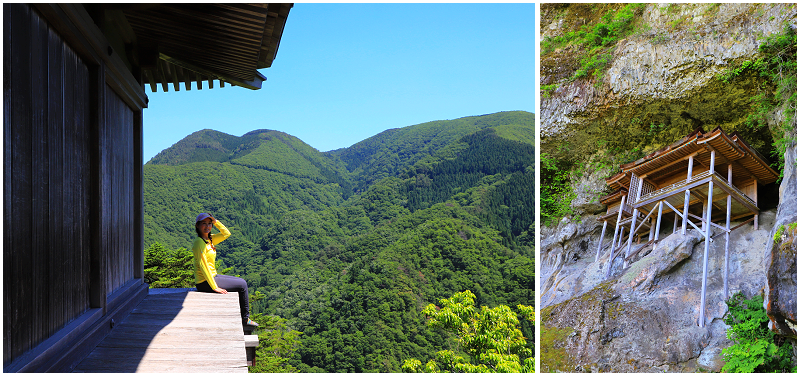
Mitokusan Nageiredo is a temple hall built into a cliff face. The approach involves climbing tree roots, rocks, and chains, so go with at least one companion, wear hiking shoes, and allow 3 to 4 hours for the round trip.
June
Monday
A Tottori attraction in Japan: Mount Mitoku’s Nageiredo, known as Japan’s most dangerous national treasure, with boundless mountain views and an incredible structure suspended on a cliff!
A Tottori attraction in Japan: Mount Mitoku’s Nageiredo, known as Japan’s most dangerous national treasure, with boundless mountain views and an incredible structure suspended on a cliff!
Mention Tottori, Japan, and many people think of the Tottori Sand Dunes. Yet the pilgrimage destination travelers most yearn to see is Nageiredo on Mount Mitoku. Suspended within a rock face, the method used to build the hall remains a mystery, and it has also been designated part of Japan Heritage. The pilgrimage trail requires visitors to climb trees, walk over roots, scramble up rocks, and pull themselves along chains. Solo entry is forbidden; visitors must enter in groups of at least two. Approved hiking shoes are required, or hikers must tie straw rope around their footwear or wear straw sandals. Monjudo offers an apparently infinite mountain panorama, but its wooden platforms on three sides project from a giant rock and may terrify anyone afraid of heights. Beyond the green ranges, Mount Daisen in Tottori is also visible, creating a realm of purified senses. Nageiredo has more than 1,300 years of history and is easy to reach for a pilgrimage by either car or bus.
🚌Public transportation to Mount Mitoku Nageiredo🚌
▲Buses to Nageiredo are frequent and depart from conveniently located JR Kurayoshi Station. Even without a car, the bus reaches Mount Mitoku from Kurayoshi in just over 30 minutes. The last return service leaves the Mitokusan entrance at 5:23 p.m., leaving ample time for a day trip. I recommend getting off at Mitoku, one stop after Mitokusan Sando Iriguchi. Follow the signs for a three-minute walk to the Mount Mitoku reception and information office. Tottori bus routes and timetables:
Click to view
Round-trip bus route for Mount Mitoku Nageiredo: Route 71, Agei-Misasa Line (Kurayoshi Station–Mitokusan), Takedabashi
Departures from and returns to Kurayoshi Station
Weekday timetable for Mount Mitoku Nageiredo:
Click to view
Holiday timetable between Kurayoshi Station and Mount Mitoku Nageiredo:
▲For Nageiredo, I recommend the earliest service from Kurayoshi Station, departing at 7:45 a.m. and arriving at 8:20. Good stops are Mitoku or the Mitokusan parking lot. The parking lot has well-maintained restrooms that are useful before the climb. Walk uphill beside the restrooms to reach the Mitoku bus stop, where signs point toward the reception office. Admission is required to enter the Mount Mitoku pilgrimage area.
▲The last bus from Mount Mitoku back to Kurayoshi Station departs at 5:23 p.m. Some people say reaching Nageiredo without a car is difficult, but they simply have not worked out the transportation. Frequent services make it highly suitable for visitors who do not drive or rent a car.
▲We rented a car for this Tottori trip, but the drive itself covers a fair distance. Taking JR to Kurayoshi and transferring to the bus is actually easier. Bus passengers should consider getting off at the final stop, the Mitokusan parking lot, primarily because it has clean, convenient restrooms where they can prepare before hiking.
▲The Mitokusan parking lot is spacious and easy for drivers to use.
▲A convenient and exceptionally clean restroom stands beside the Mitokusan parking lot. I recommend taking care of any physical needs here.
▲Continue past the side of the restroom, cross the bridge, and climb the stairs. At the top, turn right and the bus stop will be ahead on the left.
▲This is the Mitoku bus stop. If you do not need the restroom, simply get off here.
▲A map and directions stand beside the Mitoku bus stop. Climbing the stairs leads to the pilgrimage
reception desk, the paid entrance for Sanbutsuji Temple and Mount Mitoku Nageiredo.
▲Mount Mitoku has two separate fees. The first is 400 yen for Sanbutsuji Temple; the second is 800 yen to proceed to Nageiredo. Anyone entering the Nageiredo route must first buy a ticket here.
▲Visiting only Sanbutsuji costs 400 yen. Reaching Nageiredo, the temple’s inner sanctuary, costs another 800 yen.
▲This map of Mount Mitoku Nageiredo helps explain the locations.
▲First pay 400 yen here. You receive a commemorative sheet bearing prayers to ward off misfortune and dispel illness.
▲Continue uphill between tall, straight trees reaching toward the sky. Sanbutsuji’s main hall appears above.
▲I recommend not lingering at the main hall yet. Head first for the Nageiredo pilgrimage trail. This is a moderately difficult climb, so allow three to four hours for the round trip.
▲Equipment guidance appears along the route. Solo entry is forbidden and parties must contain at least two people. Trekking poles are also prohibited because the trail requires both hands and feet, poles are awkward to use, and they damage vegetation. Footwear is critical: be sure to wear hiking shoes.
▲Staff at the pilgrimage climbing office inspect your shoes first. Flat-soled shoes require straw rope tied around them or the purchase of straw sandals. Everything is done for safety. Shoes with deeply textured soles are strongly recommended, because both rope and straw sandals are difficult to walk in and can be slippery. This Hong Kong couple’s shoes were rejected, so staff asked them to buy and tie on straw rope. They said it made walking extremely difficult.
▲Consider buying a pair of gloves as well, to protect your hands while pulling chains and climbing rocks. A pair costs 100 yen, or you can bring your own. Most importantly, everyone receives a ceremonial rokko-shojo stole. Put it on and you are ready to begin the pilgrimage to Nageiredo. The stole must be returned afterward.
▲The pilgrimage climbing office provides detailed precautions. Even without Japanese, visitors can understand the illustrations.
▲The Hong Kong couple wearing straw rope truly struggled to walk. For safety, I sincerely recommend arriving in hiking shoes. This is extremely important: one careless slip could threaten your life.
▲Passing through this gate officially begins the trail to Mount Mitoku Nageiredo. The towering trees at the entrance create a sense of pilgrimage ritual.
▲Immediately after entering, you receive the grand gift of a tree climb: a 70-degree slope where you step on roots and climb using both hands and feet.
▲Challenging terrain appears everywhere. Regular hikers will manage it, but people who rarely climb may find one difficulty after another.
▲If it rained the previous day, visiting Nageiredo is not recommended because the route will be wet, slippery, and difficult.
▲After roughly 40 to 50 minutes of moving on hands and feet, you reach Monjudo, the most beautiful point on the Nageiredo route. The famous online photographs of a high platform and endless mountain scenery are taken here. This is also where you begin climbing chains up an approximately 80-degree slope. The outward and return routes differ. On the return, you descend almost straight down on the right, which is harder to negotiate.
▲Grip the chain firmly and move slowly, one step at a time. Without a fear of heights, it is not too difficult. The easier route goes up beside the wooden post on the right.
▲Monjudo is raised on wooden supports above the rock. Looking up from below, it is truly spectacular.
▲After Roulu climbed up, it was his wife Daidailing’s turn to climb
. Remember, the slope is steeper in person than it appears in photographs. Keep a firm hold on the chain.
▲The view from Monjudo is magnificent, with lush green forest stretching ahead.
▲Beneath the wooden platforms on three sides of Monjudo is a very high open drop, so walk with extreme care. Some people are too afraid to stand and instead move across the platforms while sliding on their bottoms.
▲Monjudo’s boundless mountain panorama is deeply soothing, and the breeze through the forest is pleasantly cool.
▲Search online for Mount Mitoku Nageiredo and most results show one of two things: the hall’s unique architecture suspended against the cliff, or Monjudo’s unbeatable mountain panorama.
▲Every casual photograph captures a beautiful view. Allow about 30 minutes at Monjudo to take pictures and enjoy the scenery.
▲Nageiredo does not actually receive many visitors, and almost all are Japanese. It is easy to have Monjudo nearly to yourself for photographs. Weekdays are best, however. With holiday crowds, taking unhurried pictures there becomes difficult.
▲The other side of Monjudo looks toward Mount Daisen and Yonago.
▲Zoom in to see the majestic outline of Mount Daisen in Tottori. When I spotted it, I cried out in surprise that we really could see it.
▲This is the wooden platform on the other side of Monjudo. Direct sunlight probably reaches it only after one or two in the afternoon.
▲The drop below Monjudo’s wooden platform really is high. Leave your backpack on the rock so it cannot strike something while you are wearing it and accidentally send you into the valley.
▲The wooden platform creates real pressure. Walk carefully and deliberately, slowing your steps.
▲After taking photographs at Monjudo, continue toward the final destination, Nageiredo, and sheer cliffs immediately confront you. Hold the chain and move slowly. Much of the terrain depends on the grip of your shoes, so hiking footwear is considerably safer.
▲Looking back at Monjudo, where we just took photographs, it seems astonishing that anyone could build a structure on a sheer cliff.
▲About six minutes from Monjudo is Jizodo, which looks similar. From the information I had read, I thought there was only Monjudo and did not expect to find Jizodo above it.
▲After seeing so many photographs from the Nageiredo route, you understand why hiking shoes are required and why you should not come for a day or two after rain. The terrain is already rugged and variable; after rain it becomes wet and slippery, making falls easy.
▲Reaching Jizodo requires two short sections using chains. Pass them carefully and you arrive at the hall.
▲Jizodo’s wooden platform does not create the same pressure of a potential fall as Monjudo. Visitors afraid of heights should consider stopping here.
▲Jizodo stands slightly higher than Monjudo. Its endless mountain panorama is equally beautiful, and the crowd is much smaller.
▲The view from Jizodo is also superb. Slightly higher than Monjudo, it overlooks rolling mountain ranges that make every worry disappear.
▲Continue upward to reach the bell tower. This posture is the correct way to ring the bell. We could hear ringing while walking below; it came from everyone praying here.
▲Continue toward Nageiredo. The challenge of the journey represents inner discipline and the Buddhist practice of purifying the six senses to return to one’s original simplicity.
▲Before reaching Nageiredo, the route passes Kannondo, built into the rock face.
▲Circle behind Kannondo and look back. This building, too, is an extraordinary feat.
▲Turn the corner and you reach Mount Mitoku Nageiredo. Deep in the mountains of Tottori Prefecture, this building is a national treasure and part of Sanbutsuji Temple. Its defining feature is its suspension on a vertical cliff, as if it had been thrown into the rock face—hence the name Nageiredo, or “thrown-in hall.” Legend says a Heian-period ascetic monk built it with supernatural power, and it remains astonishing today. The climb is highly demanding, requiring rock scrambling and stream crossings. Precisely because of that, pilgrims can experience unprecedented stillness and awe on a path where nature and faith intertwine.
▲Seeing Nageiredo suspended against the cliff with your own eyes is truly breathtaking. It is one of Japan’s most representative centers of mountain worship and a national-treasure building. On a trip to Tottori, I wholeheartedly recommend making this pilgrimage. The descent from Nageiredo is not easy either, so move with care at every step.
▲Signs mark the descent along the return route. The hardest section is below Monjudo, where the route drops almost vertically. Move slowly, grip the chain tightly, and exercise care. The photograph on the right shows the Monjudo descent.
▲People say going up is easy and coming down is hard. At Nageiredo, the ascent is not easy and the descent is difficult too. Safety is essential, and I hope every visitor returns unharmed.
Anyone planning to visit Nageiredo should remember these points:
✅Entry requires a party of at least two; solo climbing is prohibited.
✅Hiking shoes are recommended. If staff judge your footwear unsuitable, you must pay to tie on straw rope or wear straw sandals.
✅Do not visit the day after rain. The route is wet, slippery, hard to walk, and dangerous.
✅Trekking poles are prohibited because they damage vegetation and soil.
✅The Nageiredo climbing route resembles a miniaturized version of an intermediate mountain route in Taiwan.
✅Visitors taking the bus from Kurayoshi Station can get off at the final Mitokusan parking-lot stop, which has clean restrooms.
✅Allow about three to four hours for the round trip to Nageiredo, walking and photographing at a relaxed pace.
Round-trip bus route for Mount Mitoku Nageiredo: Route 71, Agei-Misasa Line (Kurayoshi Station–Mitokusan), Takedabashi
Departures from and returns to Kurayoshi Station
Weekday timetable for Mount Mitoku Nageiredo:
Holiday timetable between Kurayoshi Station and Mount Mitoku Nageiredo:
Roulu: traveling Taiwan’s hidden places and exploring beautiful scenery in Japan and Korea
Posted by Roulu in
Popular (
International travel
Japan travel
Source: 肉魯 走遍全台灣●環遊全世界 | Original URL: https://damon624.pixnet.net/blog/posts/49651352
Where would you stay for this story?
This is a stay-recommendation demo. Partner links will be enabled after confirmation.
Kaike Onsen and Tottori stays
Choose an onsen inn, city hotel or stay area that fits the article context.