
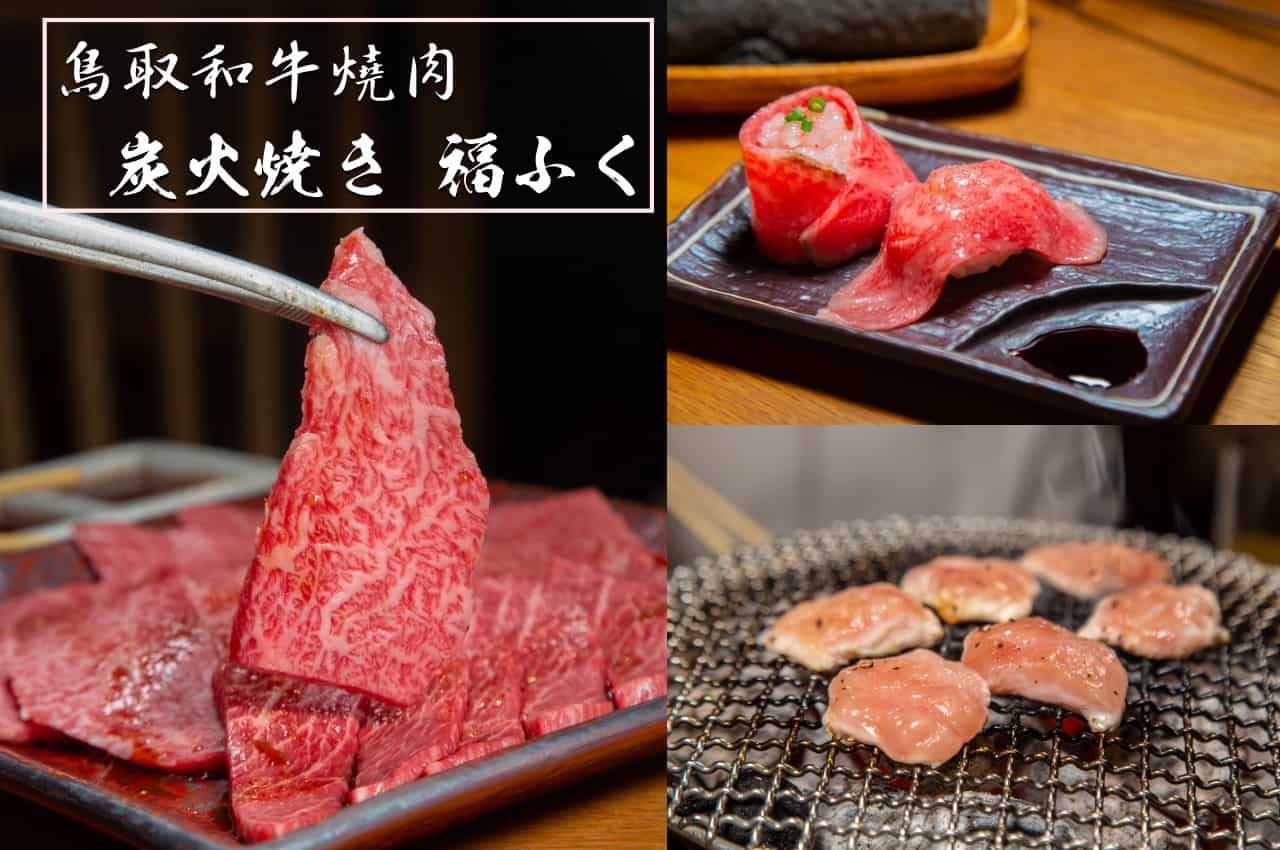
Sumibi Yakiniku Fuku is about a 7- to 10-minute walk from JR Tottori Station, specializing in Manyo Beef and Tottori Wagyu Olein 55. Reservations are recommended at least one day in advance.
Tottori food and recommended Tottori wagyu yakiniku | Taste the many flavors of Tottori wagyu at Charcoal Yakiniku FUKU
When Taiwanese diners think of Japanese wagyu, the three best-known names are Matsusaka, Kobe, and Omi beef. Miyazaki and Kagoshima beef have also become very popular lately. In fact, almost every city in Japan has its own wagyu brand. On my latest trip to Tottori, I tried Tottori wagyu for the first time and was unexpectedly impressed.
Tottori wagyu is Japanese Black beef. Its marbling is not excessive, but it is evenly distributed. The moment the beef enters your mouth, the aroma of its fat spreads clearly, accompanied by a faint, smooth fragrance. The texture is exceptionally tender and delicate. Wagyu lovers probably know about the National Competitive Exhibition of Wagyu, held once every five years to select Japan's best beef. Ketaka, a Tottori wagyu, won the very first competition. Calling it the ancestor of Japan's branded wagyu would not be an exaggeration.
Shabu-shabu and grilling are the best ways to enjoy Tottori wagyu. On a local resident's recommendation, we came to Charcoal Yakiniku FUKU. It is about a ten-minute walk from Tottori Station and easy to reach.
Charcoal Yakiniku FUKU / Sumibiyaki Fuku Fuku
Address: 334-2 Yayoi-cho, Tottori City
Telephone: +81 857-50-0029
Hours: 6:00-11:00 p.m. (last order at 10:30 p.m.); closed Sundays. Reserving the meal one day ahead is recommended
Access: about a 7-10 minute walk from Tottori Station
Related link:
Facebook fan page
Tottori wagyu is broadly divided into several brands, including Manyo Beef, Tottori Wagyu Olein 55, Inaba Wagyu, Tohaku Wagyu, and Daisen Kuroushi. Yakiniku Fuku Fuku mainly serves Manyo Beef and Tottori Wagyu Olein 55, two of the most popular Tottori wagyu brands. The quality needs no explanation, and the owner speaks English. That reduces the language problems for foreign visitors like me who cannot speak Japanese. If you speak neither English nor Japanese, that is fine too: the restaurant has a Chinese menu (laughs).
The restaurant opens from 6:00 to 11:00 p.m. and closes on Sundays. Because supplies of wagyu are limited,
I strongly recommend making a reservation at least one day ahead
so that you do not make the trip for nothing.
The second-floor dining room is not large, with just over 20 seats by my count. Most are square tables for four, which can be joined for larger parties.
That day we ordered the 4,800-yen-per-person FUKU course, about NT$1,350 each. The set includes an appetizer, steak, salt-grilled meats, vegetables, a selection of premium beef, grilled vegetables, kimchi, offal, ochazuke, and dessert. It lets diners experience the different cuts of Tottori wagyu and also includes carefully selected local vegetables, local chicken, and a house-made dessert. By the end, I was full right to the top of my head. It felt like excellent value! Compared with luxury wagyu meals that easily cost more than 10,000 yen, Tottori wagyu is much more affordable!
The condiments, from left to right, are yakiniku sauce, miso soy sauce, Japanese soy sauce, and rose salt. The meat here is seasoned beforehand, though. Unless you want stronger flavors to accompany alcohol, it tastes good enough without any sauce.
The appetizer was roast beef. While I was still taking pictures, my companions kept shouting, "This is so good!" They forced me to snap a few hasty photos, put the camera away, and start eating. The roast beef used the shank, or lower leg. It was tender and sweet, releasing juices when bitten.
The grilled steak used thick flank from the inside of the hind leg, a cut Taiwanese diners often call "monk's head." The steak was a relatively lean, firm cut with just the right amount of marbling for grilling. The photo shows a six-person portion, giving each diner about two small pieces.
The owner said that once the first side is almost done, the second side needs only a little heat before the meat should be removed immediately. While everyone is chatting, remember to appoint one person sitting off to the side (?) to watch the grill.
Cooking over charcoal brings the aroma of the beef together beautifully with the fragrance of the coals.
I expected this leaner-looking cut to taste light, but its fatty aroma was still rich. A gentle bite released plenty of juice, and a dab of wasabi added another layer of flavor.
The salt-grilled selection included pork shoulder, pork belly, bacon, and local Tottori PIYO chicken. The pork was Yoshikawa pork. It had a delicate fragrance without any unpleasant pork odor.
I especially recommend the local PIYO chicken. Its lightly charred, crisp exterior enclosed sweet, tender meat, leaving a strong impression. I wanted more.
The salted cabbage came seasoned and was remarkably sweet and crisp. It disappeared from the table just as quickly.
The beef nigiri used sirloin and thick flank. Although the latter is the same hind-leg cut served as steak, the sushi used a more heavily marbled piece. Each bite filled the mouth with sweet fragrance. How can raw beef be so captivating?
From left to right, the premium beef platter held marbled thick flank, shoulder, and brisket. By the time we had grilled them, however, no one could tell which was which (laughs).
As mentioned earlier, Yakiniku Fuku Fuku mainly uses Inaba Manyo Beef and Tottori Wagyu Olein 55. Inaba Manyo can be considered the finest Tottori wagyu. Tottori Wagyu Olein 55, meanwhile, has become very popular among Japanese diners in recent years. Oleic acid is the main component of olive oil. When beef is rich in oleic acid, its fat tastes mild and refined, while the meat becomes softer and smoother.
This is what happens when the three cuts have been grilled and no one knows which is which. I wish I could train my palate to be more sensitive!
Beef with an oleic-acid content above 55% melts at only 40 degrees Celsius. It dissolves in the mouth, flooding it with savory flavor and fragrance, and is particularly easy for the body to absorb. The taste is irresistible.
The grilled vegetables are grown in Tottori and change with the season. That day we received king oyster mushrooms, asparagus, and sponge gourd. The photo below again shows a six-person serving.
The kimchi selection included napa cabbage, cucumber, and daikon.
Next came the beef offal! The plate contained omasum, the blood vessel near the heart, and sliced lung. The selection may also change. In truth, I was already completely full by this point!
Because the weather was sweltering, the owner thoughtfully replaced the beef-shabu ochazuke with refreshing cold noodles. By then, though, I was so full I could barely think.
The final dessert was house-made brown-sugar sorbet. After the strongly flavored yakiniku, its chill arrived at exactly the right time. Fresh, not too sweet, and wonderfully refreshing!
Anyone who likes wagyu or yakiniku should put Charcoal Yakiniku Fuku Fuku on their Tottori list. The FUKU course lets you try all the different cuts of Tottori wagyu in one sitting. You can feast on premium Japanese Black beef for the remarkably kind price of less than NT$1,300, while also tasting Yoshikawa pork, PIYO chicken, and local vegetables. The value is extremely high. After the wagyu feast, I left the restaurant with an involuntarily lighter step, completely covered in happiness.
From the appetizer through dessert, the owner's standards for ingredients are evident. The care behind every selection feels sincere and makes the flavor of Tottori wagyu even more distinct and varied!
Transportation in Tottori
Transportation guide for Tottori, Japan | Three ways to reach Tottori, airport rental-car discounts, and the photogenic Tottori Sand Dunes Conan Airport
Tottori attractions
Uradome Coast, Tottori, Japan | See rugged rock formations by sightseeing boat and a garden-like scene scattered across the Sea of Japan
Tottori food
Tottori food and recommended Tottori wagyu yakiniku | Taste the many flavors of Tottori wagyu at Charcoal Yakiniku FUKU
Tottori food, Hamashita Shoten's Karo Port Market Restaurant | An extravagant sashimi set for only 980 yen! A delicious secret known to locals
Accommodation in Tottori
Recommended Misasa Onsen accommodation in Tottori | Ai no Yado Kiya Ryokan. A century-old wooden hot-spring inn with miraculous water said to make you younger just by breathing it in
Recommended Yonago accommodation at Kaike Onsen, Tottori | Choose from many yukata at Bay Side Square Kaike Hotel, with unbeatable Sea of Japan views
Recommended central Tottori accommodation, Hotel Monarque Tottori | An affordable and comfortable business hotel seven minutes on foot from JR Tottori Station
贊 助 寶 兒
Buy me a bubble milk tea!
Chat with me on Facebook!
You can also find 寶兒 on Instagram!
Share on Facebook (opens in a new window)
Share on X (opens in a new window)
Loading...
Author:
Filed Under:
╠2019 Japan ♥ San'in and Tottori
Chugoku region (San'in and San'yo)
Travel in Japan
Source: 寶兒遊樂園 | Original URL: https://bobotravel.tw/blog/post/tottori-fukufuku
Where would you stay for this story?
This is a stay-recommendation demo. Partner links will be enabled after confirmation.
Kaike Onsen and Tottori stays
Choose an onsen inn, city hotel or stay area that fits the article context.