
Yakiniku Masashige’s Kurayoshi branch buys whole Tottori cattle and highlights wagyu with 55% oleic acid. Pair the beef with Daisen chicken or beef yukhoe topped with a locally raised Daisen egg.
Yakiniku Masashige Kurayoshi (
official website
): 589-2 Yamane, Kurayoshi City, Tottori Prefecture; Tel: +81-858-26-2919; Hours: 11:30–15:00 and 17:00–23:00 (closed Mondays)
Tottori beef may not be especially famous in Taiwan, but a common saying in the San'in region holds that it is the ancestor, or original stock, of Japanese wagyu. We can talk about that story while we eat. Also, do you know what wagyu with 55% oleic acid is? This article explains in one go just how impressive Tottori beef is. And what's more, Tottori does not excel only at wagyu: even its Daisen chicken ranks among my three favorite chickens in Japan. Care to guess how much this plate of Tottori wagyu cost? The answer is ¥1,100.... Doesn't that make you want to visit Tottori?
Although Tottori wagyu is excellent, Kurayoshi does not have any highly rated yakiniku restaurants on Tabelog. The highest score I found was only 3.22, for "
Yakinikuya Taiheimon
". We ultimately chose Yakiniku Masashige, whose main branch is in Tottori City. Another reason was the parking lot next door, but most importantly, a private room was available with no wait. A quick look at the map shows quite a few yakiniku restaurants around Kurayoshi Station.
Yakiniku Masashige naturally specializes in Tottori wagyu, buying whole cattle so it can offer a variety of rare cuts. Its other selling point is the "55% oleic acid" emphasized in recent Tottori wagyu promotions. Put simply, this means the fat contains 55% oleic acid and melts at 40°C. It is the same component found in olive oil and is considered easier for the body to absorb and metabolize. Put even more simply, the fat supposedly places less strain on the body, so eating more of it will not make you "fat, fat, fat." It is important, so I said it three times....
Believe it or not, Japan has a legendary bull named Ketaka-go, regarded as the ancestor of Japanese wagyu, and it came from Tottori. Its story goes back to 1919. Japan established a national wagyu registration association and began registering and improving cattle bloodlines in 1948. In other words, Tottori began breeding wagyu nearly thirty years before wagyu development took off across Japan. This gave rise to the saying that every Japanese wagyu descends from Tottori's Ketaka-go. Reportedly, the bull had more than 9,000 offspring.... See? Whether you believe it or not, the story is widely repeated, especially in San'in and Tottori.
Tottori produces only a little over 2,000 wagyu cattle a year, accounting for just 0.8% of Japan's total. It is therefore a rare Japanese wagyu, essentially of the Japanese Black breed. Like many wagyu-producing prefectures, Tottori also has branded cattle, including Inpaku-gyu, Tohaku-gyu, Manyo-gyu, and Hakusha-gyu. After all this praise, the point is simple: if you are a Japanese-wagyu fanatic like me, your flavor memories cannot be complete without Tottori beef.
Yakiniku Masashige has a shared second-floor area seating sixty, as well as private rooms for two, four, or six people. A solo diner can also use a two-person room. Business was good at the time, so the server politely asked me to avoid photographing other guests as much as possible. For more views of the dining area, see the
official seating page
. There were too many dishes for me to bother photographing them all, so consult the official
detailed menu
if needed. Wagyu yukhoe costs ¥1,100. Yukhoe is the Korean term for seasoned raw beef. It is generally made from trimmed pieces of wagyu, dressed with a slightly sweet sauce, and topped with an egg safe to eat raw. It is silky, with the fresh sweetness of beef and the rich fat of Tottori wagyu. Because the beef is cut into fairly thick, coarse strips, it also has a gently springy tenderness and a little extra melt-in-the-mouth softness. It was outrageously delicious.
Wagyu nigiri comes in four versions at different prices: fatty wagyu nigiri for ¥820, seared fatty wagyu nigiri for ¥820, wagyu nigiri for ¥750, and seared wagyu nigiri for ¥750. We ordered the ¥750 wagyu nigiri. Tottori beef is genuinely soft, fine-textured, and pillowy. A slightly sweet mound of grated daikon on top adds moisture as you chew and helps the beef melt in the mouth. One bite costs nearly NT$200, but it is truly exquisite. Next time I want the ¥820 seared fatty wagyu nigiri.
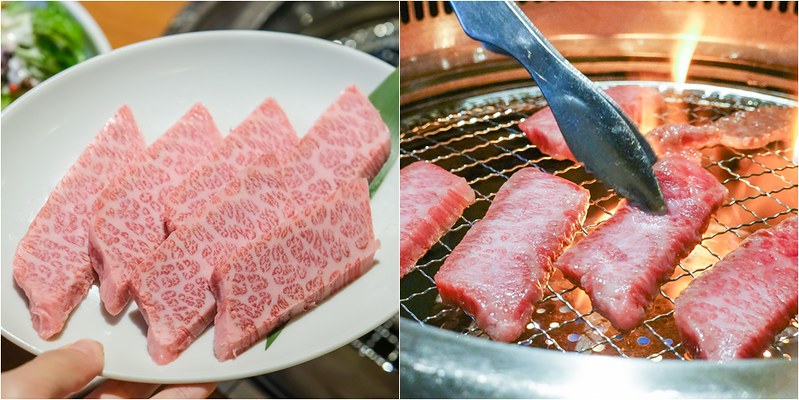
Premium kalbi, ¥1,100. Yes, you read that correctly: this plate costs only ¥1,100.... We immediately ordered two. The most expensive item on the menu was the ¥2,500 chateaubriand, the center of the tenderloin, while most other items were under ¥1,300. If you love excellent wagyu yakiniku, you will find it an extraordinary bargain.
This premium Tottori kalbi not only has evenly distributed marbling but is also cut slightly thick. The moment it hits the grill, flames leap up and the sweet fat fills the air with an enticing aroma.... It nearly dissolves with the lightest press of the jaws, and the sweetness of the fat is incredible. I could easily eat three plates by myself. At only ¥3,300, that would be enormously satisfying.
The Premium Olein 55 yakiniku set offers five cuts for just ¥2,980.... Ahhh, I told my friend I wanted the entire set to myself.... The five cuts are wagyu chimaki (shank), premium loin, premium wagyu misuji (top blade), premium brisket, and a round steak.
Of those five cuts, loin and misuji are relatively familiar. Chimaki is more unusual; when I asked, I learned that it comes from the lower leg. It has a little sinew and a very distinctive texture. The most delicious of the five was naturally the round steak, from the thigh near the rump, while the premium loin had the finest fat. But, but, but the earlier premium kalbi was still the most irresistible....
Wagyu naka-ochi kalbi costs ¥650. Naka-ochi simply means trimmed edge pieces whose shapes are less attractive. They are usually cheaper, but virtually no less delicious. Anyone looking to save money should simply order naka-ochi. This restaurant even takes the trouble to arrange it like a flower.
The ¥550 pork tontoro has beautiful marbling and a crisp, gently springy bite. Chicken thigh and seseri, or neck meat, cost ¥480. The seseri, with a little skin attached, is both springy and tender, while the thigh meat is astonishingly sweet. I asked and, sure enough, it was the famous Daisen chicken.
The ¥750 Korean-style cold noodles tasted fairly standard.... Overall, this meal was genuinely delicious without hurting the wallet—at least for diners who enjoy wagyu yakiniku. Once you see these prices, you should understand why I recommend Tottori beef so strongly.
):
589-2 Yamane, Kurayoshi City, Tottori Prefecture; Tel:
+81-858-26-2919; Hours:
11:30–15:00 and
17:00–23:00 (closed Mondays)
Source: 小虎食夢網 | Original URL: https://www.foodtigertw.com/blog/posts/3050239732
Where would you stay for this story?
This is a stay-recommendation demo. Partner links will be enabled after confirmation.
Kaike Onsen and Tottori stays
Choose an onsen inn, city hotel or stay area that fits the article context.