
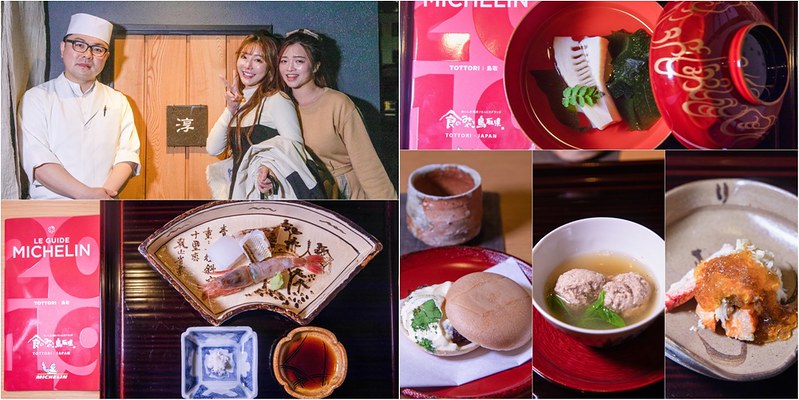
Jun in Tottori City’s Eirakuonsencho serves dishes featuring local horsehair crab, mosa shrimp, and white squid. Dinner is available from 6:00 to 10:00 p.m., and the restaurant is closed on Sundays.
May
Wednesday
[Tottori Michelin Series 2] Jun: Japanese cuisine made with Tottori ingredients, including exquisite Tottori hairy crab, mosa shrimp, and white squid. The least expensive one-star Japanese restaurant?
Jun (
): 257 Eirakuonsencho, Tottori, Tottori Prefecture. Tel: +81-857-29-9054. Hours: 6:00–10:00 p.m. (closed Sundays)
I never expected my first Michelin-starred restaurant in Japan to be in Tottori, a place even Japanese people consider rural. Still less did I expect to visit this prefecture, rarely seen even by Japanese travelers, seven times, with more trips clearly ahead. It is no exaggeration to say I have fallen in love with Tottori. What does Japan’s least populous prefecture offer that keeps drawing me back? The answer may involve the recently popular travel idea of escaping the crowd. Because it is rural, it is never congested. Because it is rural, travel is more relaxed and enjoyable. Most importantly, prices are unbelievably low. This Michelin Japanese dinner, for example, costs only 8,000 yen, or about NT$2,000. Our autumn 2023 Little Tiger Foodies trip, “Tottori Foliage, Hot Springs, and Michelin,” will definitely bring everyone here to collect a star.
[Japan—Tottori Michelin] Hot Air: Michelin ramen made with local ingredients in a 500-year-old hot-spring village in rural Tottori, plus three free footbaths to enjoy
In that article about the only Michelin-listed ramen shop across the Sanin-Sanyo, or Chugoku, region, I briefly mentioned Tottori Michelin restaurants and hoped I could visit one someday. That wish came true in less than six months, and I also managed to visit two Michelin-recommended places along the way.
Tottori Michelin list:
Two Michelin stars
🔸Kaniyoshi http://www.kaniyoshi.com/
The world’s first crab specialty restaurant to receive two Michelin stars.
🔸Mitsuki https://www.facebook.com/pages/%E3%81%BF%E3%81%A4%E3%81%8D/1419382514947642
The owner specializes in Kyoto cuisine and accepts only one party a day so diners will not be disturbed by other guests and can enjoy their meal at ease.
One Michelin star
🔸Jun https://ya11000.gorp.jp/
Its cooking draws out the natural flavor of the ingredients and lets diners enjoy the tastes of each season.
🔸Akiyama https://tabelog.com/tottori/A3102/A310201/31004297/
Authentic kaiseki cuisine that pursues beauty not only in flavor but also in presentation.
🔸Shusai Kikyo-ya http://www.kikyouya-yonago.com/
Set courses made with local ingredients from the mountains and sea. The owner is a sake expert, particularly knowledgeable about warm sake, and can recommend a pairing for the food.
🔸Hakushu Suzunoki http://www.suzunoki.tottori.jp/
The owner insists on serving traditional Japanese cuisine rather than creative fusion dishes.
Bib Gourmand
🥢Shokushu Totoro https://tabelog.com/tottori/A3101/A310101/31004114/
🥢Soba Kawaguchi https://soba-kawaguchi.gorp.jp/
Tanrei Tori Ramen Hot Air (visited)
https://www.facebook.com/hotairgo1/
🍴Fée des Neiges https://www.feedesneiges.jp/
🥢Rengatei http://sp.raqmo.com/rengatei/
🥢Mitakien https://ashidumitakien.jp/
🥢Ajidokoro Shin https://www.ajidokoro-shin.com/
🥢Sakedokoro Juan https://tabelog.com/tottori/A3103/A310301/31000703/
🥢Sobadokoro Kamidai https://tabelog.com/tottori/A3103/A310301/31000246/
🥢Mingei Kappo Onajimiya http://www.onajimiya.jp/
Jun—named after chef Junichiro Takeuchi—is only a three-minute walk from Tottori Station, with many convenient hotels nearby. Interestingly, Jun has a Tabelog rating of only 3.31. A Tottori friend laughed that locals do not know how to rate restaurants and few rating-minded tourists ever come to Tottori. I could not tell whether that was pride or self-mockery. In any case, the restaurant is extremely discreet; before entering, I thought its modesty was limited to the exterior.
It remained discreet inside because there was no Michelin plaque anywhere. According to my friend, Chef Takeuchi hopes people will come not for Michelin’s fame, but to quietly enjoy the Tottori regional Japanese cuisine he makes from local ingredients. We therefore asked TV food-show celebrity Jiao Zhifang, traveling with us, to hold up the Tottori Michelin guide for our photographs. Our companions also included two Rakuten Girls,
Eli Ni
and
Chuyi
. I rarely dare ask Japanese chefs to pose for a photo with me, but Chef Takeuchi was unexpectedly cooperative and exceptionally friendly.
The restaurant has only four counter seats and one rectangular four-person table, for eight seats in total. There were six of us that day, and the chef specially gave us exclusive use of the room to make filming easier.
The place may be tiny, but its thoughtful, warm decor is clear. If we return next year, perhaps we will see a “dragon” on display.
There was no Michelin plaque, but I did see Mr. Takeuchi’s license to prepare pufferfish. Come to think of it, I do not believe I have eaten pufferfish in Tottori.
Before the meal, the director of the Tottori tourism bureau recommended Otokoyama Shuzo’s Takaisami sake, which I had covered on an earlier visit. This label appears at almost every izakaya in Tottori. For details, see:
[Japan—Tottori Food and Local Sake] Otokoyama Shuzo (Takaisami): 150 years of tradition, with connections to the prime minister, Shohei Ohtani, and Hidetoshi Nakata
Hiokizakura, meanwhile, is particularly suited to drinking warm.
Freshly grated Tottori wasabi really was a little different. Mildly hot and nose-tingling, it was moist and sticky but highly aromatic. Before dinner, I asked the Tottori friend who made our reservation how much the meal cost. When the answer was 8,000 yen, I wondered whether I had misheard. A one-star dinner did not even reach NT$2,000. Since Japanese people earn more than twice as much as we do, the local impact is more like a NT$1,000 meal in Taiwan.
Tottori hairy crab came with Tosa-vinegar jelly. Only on my seventh visit did I learn that Tottori has hairy crab in addition to Matsuba and red snow crab. This crab was wonderfully sweet. Along with whole crab legs, it included a piece of rich crab innards. Tosa-vinegar jelly, commonly used in Japan, is made from Tosa vinegar, light soy sauce, and stock. Sweet, tart, and melting, it is especially well suited to seafood. It accented the crab’s fresh sweetness, gave the overall texture more substance, and added layers of both flavor and mouthfeel. My appetite flew wide open.
The sashimi assortment contained mosa shrimp, white squid, and seared sandfish. Condiments included wasabi, Tosa soy sauce, and salt. All three types of seafood were caught locally in Tottori. Salt was the most unusual option. The chef explained that for simply flavored sashimi, salt can bring out the sweetness of the fish better, without soy sauce getting in the way.
Seafood was the greatest revelation of this Tottori trip, especially the mosa shrimp that surprised me two or three times in succession. Fried, simmered, or raw, it was outrageously delicious. Mosa shrimp is the local name for kuro-zako shrimp. It is most abundant and highest in quality along the Sea of Japan coast, particularly in Tottori. Its season generally runs from September to May, and our late-April visit caught the first wave. The hard shell somewhat resembles the slipper lobster found near Taiwan’s Guishan Island. Its flesh is soft, delicate, and almost melting, with sweetness fully equal to botan shrimp. The vivid green roe tasted astonishingly fresh.
The other Tottori seafood revelation was white squid. It had a slightly sticky springiness and grew sweeter with every chew. Even our companion
Chuyi
, who normally does not care for cuttlefish or squid, praised it repeatedly. Dipped in light salt that was savory without bitterness, it tasted even fresher and sweeter, just as the chef had promised.
The sandfish was prepared yakishimo style. Yakishimo resembles what we think of as searing, but the flame is applied mainly to the skin rather than the fish itself. The aroma of the seared skin highlighted the flesh’s fresh sweetness, while both texture and fragrance somewhat resembled unglazed grilled eel.
Live conger eel in yakishimo style, served with plum-vinegar sauce and Tottori radish.
This may have been my first time seeing a chef prepare conger eel right in front of the counter. His knife moved decisively before he lightly seared the skin.
The yakishimo technique not only increases the skin’s fragrance and removes its inevitable trace of fishiness, but also uses indirect heat to leave the flesh beneath half-cooked. It combines tenderness with the fresh flavor developed by cooking. A vinegary sauce containing plum and mildly spicy, moisture-rich Tottori radish bring several expressions of Tottori freshness into one bite: gently satisfying, comforting, and delicious.
The soup course was simmered tender Shimada bamboo shoot. Before serving, the chef scattered tea fragrance over the bowl, adding a ceremonial touch and another opening aroma before and after the lid was lifted. Shimada bamboo shoot is an important crop of the Yasugi area and a major spring ingredient in Tottori. Many high-end restaurants in Osaka and Kyoto reportedly use it.
This is no exaggeration: the Shimada bamboo shoot was exceptionally crisp, fresh, and sweet, releasing clean moisture with every chew. The crystal-clear stock earned repeated praise from our connoisseur companion Jiao. Its freshness was extraordinary.
Hassun: sea-bream roe simmered with ginger, smoked firefly squid, mullet roe, thick rolled omelet, small conger-eel yuzu sushi, and mozuku seaweed in vinegar
The mozuku vinegar on the left had a little ginger on top to soften the acidity and make it moreish. The white whelk with nuta on the right used a snail-like shellfish that is a specialty of Sakaiminato, Tottori. Nuta is a regional Tosa preparation that generally combines miso, vinegar, and sugar with vegetables or fish, and occasionally meat. It often appears among small hassun dishes. Its texture is slightly sticky, with the ingredient’s freshness beneath sweet-and-sour seasoning. The white whelk had a crisp bite somewhat like a snail.
Firefly squid has always been my weakness in the wrong sense. Even when advertised as Japan’s best from Toyama in Hokuriku, I could not enjoy it. Yet I could eat this Tottori firefly squid. Chef Takeuchi smoked it, a method I love, thoroughly softening the flavor I dislike. At last, I have found firefly squid I enjoy.
The sea-bream roe was simmered with ginger. I believe I first ate sea-bream roe in Shimane, next to Tottori, and thought it astonishing then. It is uncommon, however, so opportunities to eat it are rare. This time Chef Takeuchi simply simmered it with ginger, retaining the roe’s fluffy, melting texture. A slight ginger fragrance showed through its fresh flavor without disturbing the star ingredient at all. It was exceptionally accomplished.
The mullet roe was also made from Tottori fish, salted and air-dried by Chef Takeuchi himself. Its color was a natural pale yellow. The texture was not as dense as Taiwan’s version, but its fresh sweetness was beyond question.
The small conger-eel yuzu sushi was somewhat like pressed sushi, with firmer rice grains. The eel wrapped around the vinegared rice with its skin underneath, and at first I mistakenly thought a layer of nori was tucked inside. The eel was soft and sweet, with an airy hint of yuzu. It was my favorite item on the hassun plate.
The thick omelet had a texture unlike the traditional kind, but it was also not the smooth softness produced by adding yam. It resembled either a firm custard or an especially fine fish cake. The egg fragrance revealed the savory stock beneath it, making it quite distinctive. I wonder whether a little fish was added.
Wild-boar meatballs and koshiabura mountain greens were simmered together. The broth was a little salty but delicious. The meatballs used wild boar from the Daisen area of Tottori. Perhaps they used a fattier cut, or perhaps it absorbed some stock, but the ball was fluffy and melting like Taiwanese lion’s-head meatballs. Contrary to expectation, it had none of wild boar’s dry, obstructive chewiness. The “queen of mountain vegetables,” koshiabura, added flavor and is another common wild food in Tottori. It truly tasted a little untamed. A Tottori friend said people either love it or dislike it, much like the distinctive peppery note of Thai basil.
Asparagus tempura and tilefish fried in pinecone style, served with mysterious awayuki salt.
Pinecone frying is a common technique for sea bream, somewhat like squirrel fish or frying with the scales raised. The crisp, fragrant skin and sweet tilefish were paired with powder made from Daitokuji natto. The dish showed Chef Takeuchi’s precision with ingredients: preserving their freshness as far as possible while revealing more possibilities in both the ingredient and the cooking.
The asparagus tempura likewise used exceptionally thick Tottori asparagus. It released a small burst of juice when bitten. A batter scarcely capable of being thinner provided a faint initial tang and two or three seconds of fried fragrance. It was excellent.
Most unusual was the dish of awayuki salt. Chef Takeuchi said it was made from salt and flour. Strangely, it did not become overly salty however much we used, yet it had a distinctive saline aroma. Picked up with chopsticks, it was slightly translucent and looked somewhat like a large sheet of MSG crystals. I had never seen or tasted it before. Michelin dining truly keeps expanding my understanding of ingredients and cuisine.
Sakura trout rice, toasted sheet wakame, red miso soup, and pickles.
How terrible—we were eating our national treasure. Come to think of it, this may really have been my first taste of sakura trout. It was excellent salmon rice, though if I am honest, the rice itself may have moved me a little more.
The more interesting way to eat it involved the toasted sheet wakame. Sheet wakame is a specialty of the Sanin coast and is particularly famous in Tottori. Dried and toasted, it looks like nori or very thin preserved mustard greens. True to its appearance, it carries a trace of the fragrance of dried mustard greens. Most of the time it resembles nori, of course, but with less intense marine flavor. It can be eaten alone or crumbled into rice. Tottori people reportedly mix this sheet wakame, rather than nori, into plain rice. Honestly, it was outrageously good, far better than nori rice. Anyone with a chance to visit Tottori should try it.
Chef Takeuchi’s homemade pickles were also delicious and ideal with rice.
Dessert was “monaka with ogura bean paste and pudding.” I read the name and repeated the word “pudding” twice before opening the monaka in puzzlement.
The ogura bean paste was smooth while still letting each adzuki bean remain distinct. The green powder was matcha. Most mysterious was the pale yellow sauce: it really was pudding. Mildly sweet, or perhaps a little sweeter than mild, it was sweet in an appealing way. Together with the thin, crisp, exceptionally fragrant monaka wafer, it was absurdly delicious. I badly wanted to order another one separately. I will probably boast about this monaka for the rest of my life.
Jun (
): 257 Eirakuonsencho, Tottori, Tottori Prefecture. Tel: +81-857-29-9054. Hours: 6:00–10:00 p.m. (closed Sundays)
More Tottori Michelin articles:
[Japan—Tottori Michelin] Hot Air: Michelin ramen made with local ingredients in a 500-year-old hot-spring village in rural Tottori, plus three free footbaths to enjoy
Source: 小虎食夢網 | Original URL: https://www.foodtigertw.com/blog/posts/3050487180
Where would you stay for this story?
This is a stay-recommendation demo. Partner links will be enabled after confirmation.
Kaike Onsen and Tottori stays
Choose an onsen inn, city hotel or stay area that fits the article context.