
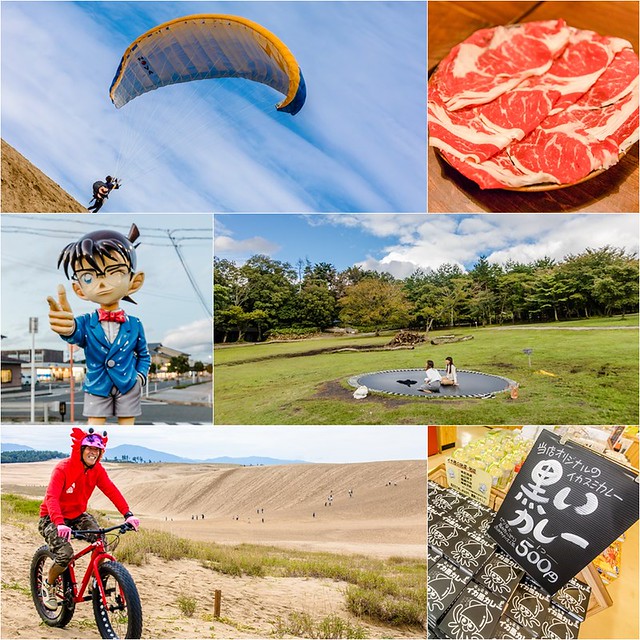
A single day can take you from Daisen’s forests and Conan’s hometown in Hokuei to the Uradome Coast, ending at the Tottori Sand Dunes with paragliding or an off-road fat-bike ride.
Jan
Sun
【One-Day Tottori Trip, San’in, Japan】Mount Daisen Forest National Park Campground (FBI), Conan’s Hometown in Hokuei, Gosho Aoyama Manga Factory, Conan Station, Takumi Kappo (the birthplace of shabu-shabu), feeding seabirds on a Uradome Coast cruise, paragliding and off-road desert cycling at the Tottori Sand Dunes, and the Mirror of the Sky
【One-Day Tottori Trip, San’in, Japan】Mount Daisen Forest National Park Campground (FBI), Conan’s Hometown in Hokuei, Gosho Aoyama Manga Factory, Conan Station, Takumi Kappo (the birthplace of shabu-shabu), feeding seabirds on a Uradome Coast cruise, paragliding and off-road desert cycling at the Tottori Sand Dunes, and the Mirror of the Sky
If you ask Japanese people what is new in Tottori, eight out of ten will probably say it was Japan’s last prefecture to get a Starbucks (
【Tottori Attraction, San’in, Japan】The Last Prefecture in Japan to Open a Starbucks: Starbucks Tottori
). If you ask Taiwanese people what Tottori has, they might answer Conan and Kitaro. Yet this “kingdom of cloudy skies” has many more people, events, things, and attractions waiting to be experienced. I have visited at least four or five times, and every trip gives me endless new stories, even at the same place. At the dunes, for example, did you know you can paraglide, ride a desert bicycle, and visit a Tottori version of the “Mirror of the Sky”? And did you know shabu-shabu, popular in Taiwan and Japan, actually spread from Tottori? A quick check revealed that I have written nearly twenty Tottori articles—far more than for the other four prefectures in San’yo and San’in.
On this San’in and San’yo journey, we started with
【One-Day Yamaguchi Trip, San’yo, Japan】Beppu Benten Pond, Rurikoji Five-Story Pagoda, Yuda Onsen, Dassai Brewery Tour, Lunch: Sanzoku Village Yakiniku, Dinner: Choshuya Kawara Soba, Stay: Hotel Kamefuku
and moved rightward to Hiroshima.
【Hiroshima, San’yo, Japan】See: Itsukushima Shrine, one of Japan’s Three Scenic Views; Sandankyo in Akiota; Hiroshima Okonomiyaki Cooking at Ekimae Hiroba. Eat: Pickled-Cabbage Fried Noodles at Raimu and Taiyaki Manju at Kake Yoshio. Stay: VIA INN HIROSHIMA
Next, we crossed the Chugoku Mountains to
【One-Day Shimane Trip, San’in, Japan】See: Tamatsukuri Yu Shrine, Yaegaki Shrine, Matsue Castle Horikawa Cruise and Walk, Japanese-Sweets Workshop at Karakoro Art Studio. Eat: Hakata Seafood Wholesaler and Tai-meshi at Minamikan. Stay: Matsue New Urban Hotel, a Scenic Hot-Spring Hotel Beside Lake Shinji
and then continued rightward into Tottori. Our first stop was the “Mount Daisen Campground,” which I had never heard of but is famous in Japan’s camping community.
JR West Rail Pass Discounts:
JR West Rail Pass
Kansai Area Pass
Kansai Wide Area Pass
San’yo–San’in Area Pass
Kansai–Hiroshima Area Pass
Okayama–Hiroshima–Yamaguchi Area Pass
Hiroshima–Yamaguchi Area Pass
Kansai–Hokuriku Area Pass
Hokuriku Area Pass
San’in–Okayama Area Pass
Japan has a saying: “Mount Fuji in the east, Mount Daisen in the west.” Daisen is the pride of Tottori residents, much as Kagoshima residents never doubt Sakurajima. At the foot of Daisen, one of Japan’s four sacred mountains, lies the national-level Mount Daisen Forest National Park. It measures about 40 kilometers east to west and 35 kilometers north to south, with a 1.73-kilometer main peak. A Tottori resident told me Daisen looks beautiful from every angle and distance within the prefecture, but there is one essential viewpoint: Mount Daisen Campground, known as FBI (First Class Backpackers Inn).
Mount Daisen Forest National Park covers an enormous area and repeatedly ranked first in Tottori voting for family attractions. Its FBI campground is considered a must-stay by Japanese camping enthusiasts. Although the weather shifted between sun and cloud with occasional drizzle, and it was not a holiday, many families and friends still drove here to camp. The campground also has an observation deck children will adore, offering the best private distant view of Daisen. Unfortunately, thick cloud completely hid one of Japan’s four sacred mountains that day.
There are many shared facilities, and even the toilets look like tents... That may be fun for camping enthusiasts, but for me... (laughs).
I am very interested in these tent rooms, though. They feel incredibly romantic. In summer, people say you can see the Milky Way stretching all the way toward distant Mount Daisen. Romantic just to imagine, isn’t it?
The campground is vast, with plenty of equipment for families. There is also a broad grassland where children and pets can run and where evening campfires pose no problem.
When we visited, we saw two close friends completely relaxed in nature, playing happily like big children. They did not stop when we asked to take a photo, merely turning back with smiles and leaning their heads together. As I pressed the shutter, I suddenly envied their leisurely ease.
Besides the tents on the grass, an independent wooden restaurant stands in the middle of the campground, giving campers and visitors somewhere to eat. It is surrounded by facilities for lazing away the day, especially hammocks in many shapes and colors.
The restaurant is thoughtfully decorated inside and out. The interior has a hint of a tropical bar; when you enter after tiring yourself out camping, your mood shifts as though you have traveled abroad to unwind.
Lanterns in various colors are available for campers to rent at night.
Details about camping here are explained
quite thoroughly in this article, so interested readers can use it as a reference.
FBI address: 706 Kobayashi, Hoki-cho, Saihaku District, Tottori Prefecture. Tel: 0859-57-3428. Open annually from March through the end of November (closed Thursdays in May, June, October, and November; open daily in July, August, and September)
FBI Official Website
Any mention of Tottori as a manga kingdom must include its two major figures, Conan and Kitaro. Many Taiwanese people probably know Tottori entirely because of these two.
For the Mizuki Shigeru Road, museum, Kitaro Station, and train created in Sakaiminato to commemorate Kitaro creator Shigeru Mizuki, see Little Tiger’s earlier article:
【Japan Travel】【Sakaiminato, Tottori Prefecture】Mizuki Shigeru Road, Museum, and Kitaro Train
Besides Kitaro, Conan is the other manga character Tottori has strongly promoted in recent years. What is the difference between the two for Taiwanese anime fans? The biggest difference may be age, XD. Older people like me generally know Kitaro better; younger people naturally favor Conan. Consequently, the Gosho Aoyama Manga Factory has become nearly essential for Taiwanese visitors to Tottori.
The Gosho Aoyama Manga Factory is in Hokuei, hometown of Conan creator Gosho Aoyama. Many Conan attractions surround it; even railways, stations, bridges, and the airport bear Conan’s name. After all, in just over twenty years since June 1994, Detective Conan has been translated into many languages and captivated dozens of countries.
For more about the Gosho Aoyama Manga Factory, which I have visited three times, interested readers can see my earlier article:
【Tottori Travel, San’in, Japan】Conan Avenue and Gosho Aoyama Manga Factory (Transportation, Admission, and Visitor Information)
Conan fans visiting for the first time will surely want to jump into the professor’s car, just as I did (laughs).
These three differently designed tickets are not just collectibles for Conan fans; they have another function. You truly must visit Conan’s hometown yourself to discover the secret (laughs).
When I entered, the ticket counter specifically asked how many times I had visited. Wondering whether repeat visitors received a benefit, I honestly answered, “The first time,” and received this beginner-level exam. The second surprise was that visitors could inspect the museum carefully and solve riddles. I heard the exams become increasingly difficult on second and third visits, with the ultimate goal of becoming a master!
The wall lists how many people passed each test. Some riddle-loving Conan visitors really returned several times and ultimately earned master certification. Impressive!
Naturally, the museum contains mostly Conan manga, original illustrations, and manuscripts. Conan fans must tremble with excitement.
Testimonies from different years, activities, and works appear in every form. A Conan fan will surely know each one well!
A reconstruction of creator Gosho Aoyama’s studio is another place where Conan fans compete to take pictures.
As a Conan fan, can you say how many films there are? As of April 2017, the answer was 21.
Detective Conan films open in theaters every April during Golden Week. The museum shows a trailer and excerpts from the newest film, reportedly a little different from versions circulating online. Detective Conan: The Crimson Love Letter, released April 15, 2017, was the latest, twenty-first animated film.
P.S. Filming this video is prohibited, and recording is absolutely forbidden. We had press credentials and confirmed repeatedly before taking a single story-irrelevant photograph to share.
Now, I teased the ticket’s secret earlier. It can actually be used with certain interactive games inside. Scan a different ticket and a different character appears. Isn’t that fun?
There are many manga-related interactive games. On the skateboard Conan often uses, for example, you can ride through settings from the series as though entering the manga.
This is so cool... It recreates a hidden, mysterious gadget from the manga. Does anyone remember which story featured it, XD?
After touring the museum, taking home some Conan souvenirs feels only natural, doesn’t it?
Has Conan tasted this popcorn? Could it have a mysterious flavor? (Laughs.)
What I most wanted was this Conan cap, but after remembering that I have lost dozens of hats since childhood, I decided against it.
The sun happened to be setting when we stepped outside, and it was quite beautiful.
【Gosho Aoyama Manga Factory】
http://www.gamf.jp/chinese/
1414 Yura-shuku, Hokuei-cho, Tohaku District, Tottori Prefecture
Hours: 9:30 a.m.–5:30 p.m. (last admission 5:00 p.m.); no fixed closing day
Admission:
Children below elementary-school age: Free
Elementary students: ¥300
Junior-high and high-school students: ¥500
Adults: ¥700
If it is still early, I also recommend the recently completed Beika Shopping Street. Besides Conan souvenirs, it sells Tottori agricultural produce and all kinds of gifts.
A bakery at the back uses Tottori ingredients and comes highly recommended by a local friend. Its cream bread made with Daisen milk is soft and delicious—highly recommended.
Then there is my new favorite, currently the milk I like most in Japan: Daisen White Rose Milk. The coffee milk in particular easily beats Koiwai or Takachiho, which Taiwanese people love. It was once available only in Tottori, but can now be bought across the Chugoku region, in Kyoto and Osaka, and even in some Kanto locations, including large cartons (heart eyes).
Next, we hurried over during blue hour to photograph Conan Station. For details, see Little Tiger’s earlier article:
【Tottori Travel, Japan】Conan Station (Yura Station): Essential for Conan Fans and a Cute Manga Stop on the San’in Main Line
Conan Station was originally named Yura Station. It received the nickname “Conan Station” in the winter of 2013, sparking a tourism boom. Yura is a stop on JR West’s San’in Main Line between Tottori and Yonago, so anime fans can pair it with Kitaro for a two-manga journey.
The station is small, but Conan posters and pictures fill the interior. Conan fans will happily take photos and check in endlessly.
Conan appears everywhere on the platforms and the stairs connecting them.
The dedicated Conan train has no fixed departure time; the station announces it on the day. Riding or photographing it depends on luck. I suggest checking whenever you pass a station along the line near departure time—that is all you can do (sigh). The trains come in yellow and pink, so plan on the day if you want pictures. (
See the timetable here
). Along the road extending from Conan Station stand many sculptures of recurring manga characters. Conan fans can see how many they find. Stamp collectors can take this Conan Avenue map and follow it to each stop, stamping proof of their visit.
The temperature suddenly fell that day, and after photographing three or four, I hid in the car from the cold.
【Conan Station * Yura Station】
584 Yura-shuku, Hokuei-cho, Tohaku District, Tottori Prefecture
Walking down the street, I smelled ramen from this diner and suddenly felt hungry like Goro. It is reportedly a famous and excellent local restaurant specializing in Tottori’s distinctive beef-bone-broth ramen. I hope to taste it on my fifth visit.
Reference page (Tabelog 3.25)
To make up for missing the beef-bone ramen, a local friend took us to Takumi Kappo, known for Tottori Wagyu shabu-shabu. Its Tabelog score was an even higher 3.38.
According to our local friend, the main reason it is famous in Tottori and throughout Japan is that it originated Japanese shabu-shabu, reportedly inspired by Chinese mutton hot pot.
Tottori Wagyu may be unfamiliar to Taiwanese visitors. Its most famous line is Inpaku beef, said to be the ancestor of Japanese Wagyu. Out of curiosity, I asked and learned that the Wagyu served here is not Inpaku beef.
The appetizer was slightly tough, slightly fishy whelk meat. I could not manage it.
Honestly, the Tottori Wagyu was truly delicious. Although it looked a little like pork, the sweetness of its fat and its smooth, tender texture were flawless. Perhaps because we had shabu-shabu, it was less greasy; I could easily finish two large plates by myself!!!
The broth was simple, with almost no distracting flavors and only a light kombu note.
After the Tottori beef came assorted vegetables and mushrooms. They were eaten simply, mostly retaining their natural flavors, making the meal refreshing and easy to continue bite after bite.
My favorite dip for Japanese Wagyu shabu-shabu is sesame sauce, and this bowl may have been the best I have ever had. Its sesame aroma had just the right strength without overpowering the food, plus a faint fruity, refreshing sweet-and-sour note that enhanced the flavor and cut the richness. Truly impressive.
For diners who do not eat beef, various Tottori seafood set meals are also available for around ¥2,000, which is excellent value.
Dessert was a Tottori-grown persimmon, and it really was delicious. Those familiar with Tottori persimmons will know the Saijo variety.
Tottori local sake Takaisami has the extra watery sweetness I enjoy in sake.
Takumi Kappo: 652 Sakaemachi, Tottori City, Tottori Prefecture (
five minutes on foot from the north exit of JR Tottori Station
). Tel:
+81-857-26-6355. Hours:
11:30 a.m.–2:30 p.m. (L.O. 2:00 p.m.)
5:00 p.m.–10:00 p.m. (L.O. 9:00 p.m.)
Our first activity the next morning was the Uradome Coast, which we had visited before. Strong winds prevented us from taking the sightseeing boat then, so this trip made up for that disappointment.
The number of Korean tourists in Tottori has increased sharply in recent years, partly because the drama Athena: Goddess of War was filmed here.
San’in Kaigan National Park (kana:
さんいんかいがんこくりつこうえん
) is a national park in Japan’s San’in region. It spans 75 kilometers of Sea of Japan coastline, from Amino Coast in Tango, Kyoto Prefecture, through Tajima Mihonoura in Hyogo, to the Tottori Sand Dunes in eastern Tottori Prefecture.
For the beauty of this stretch of coast, see Little Tiger’s earlier article:
【Tottori Travel, San’in, Japan】San’in Kaigan National Geopark—Uradome Coast (Island Cruise and Seafood Set Meal)
Now let us see the national park’s different beauty from the sea.
Uradome Coast
(a nationally designated Place of Scenic Beauty and one of Japan’s 100 Best Shores) is at its finest along the nature trail beginning in Iwami District. Highlights include Sengan Matsushima, Natane Island, the Natane Five Islands, Ryujin Cave, Kannonura, West Horai Island, Tarobei Island, Kamogaiso Coast, Kuroshima, the White-Powder Cliffs, Mizushiri Sea Arch, Camel Island, and Iwatsubame Sea Arch. Duration and fares vary by route.
Like many Japanese sightseeing boats, passengers can feed seabirds, though hawks occasionally join in. The sea wind is relatively strong here, so be careful while feeding birds or taking pictures. The first rule is to stand securely; the second and third are the same.
The stretch near the harbor reminded me of Ine in Kyoto Prefecture. It would probably be beautiful to walk here if time permits.
Sengan Matsushima is the most famous sight on the Uradome Coast. Taking the boat let us photograph its magnificent form from much closer. Its name dates to the Edo period, when a feudal lord reportedly offered a reward of one thousand kan to anyone who moved the island’s pine tree into his garden. Whether anyone received the reward is unclear. What is clear is that today’s pine is the second generation, not the original Edo-period tree; the first reportedly died. My guess is that no one collected the thousand kan =)
While waiting for departure, visitors can avoid boredom with the shop’s food and souvenirs (laughs), including famous squid soft-serve that surprisingly does not blacken your mouth, squid burgers, tempura, and other seasonal set meals.
The top-ranked souvenir is black squid-ink curry. I bought a packet, and it was genuinely very good!
This sand-dune specialty is excellent too.
Coast Island Cruise address:
Tottori Prefecture
Iwami-cho, Iwami District
2182. Tel: 0857-73-1212. Hours: 11:00 a.m.–2:00 p.m. (lunch only)
Coast Island Cruise official website:
ttp://www.yourun1000.com/index.cgi?contents=top
Iwami Tourism Association:
http://www.iwamikanko.org/places/view/92
Our final Tottori activity once again ended at the renowned Tottori Sand Dunes. Across four visits, my feelings changed from indifference to amazement, and every trip brought a different discovery. This time I finally tried the paragliding missed on my previous two visits and unexpectedly learned about Tottori’s recently viral “Mirror of the Sky.”
The Tottori Sand Dunes lie on the Sea of Japan coast in Tottori City. They extend 16 kilometers east to west and 2.4 kilometers north to south, with a maximum height difference of about 90 meters. Part of the specially protected zone of San’in Kaigan National Park, they are Japan’s largest tourist dunes. The Japanese government designated them a Natural Monument in 1955, and they joined Japan’s Top 100 Geological Sites in 2007.
For greater detail, see Little Tiger’s earlier article:
【China Region, San’in, Tottori】Tottori Sand Dunes + Sand Museum + Inoue Fisheries
This time, let us introduce the paragliding I only experienced on my fourth visit. Refer to the reservation information for full details.
The entire program lasts roughly three hours, from exercises and briefing to completion. It costs about ¥6,000, with four sessions daily at 6:30, 9:30, 12:30, and 15:30.
Besides the endlessly breathtaking scenery, what impressed me most over several visits was the extraordinarily fine sand; even when it entered my shoes, I could barely feel it. Of all the places I have visited, only here and the Gold Coast gave me this sensation. I love this “sand.”
The Tottori Sand Dunes look different in every season. Even the dunes change with the season and wind direction, making them exceptionally distinctive.
I had assumed paragliders flew toward the sea. During the experience, I learned that an inward-facing hollow lies among the dunes; participants fly from the upper rim toward the valley floor. The overall process felt much safer than expected.
Although it did not feel very high, the view above was excellent. The sea breeze felt especially comfortable; even if it was slightly chilly, XD, excitement quickly drove away the cold.
Honestly, taking off is exciting, but the most visually powerful scene may be filmed from below: each paraglider opening between the dunes, blue sky, and white clouds.
Well, landing safely probably still requires some practice, XD.
For some reason I love this photo, so I will use it to end this very special flight. Thank you for your hard work, instructor.
After saying goodbye to the female instructor who taught us to fly over the dunes, we found another handsome male instructor, an expert in off-road cycling near the dunes.
With strong promotion by the Tottori tourism bureau in recent years, the Tottori version of the “Mirror of the Sky” beside the dunes was discovered and paired with off-road desert cycling, instantly attracting many photographers and cyclists. Unfortunately, we lacked time and the poor weather hid the sunset, so we gave up. That left me another regret in Tottori, one I hope to resolve on my fifth visit!
Although we could not photograph the Mirror of the Sky, the expert gave us a brief taste of the thrill of cycling on the dunes. Honestly, it was not as difficult as expected, perhaps because of the wider tires. The distinctive part is that, besides leading the special bicycle tour, they offer professional photography too!
The cycling Mirror of the Sky tour is seasonal, and times vary. Refer to the schedule above.
Address: 1709-1 Uno, Yurihama-cho, Tohaku District, Tottori Prefecture
Tel: 080-1649-1796
Hours: 9:30 a.m.–6:00 p.m.
Fee: ¥5,000, including insurance, helmet, and consumption tax (about two hours; cash only)
Official website:
www.trailon.jp
Notes: Reservation required; groups of six (maximum six people); participants must be taller than 150 cm
More from this San’in and San’yo itinerary:
【One-Day Yamaguchi Trip, San’yo, Japan】Beppu Benten Pond, Rurikoji Five-Story Pagoda, Yuda Onsen, Dassai Brewery Tour, Lunch: Sanzoku Village Yakiniku, Dinner: Choshuya Kawara Soba, Stay: Hotel Kamefuku
【Hiroshima, San’yo, Japan】See: Itsukushima Shrine, one of Japan’s Three Scenic Views; Sandankyo in Akiota; Hiroshima Okonomiyaki Cooking at Ekimae Hiroba. Eat: Pickled-Cabbage Fried Noodles at Raimu and Taiyaki Manju at Kake Yoshio. Stay: VIA INN HIROSHIMA
【One-Day Shimane Trip, San’in, Japan】See: Tamatsukuri Yu Shrine, Yaegaki Shrine, Matsue Castle Horikawa Cruise and Walk, Japanese-Sweets Workshop at Karakoro Art Studio. Eat: Hakata Seafood Wholesaler and Tai-meshi at Minamikan. Stay: Matsue New Urban Hotel, a Scenic Hot-Spring Hotel Beside Lake Shinji
More:
San’in–Tottori (20)
Compare Tottori Accommodation Prices
JR West Rail Pass Discounts:
JR West Rail Pass
Kansai Area Pass
Kansai Wide Area Pass
San’yo–San’in Area Pass
Kansai–Hiroshima Area Pass
Okayama–Hiroshima–Yamaguchi Area Pass
Hiroshima–Yamaguchi Area Pass
Kansai–Hokuriku Area Pass
Hokuriku Area Pass
San’in–Okayama Area Pass
Source: 小虎食夢網 | Original URL: https://www.foodtigertw.com/blog/posts/3047773749
Where would you stay for this story?
This is a stay-recommendation demo. Partner links will be enabled after confirmation.
Kaike Onsen and Tottori stays
Choose an onsen inn, city hotel or stay area that fits the article context.