
Hakuto Shrine is known for the White Rabbit of Inaba legend and prayers for love and good relationships. Its rabbit charms and matchmaking stones make distinctive keepsakes, and the shrine is about 40 minutes by bus from JR Tottori Station.
Mar
Thu
Hakuto Shrine in Tottori, Japan: Japan's cutest rabbit charms, irresistible rabbit souvenirs, the myth of the White Rabbit of Inaba, a deity who grants good relationships, and the Lovers' Sanctuary at Hakuto Coast
Hakuto Shrine in Tottori, Japan, with Japan's cutest rabbit charms, irresistible rabbit souvenirs, the legend of the White Rabbit of Inaba, a deity who grants good relationships, and the Lovers' Sanctuary at Hakuto Coast
In Japan, rabbits symbolize the forming of bonds. One myth tells the following story. The eighty gods admired Yagami-hime, a beautiful woman of Inaba Province, so they set out together for what is now Hakuto Coast. Along the way, they encountered a white rabbit in terrible pain, its skin stripped away after it had deceived the sea crocodiles. The spiteful eighty brother gods told the rabbit that it would recover if it bathed in the sea and then dried itself in the wind. Instead, its injuries grew worse. Okuninushi-no-Mikoto, who arrived later carrying his brothers' luggage, felt pity for the rabbit. He took it to wash its wounds in a pond, then applied cattail pollen. The rabbit returned to its original condition. That pond can still be seen at Hakuto Shrine today and is known as Mitarashi Pond. To repay the kindness, the rabbit
acted as a matchmaker and brought together
Okuninushi-no-Mikoto and Yagami-hime. This is the origin of the myth of the White Rabbit of Inaba. Okuninushi-no-Mikoto is also Daikokuten, one of the Seven Lucky Gods. Jishu Shrine in Kyoto is considered especially effective for prayers for a good match, and the white rabbit there is the White Rabbit of Inaba. If you come to Japan hoping for love and a good relationship, make a pilgrimage to Hakuto Shrine in Tottori, the birthplace of this love story.
Hakuto Shrine, Tottori
Official website:
https://www.tottori-tour.jp/zh-tw/sightseeing/106/
Address: 603 Hakuto Miyakoshi, Tottori City, Tottori Prefecture
Telephone: 0857-26-0756 (Tottori City Tourism and Convention Association)
Transportation: From JR Tottori Station, take a Hinomaru Bus toward Shikano for about 40 minutes and get off at Hakuto Jinja-mae, directly in front of the shrine.
Click here for the bus timetable
▲ Apart from the Tottori Sand Dunes, Hakuto Shrine is the other best-known attraction in Tottori Prefecture. About 11 buses run from Tottori Station to Hakuto Shrine each day. If you prefer not to take the bus, you can also use the
1,000-yen sightseeing taxi.
Hakuto Shrine faces Hakuto Coast across the road, making the legendary myth of the White Rabbit of Inaba feel vividly present.
▲ At the entrance to Hakuto Shrine, you can see figures of Okuninushi-no-Mikoto and the White Rabbit of Inaba. “Inaba” refers to what is now Tottori Prefecture. Delving into this myth is fascinating too.
▲ If you are praying for a good match and longing for love to arrive, Hakuto Shrine is an essential stop. If time permits, also visit Hakuto Coast, see Okinoshima Island, and look out over Hakuto Coast from the Hill of the White Rabbit at Keta Point.
▲ Reaching Hakuto Shrine requires a walk of about three minutes. Remember to look back at Hakuto Coast along the way.
▲ The path to Hakuto Shrine passes through a pleasant little forest. Cute stone carvings of white rabbits sit on every lamp base along both sides.
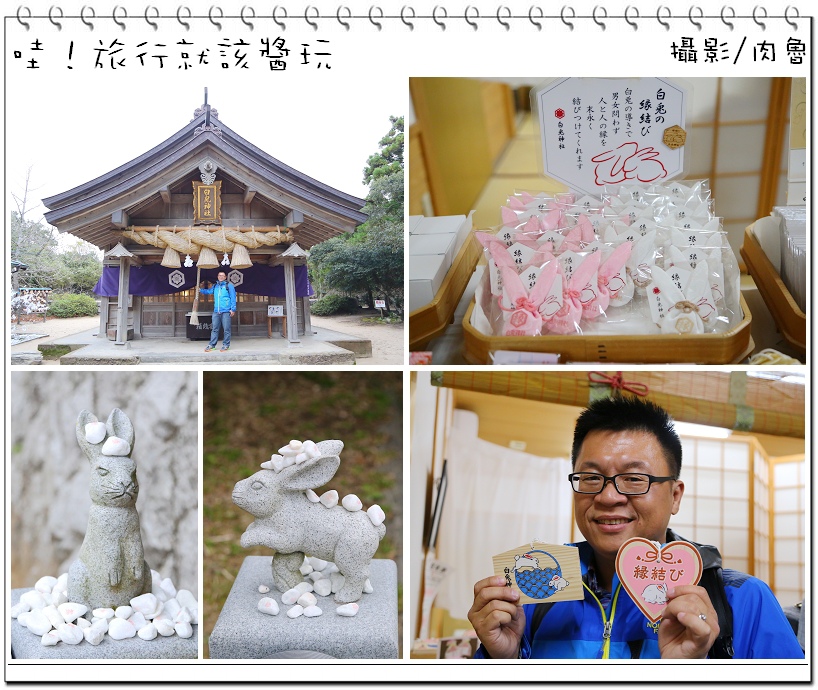
▲ Look closely at the white rabbit statues and you will see them covered with white stones bearing the character for “bond.” At first glance I had no idea what they meant; they simply seemed likely to bring good romantic fortune.
▲ Later I noticed that the top of the torii gate was also covered with white stones marked “bond.” I then learned that these are musubi-ishi, special matchmaking stones found only at Hakuto Shrine. If you successfully toss one onto the torii, your wish or hoped-for relationship is said to come true quickly. If you see people throwing stones when you next visit Hakuto Shrine, do not misunderstand what they are doing. The stones come in packets of five. If your first stone lands on the torii, what should you do with the rest? People place their remaining musubi-ishi on the white rabbit statues, which is why so many stones cover the rabbits at Hakuto Shrine. The Japanese have even turned this into a business, and everyone seems amazingly accurate. Getting a stone onto the torii is not easy.
▲ Before entering Hakuto Shrine, remember to scoop up water and cleanse your hands as a sign of respect. Across from this spot is Mitarashi Pond, where Okuninushi-no-Mikoto washed the rabbit. It is also called the Pond That Neither Rises nor Falls. I later realized that I had completely forgotten to photograph it.
Click here to see a photo of Mitarashi Pond
▲ Hakuto Shrine is not only home to a deity of matchmaking. The myth also associates the White Rabbit of Inaba with prayers for recovery from skin diseases and burns. The old-fashioned shrine is exceptionally peaceful and easy to love.
▲ Tottori lies on Japan's Sanin Coast, where the weather is always changeable. A sudden sun shower fell that day, and in photographs it looked like drifting white snow, as though the romantic love story of Okuninushi-no-Mikoto were unfolding before us.
▲ Hakuto Shrine has a shimenawa rope woven from straw. At shrines, it serves to ward off evil. Japan's most famous example is the shimenawa at Izumo Taisha Grand Shrine.
▲ Keep a close eye on your wallet when you visit Hakuto Shrine, because its white rabbit charms and souvenirs are far too tempting. Someone bought more than 30 rabbit-shaped charms in one go, leaving even the shrine staff speechless.
▲ This is the White Rabbit matchmaking charm. It comes in pink and white, and its playful rabbit-ear shape is overwhelmingly cute.
▲ Every kind of charm is connected to a rabbit design. Hakuto Shrine's charms must be among the most irresistible, distinctive, and happiness-filled in Japan.
▲ I bought several adorable white rabbit clay bells. Adults and children, men and women alike are guaranteed to go wild for these rabbits.
▲ Guard your wallet carefully so that a whole stack of yen notes does not fly out in an instant.
▲ Below Hakuto Shrine is also a rest facility selling local products and food. Inside, you can see a wooden torii motif representing the White Rabbit's matchmaking role.
▲ All the different white rabbit decorations immerse visitors in an atmosphere of happy romance.
▲ There is also an honorary stationmaster's room here. Stationmaster Mikoto is an adorable white rabbit with set working hours. Isn't that fun?
▲ A pedestrian bridge connects Hakuto Shrine and Hakuto Coast. Walk above the coast and gaze out to sea for a beautiful view of the Sea of Japan.
▲ Looking east, the coastline extends into the distance. You can also follow the signs along the nearby path down to the shore.
▲ Hakuto Coast has an island called Okinoshima, said to be where the White Rabbit of Inaba once lived. The ancient myth seems to leap across time and unfold before your eyes.
Hakuto Shrine, Tottori
Official website:
https://www.tottori-tour.jp/zh-tw/sightseeing/106/
Address: 603 Hakuto Miyakoshi, Tottori City, Tottori Prefecture
Telephone: 0857-26-0756 (Tottori City Tourism and Convention Association)
Transportation: From JR Tottori Station, take a Hinomaru Bus toward Shikano for about 40 minutes and get off at Hakuto Jinja-mae, directly in front of the shrine.
Click here for the bus timetable
Tottori Station → Hakuto Shrine
Hakuto Shrine
Tottori Station
Tottori Sand Dunes, Japan: a mysterious hidden landscape shaped by 100,000 years of nature, with the uncanny feeling of roaming the Sahara and even camel rides across the dunes (about 2.5 hours from Osaka to Tottori Station and 0.5 hours from Tottori Station to the Tottori Sand Dunes)
Japan: Make the most of Tottori's 1,000-yen taxi travel offer, a sightseeing service exclusively for international visitors that even solo travelers can use. Cars have a Japanese-Chinese interpretation system, so communication is easy without Japanese. Each ride lasts a full three hours. For the Tottori Sand Dunes, Hakuto Shrine, Hakuto Coast, Uradome Coast, Tottori Castle Ruins, or Amedaki Falls, the 1,000-yen sightseeing taxi is the right choice.
Takumi Kappo, Japan: exquisitely marbled Tottori Wagyu that melts in your mouth, a comfortable wooden building with Japanese tatami rooms, and delicious Wagyu shabu-shabu that is a must in Tottori, at the birthplace of Japanese shabu-shabu
肉魯: Traveling Taiwan's hidden places and exploring beautiful scenery in Japan and Korea
Posted by 肉魯
Popularity (
Overseas travel
Japan travel
Source: 肉魯 走遍全台灣●環遊全世界 | Original URL: https://damon624.pixnet.net/blog/posts/43500704
Where would you stay for this story?
This is a stay-recommendation demo. Partner links will be enabled after confirmation.
Kaike Onsen and Tottori stays
Choose an onsen inn, city hotel or stay area that fits the article context.