
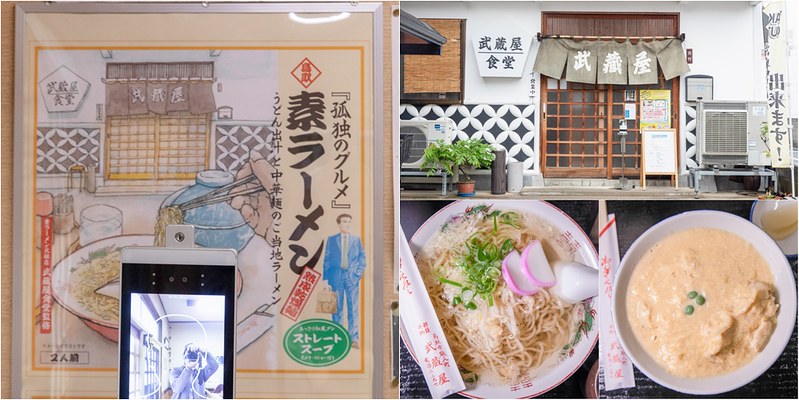
Century-old Musashiya Shokudo is the birthplace of Tottori’s original su ramen, a famously simple bowl of noodles. It has also become a pilgrimage stop for fans of the TV series Solitary Gourmet.
Musashiya Shokudo (
Official website
): 15 Shokuninmachi, Tottori City, Tottori Prefecture. Tel: 0857-22-3397. Hours: 10:30 a.m.–3:30 p.m. (closed Sundays and public holidays)
If I could choose only one bowl of noodles in Tottori, my answer might not be Hot Air, the only Michelin-listed ramen shop in the San'in and Sanyo regions (
Hot Air
), nor Mikazuki's beef-bone ramen, the bowl that captured my soul in Kurayoshi's old town (
Mikazuki – Beef-Bone Ramen
). Instead, it might be the ramen that best represents Tottori: su ramen. It even prompted Solitary Gourmet to make an exception and feature the dish in both the manga and television series. Any discussion of Tottori's most distinctive su ramen should naturally begin with Musashiya Shokudo, a restaurant with more than a century of history and the birthplace of the dish.
The appeal of Musashiya Shokudo's su ramen drew the well-known Taiwanese food expert, cooking-show host, and producer (
Chiao Chih-fang
), affectionately known as Brother Chiao, as well as the hugely popular influencer and former Rakuten Girl who was selected for a list of the world's 100 most beautiful faces (
Ni Xuan
). Both traveled a long way for this bowl of su ramen found only in Tottori. Musashimaru Shokudo is a walk of a little over ten minutes from Tottori Station, and there are many hotels of all sizes nearby, so making the pilgrimage is not difficult.
“Tottori Shoku no Miyako” can be understood as a recommendation, a local specialty, or a dish Tottori proudly celebrates. Founded in Meiji 45 (1912), Musashiya Shokudo has more than a century of history and is certainly entitled to display the “Tottori Shoku no Miyako” logo. There are also many long-established shops in Tottori's old town worth visiting. Given the chance, I would love to follow this map and explore them.
Let me admit something at the outset: my husband was so eager to eat and so worried that the noodles would soften that he forgot to photograph the dining room. Anyone interested can refer to
the video filmed by Brother Chiao
. Incidentally, Musashiya Shokudo is open only until 3 p.m. After 3, the second generation operates an izakaya called Kojiro here. It is closed every Sunday and Monday, however, so keep that in mind.
The menu was unexpectedly extensive. It seemed to have almost everything one would find in an ordinary Japanese diner, but when I said so, our friend from Tottori replied, “The names may look the same, but every dish has its own Tottori character.” For example, she turned around and ordered an utterly ordinary chicken oyakodon from the owner without bothering to ask whether we agreed, ha.
Before eating su ramen, I should explain that “su” does not mean vegetarian as the Chinese character might literally suggest. If one had to define it, the word means “plain” or “simple.” This bowl of su ramen can be tasted nowhere in Japan except Tottori. Some people also say it is the prototype from which all Japanese ramen developed. Of course, similar claims can be heard in Kitakata, Fukushima, and Onomichi, Hiroshima. Still, it is entirely true that this su ramen exists only in Tottori and originated at Musashiya Shokudo.
Fans of Solitary Gourmet will surely remember that episode 8 of season 8, broadcast in 2018, was filmed in Tottori. It paid tribute to Jiro Taniguchi, the Tottori-born artist of the Solitary Gourmet manga, who naturally grew up eating su ramen. Here is something else that even fans may not know. According to accounts online, when TV Tokyo first approached Solitary Gourmet about working together, there was an unwritten internal rule: whenever possible, the television show would not film at restaurants that had appeared in the manga. Put simply, the manga would do its thing and television would do its own. Tottori's su ramen was half an exception. It was only half an exception because both the manga and television series introduced su ramen, but they featured different restaurants.
More precisely, the su ramen in the manga came from Musashiya Shokudo, the dish's original restaurant. Viewers of the television drama know that Goro, played by Yutaka Matsushige, ate his at the city hall cafeteria, which has since moved into a certain driving school's dining hall. I have not eaten there yet either. Interestingly, however, a closer look inside Musashiya Shokudo reveals that the autograph board from Masayuki Kusumi, the writer of Solitary Gourmet, is dated August 2022. Does that mean that neither the manga creators nor the television crew had visited this restaurant when the comic and episode were originally made?
Anyone who enjoys Japanese food and often eats ramen in Japan will probably find several familiar elements in this bowl of su ramen. Simply put, it contains traces of Japan's three great noodle styles: ramen, udon, and soba. The uncomplicated broth is based on bonito flakes and kombu, recalling both soba and udon. The fish cake resembles the toppings on Kanto-style soy-sauce ramen, while the tempura crumbs evoke udon. The noodles are chuka soba, yet the bowl as a whole also has some of the restrained elegance of buckwheat soba.
The broth looks light and tastes even lighter, offering the delicate flavor of kombu, a faint sweetness at the back of the throat, and, of course, a little of the flavor that the noodles release into the soup. That final quality is difficult to detect in other ramen.
Fish cake, tempura crumbs, chopped scallions, and even a few bean sprouts make the bowl plain without being too plain. Its simplicity may look spare to modern eyes, yet it also carries the modest luxury of the Meiji era. If you try to place yourself in rural Tottori during the early years of the Meiji Restoration, you may understand what I am trying to express.
The slightly wavy, medium-thick noodles have the chew of chuka soba, along with a faint sensation of eating buckwheat noodles. Before you notice, half the bowl is gone, settling warmly and gradually into the stomach with a quiet sense of satisfaction.
Su ramen has another major characteristic: the pepper on the table. This is not the generic pepper found in diners everywhere. It would not be an exaggeration to call it the soul of Tottori su ramen. Of course, the pepper differs slightly from restaurant to restaurant and from one bowl to another across Tottori. Nor is this Tottori pepper used only for su ramen. You can also see and taste it in another of the prefecture's celebrated dishes, beef-bone ramen.
Even the packaged Musashiya Shokudo su ramen sold at many shopping centers in Tottori, including the station, contains two small packets of pepper. Its distinguishing feature is a somewhat stronger aroma reminiscent of Chinese medicinal herbs. It gives the finishing touch to an already refined, understated broth. Naturally, those tempura crumbs are also indispensable to su ramen.
In less than ten minutes, nothing remained but a photograph of the empty bowl. Perhaps that is the greatest respect I can show ramen and soup.
Our Tottori friend ordered this 600-yen chicken oyakodon without our consent, and it looked genuinely unlike the usual version. My first visual impression was that it seemed a little runny. After shoveling in a bite, however, I found the texture soft and silky, somewhat like beef with soft-scrambled egg, but with even more of the rich egg aroma of oyakodon and a stronger sweetness from the broth. Perhaps eggs were expensive in the past, so cooks made the mixture thinner to make the bowl look as though it contained more egg. In any case, it slips down very smoothly. The chicken inside seemed a little salty; I do not know whether it had been marinated first. The rice was also on the softer, almost stewed side. Overall, it was delicious and at the very least highly distinctive, quite unlike oyakodon elsewhere. If you are worried that su ramen will not fill you up, order a Tottori chicken oyakodon as well and try something new.
Incidentally, this Tottori chicken oyakodon is topped with three green peas, an element with its own story and explanation in Japanese dining culture. The older the diner, particularly one with a hint of Western-style cooking, the more likely you are to encounter it. The generally accepted origin of the green peas is Rengatei, a century-old Western-style restaurant in Tokyo's Ginza district. Its signature omurice was topped with three green peas. There is another allusion here: odd numbers are considered auspicious. After Rengatei's omurice became famous, ordinary diners began copying and selling it. To appear up to date, they also started placing three green peas on certain dishes, a kind of self-consoling attempt to follow the latest fashion. In modern terms, it might be understood as the influencer aesthetic of selling a cultivated, artsy image.
Source: 小虎食夢網 | Original URL: https://www.foodtigertw.com/blog/posts/3050519380
Where would you stay for this story?
This is a stay-recommendation demo. Partner links will be enabled after confirmation.
Kaike Onsen and Tottori stays
Choose an onsen inn, city hotel or stay area that fits the article context.