
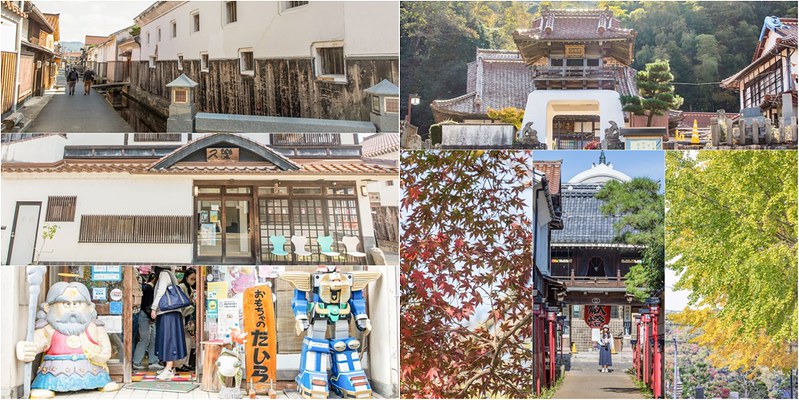
A 12-hour walk through Kurayoshi can link its 400-year-old streets, the roughly 600-year-old ruins of Utsubuki Castle, shrines, autumn maples and ginkgo trees, and five local food stops in one fast-paced route.
Tottori Kurayoshi Tourism Association
Official website
2568-1 Uomachi, Kurayoshi, Tottori Prefecture (inside Akagawara Building No. 10), telephone: 0858-24-5371
Japan has a systematic approach to preserving cultural heritage and a strong awareness of its importance. As a result, almost every prefecture has several old streets with a historic atmosphere, often dating back three or four centuries. When it comes to old streets in Tottori, the foremost choice must be Kurayoshi’s historic district, which has more than 400 years of history. Its roots reach even farther back to Utsubuki Castle, built more than 600 years ago. There are cherry blossoms in spring and autumn leaves later in the year, along with old houses, shrines, history and culture, photo spots popular with young people, century-old restaurants, and artsy cafes. The thousand-year-old Misasa Onsen and the Japanese Heritage site of Mitokusan Sanbutsuji Temple are nearby and can be visited on the same trip.
Kurayoshi lies in central Tottori, roughly at the midpoint of the San’in Main Line. In addition to the nearby
Misasa Onsen
mentioned above,
Hawai Onsen
near Matsuzaki, the previous JR station, is also well worth a soak. Beyond the next station, Shimohokuei, is the familiar Yura “
Conan Station
.” One point to remember, however, is that Kurayoshi’s historic district is about three kilometers from JR Kurayoshi Station, so you will need to take a bus or taxi.
[Bus Stops in Front of Kurayoshi Station]
1: Nihon Kotsu Kurayoshi Bus Center, Hinomaru Kaida Garage, Tottori Prefecture Chuo Driving School
2: Kurayoshi Shirakabe Dozogun and Akagawara; Enkei Gekijo Kurayoshi Figure Museum; Sekigane Onsen; Park Square, Kurayoshi Mirai Chushin, and Nashikko-kan; Gosho Aoyama Manga Factory
3: Misasa Onsen, Mount Mitoku, and Misasa Town
4: Hawai Onsen, Togo Onsen, Yurihama Town, Hokuei Town, and Gosho Aoyama Manga Factory
5: School buses for Tottori College of Nursing and Tottori College
6: Highway buses and Tottori Airport
Anyone somewhat familiar with Japan will know that Tottori is called the “Manga Kingdom.” Besides the universally known Detective Conan and GeGeGe no Kitaro, Jiro Taniguchi, the artist half of the two-person team behind The Solitary Gourmet—which likewise has many fans in Taiwan—was also from Tottori. In recent years, the prefecture has held the
Manga Kingdom Tottori International Comic Art Contest
for eleven consecutive years. The Kurayoshi tourism ambassador greeting visitors outside the station is also KONAMI’s virtual idol,
HinaBita,
who is overwhelmingly adorable.
I have recently noticed a trend among old Japanese stations toward designs in which old and new coexist. Sometimes the front is new and the back old; sometimes the two sides are symmetrical. When designed well, the result can be very attractive, and Kurayoshi Station is a good example. The shopping center integrated with the station is genuinely a great place to shop.
[Shopping in Tottori, Japan] Seven Tottori Souvenirs: Local Sake, Curry, Somen, Milk, Onsen Manju, Rakkyo, and Nijisseiki Pears
More than half of the souvenirs in that article were bought here.
The Kurayoshi Shirakabe Dozogun is the heart of a walking tour through Kurayoshi. More than 600 years ago during the Muromachi period, a castle town for Utsubuki Castle arose around the Tenjin River. Cultural remains from the Edo period, which began in the 17th century, stand along both banks. Many buildings over a century old still survive among the red-tiled and white-walled storehouses. Besides taking you through the lanes of the historic district in search of the best photo spots, this article also includes
the century-old Seisui-an,
the sixty-year-old Restaurant Mikazuki,
and
Kura in Akagawara Building No. 5,
the place most popular with young Japanese visitors.
Whether you arrive by taxi, bus, or car, you will probably enter through the small park beside the Kurayoshi Tourism Association. The nearby statue commemorates Kotozakura Masakatsu, the 53rd yokozuna and a native of Kurayoshi, Tottori.
The area now commonly called the Shirakabe Dozogun was originally known as Utsubuki Tamagawa. Because its old buildings stand at the foot of Mount Utsubuki and along both banks of the Tenjin River, the Japanese government designated it an Important Preservation District for Groups of Traditional Buildings under the name “Kurayoshi Utsubuki Tamagawa Preservation District for Groups of Traditional Buildings.” The district was already a commercial center in the early Edo period and continued to develop through the Taisho era. Today it retains about 100 traditional buildings constructed between the late Edo and early Showa periods. Kurayoshi is now carrying out a plan to revitalize these old buildings, and there are currently
eighteen historic buildings in all.
The current uses of the Akagawara buildings are as follows:
(Akagawara Building No. 1)
A storehouse from a Taisho-era soy sauce factory, now converted for new use. Many Tottori souvenirs fill the spacious interior.
(Akagawara Building No. 2)
The Wine Storehouse offers its own wine as well as a special collection of wines from across western Japan. Paid tastings are available.
The Charred-Cedar Carving Hall and Handweaving Workshop Kurayoshi Kasuri displays works by Ryumon Yamamoto, a Buddhist sculptor living in Kurayoshi, along with Kurayoshi kasuri looms and other items.
(Akagawara Building No. 3)
Nakano Chikugei occupies a converted sake storehouse and is a long-established bamboo craft shop founded in 1912, the first year of the Taisho era.
(Akagawara Building No. 5)
Kura is a cafe where you can enjoy coffee ground with a stone mill.
(Akagawara Building No. 6)
Kuwata Soy Sauce Brewery is lined with wooden soy sauce barrels from the Meiji and Taisho eras, now a rare sight. Besides soy sauce, it sells soy sauce soft serve, macarons, jelly, and other products.
(Akagawara Building No. 7)
The main store of Gensui Shuzo was founded during the Kaei era. Tastings and free brewery tours are available, although tours require reservations.
(Akagawara Building No. 8)
Torazo, the House of Japanese Sweets, sells local specialties and handicrafts. Its tea area serves the locally famous Utsubuki Park dango.
The handmade-soba restaurant Utsubuki-an uses buckwheat flour grown at the foot of Mount Daisen and follows a traditional hot-water kneading method.
(Akagawara Building No. 10)
The Kurayoshi Shirakabe Dozogun Tourist Information Center offers sightseeing advice for Kurayoshi as well as a wide selection of informative brochures. Wheelchairs, lightweight strollers, and other equipment can be borrowed free of charge.
(Akagawara Building No. 11)
The Pottery Hall lets visitors experience the pleasure of pottery making in a short session.
(Akagawara Building No. 12)
Kyuuwa displays famous local products as well as paintings and works by local artists.
(Akagawara Building No. 13)
Shirakabe Club was built before 1908 and formerly housed the Kurayoshi branch of Daisan Bank. It is now a Western-style restaurant using local ingredients. It is the only nationally registered tangible cultural property in the Shirakabe Dozogun.
(Akagawara Building No. 15)
Japanese Restaurant Asuka occupies a converted machiya townhouse and serves Japanese cuisine made with local ingredients.
(Akagawara Building No. 16)
Tea House Awayuki is the only cafe in the Shirakabe Dozogun where visitors can play go.
(Akagawara Building No. 18)
Utsubuki Kairo was designed by architect
Mitsuru Senda
and opened in July 2019 as a
multiuse complex. Its rooftop observation deck overlooks the white-walled storehouses and red-tiled buildings.
Source for the information above: https://www.tottori-tour.jp/zh-tw/sightseeing/173/
The ideal outfit for walking around Kurayoshi is unquestionably Kurayoshi kasuri, woven with a traditional Kurayoshi technique dating from the Edo period. Visitors can go to Akagawara Building No. 1 for a tour wearing the traditional Kurayoshi kasuri kimono. Related article:
[Travel in Kurayoshi, Tottori, San’in, Japan] Wear a Traditional Kurayoshi Kasuri Kimono for a Day Around the Shirakabe Dozogun and Akagawara District
Dining report on Kura in Akagawara Building No. 5:
[Kurayoshi Dining in Tottori, Japan] A Century-Old Folk-House Cafe: Kura in Akagawara Building No. 5, with Stone-Ground Coffee, Rainbow Jelly Soda, and Photogenic Colorful Grilled Dango
Dairenji Temple beside Kura is an ancient temple over a thousand years old, with origins in the Yoro era of 717–723, although it was rebuilt in 1955. Unfortunately, it was undergoing extensive renovation that day, so we could not enter.
The two rows of red lamp posts at the entrance have appeared in many travel magazines and television programs. Together with the wooden temple gate and large red lantern behind them, they create an exceptionally atmospheric scene. This is also one of Kurayoshi’s designated photo spots among female social-media influencers.
If you belong to Taiwan’s fifth- or sixth-grade generation, you have probably heard of the hugely popular film Legend of the Eight Samurai, starring Hiroko Yakushimaru and Hiroyuki Sanada. Although the story is set in Awa Province, now Chiba, the eight warriors—the eight loyal retainers—are said to have been modeled on Kurayoshi’s loyal Eight Wise Warriors. Kurayoshi therefore has another version of the Satomi Hakkenden tradition. Related anime-style characters appear throughout the city, along with surviving architecture and cultural relics such as the warriors’ graves and former residences.
The century-old Seisui-an occupies an Edo-period building. Its twelve-color mochi shabu-shabu is, in my view, a specialty that every visitor to Kurayoshi should try.
[The Sixth Tottori Installment of Can I Charge My Bike? with Tetsuro Degawa—Tottori Food] Machiya Seisui-an, a Century-Old Kurayoshi Restaurant, and Twelve-Color Mochi Shabu-Shabu
The sixty-year-old Restaurant Mikazuki retains the strong character of a Taisho- and Showa-era dining room. Its beef-bone ramen has been praised as the most delicious bowl in all of Tottori.
[Kurayoshi Dining in Tottori, Japan] Restaurant Mikazuki, a Sixty-Year-Old Kurayoshi Institution Combining Japanese, Western, and Chinese Nostalgic Flavors; Signature Beef-Bone Ramen and Sizzling Tottori-Beef Hamburg Steak
Kurayoshi has many local-liquor bars and bistros in converted old houses, serving beer, sake, or whisky. For example, we stopped that afternoon at Brew Lab Kurayoshi, which specializes in Tottori craft beer. See the detailed article:
[Kurayoshi Dining in Tottori, Japan] Brew Lab Kurayoshi: A Century-Old Wooden House in a Four-Hundred-Year-Old District and the Intoxicating Aroma of Craft Beer
Kurayoshi’s Takada Sake Brewery and fruit-wine brewery are both beautiful old buildings from the outside. I sincerely think Kurayoshi deserves a two-night stay so you can visit these places one by one and drink your fill of their excellent beverages.
In addition to Edo-period buildings, the area around the historic district conveys the architectural atmosphere of the Taisho and Showa eras. Walking the old streets of Kurayoshi feels like witnessing the passage of time.
Continuing west into Nishiiwakuramachi, the number of tourists gradually decreases and the architectural style of the old houses changes slightly, while the shops give off an even stronger working-class neighborhood character.
The toy and candy shop overflows with Showa-era nostalgia and makes you never want to leave.
Both the Buddhist-statue carving shop and the jewelry store are wonderfully retro. Anyone who enjoys browsing old-fashioned shops like these will love them.
Perhaps because both belong to the San’in region, a fair number of Izumo Taisha branch shrines can be seen in Tottori.
In front of Myojakuji Temple beside the Kurayoshi branch of Izumo Taisha stand two beautiful, enormous ginkgo trees over a century old. This is another Kurayoshi autumn photo spot favored by female social-media influencers.
On the way to Utsubuki Park, we found this Kurayoshi Shrine. After looking it up, I learned that this seems to be the former site; today’s Kurayoshi Shrine has moved elsewhere.
Kurayoshi Kindergarten across the road also has a history of a hundred years. Kurayoshi truly is an old town filled with culture.
Shonyuji Temple in front of Utsubuki Castle Park.
Utsubuki Park occupies the ruins of Utsubuki Castle, built more than 600 years ago during the Enbun era of 1356–1361 in the Northern and Southern Courts period by Moroyoshi Yamana, eldest son of Tokiuji Yamana, governor of Hoki Province. Today’s historic Kurayoshi district was the castle town of that period. Utsubuki Castle survived until 1615, when it was abolished under the One Castle per Province decree, among the first famous castles of Japan’s Warring States period to be eliminated.
Cherry trees line both sides of Utsubuki Park’s paths, making it Kurayoshi’s best cherry-blossom viewing site. I hope I will have a chance to see the blossoms here next year.
In November, Utsubuki Park is half red and half green, creating a distinctive beauty of its own.
Remarkably, Utsubuki Park has a miniature zoo, although all the animals inside are monkeys. The park also contains the Utsubuki Museum, an observation deck, and the castle-ruins park.
Many buildings along Kurayoshi’s old streets are beautifully covered in red and green plants. They make you press the shutter again and again, but there are genuinely too many to photograph them all.
Finally, here is the Enkei Gekijo associated with Kurayoshi’s popular Instagram photo spot, the “Eye of Kurayoshi.” The former Meirin Elementary School, built in 1955 and over sixty years old, is one of the few surviving circular school buildings in Japan. It has the longest history among those preserved and is now the oldest extant circular school building in the country.
[The Seventh Tottori Installment of Can I Charge My Bike? with Tetsuro Degawa—Tottori Attraction] Enkei Gekijo Kurayoshi: A Figure Museum Converted from Japan’s Oldest Sixty-Year-Old Circular School Building and the Viral Instagram Spot “Eye of Kurayoshi”
Source: 小虎食夢網 | Original URL: https://www.foodtigertw.com/blog/posts/3050296160
Where would you stay for this story?
This is a stay-recommendation demo. Partner links will be enabled after confirmation.
Kaike Onsen and Tottori stays
Choose an onsen inn, city hotel or stay area that fits the article context.