
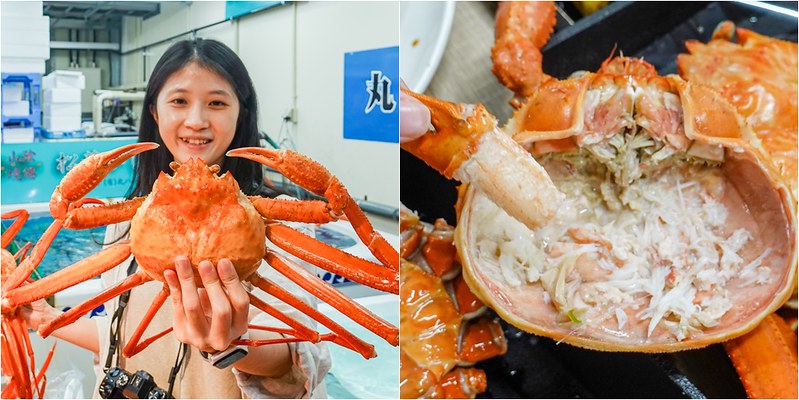
At the Sakaiminato Marine Products Direct Sales Center, you can find Tottori crab and red snow crab from ¥1,000, then sample a charming crab tempura snack.
Sakaiminato Seafood Direct Sales Center (
official website
): 9-5 Showamachi, Sakaiminato City, Tottori Prefecture; Tel: 0859-30-3857; Hours: 8:00–16:00 (closed Tuesdays)
Feasting on crab is a standard item on many food lovers' itineraries in Japan. Hokkaido may be the best-known destination, but you may be surprised to learn that Tottori catches more crab than any other Japanese prefecture, earning it the nickname "Crab Prefecture." Perhaps for that reason, I find Tottori the best-value place for eating crab. From November through February in particular, beni-zuwaigani and Tottori crab can cost only ¥1,000 apiece, delivering great flavor and satisfaction without hurting the wallet. The best place to eat crab is the seafood direct-sales center in Sakaiminato. Let's go to Tottori for crab!
Anyone with even a little familiarity with Japan will probably respond to "Sakaiminato" with "Kitaro." For the Kitaro report, see this article:
[Sakaiminato City, Tottori Prefecture] Mizuki Shigeru Road, the Museum, and the Kitaro Train
. Compared with Mizuki Shigeru Road, the attraction with even more appeal for food lovers is the Seafood Direct Sales Center, a little way outside central Sakaiminato. Because it is a wholesale and direct-sales center, prices are especially low, so come here and eat without worrying about your wallet. Feasting on crab in Tottori has become one of the most important parts of my annual visits to Japan.
Sakaiminato is the largest fishing city on Japan's Sea of Japan coast. From 1992 through 1996, it was also the Japanese port with the country's largest catch. Interestingly, Sakaiminato is the least populous city in Tottori Prefecture and the smallest by area in the Chugoku region, the San'in region, and Tottori itself. Yet it has two crucial tourism resources: Kitaro and Tottori crab. If you use public transportation, take the Hama Loop Bus Main Course from Sakaiminato Station for about eight minutes and get off at stop 51, Sakaiminato Seafood Direct Sales Center / Sakaiminato Joint Government Building.
Hama Loop Bus timetable
The Sakaiminato Seafood Direct Sales Center brings together twelve fishmongers from around Sakaiminato, with dozens of seafood shops lining both sides. Its greatest attraction is the ability to buy seafood and eat it immediately. In the middle of the aisle between the stalls are many square tables where visitors can feast on their purchases right away.
Besides Matsuba crab from November through February, different catches come into season at the Sakaiminato Seafood Direct Sales Center throughout the year: Sakaiminato salmon from March to May, fresh bluefin tuna from June to July, Natsuki rock oysters from June to August, white squid from June to November, and beni-zuwaigani from September through June. Put simply, crab is available in Tottori for roughly two-thirds of the year, with different delicious seafood in season throughout the calendar.
If interested, you can also visit Sakaiminato wharf during the season to watch Tottori crab auctions. See:
[Travel in Tottori, San'in, Japan] Beni-Zuwaigani Auction and Sakaiminato Fish Market Tour: A Silent Bidding War
. Incidentally, in 2021 a premium Itsukiboshi crab sold at auction in Sakaiminato for as much as ¥5 million, making it Japan's most expensive crab.
November through February is the busiest period at the Sakaiminato Seafood Direct Sales Center. Crowds come for affordable, high-quality Tottori crab—Matsuba crab and beni-zuwaigani—and well over half the stalls have piles of Tottori crab out front.
After walking around, I found prices of roughly ¥1,000 to ¥5,500. Besides size, the crabs also differed in color and appearance, but overall you seemed to get what you paid for.
Some less attractive or smaller crabs are sold by the bag, with a large bag of six or seven costing only ¥1,500. I heard an elderly woman say that she would buy two bags to take home for miso soup.
Besides whole fresh Tottori crabs, some stalls sell only the bodies—labeled "heads"—or only the legs. There are also boxes like these in which the crab has already been picked apart for you. If you do not want your hands to smell of seafood, a neatly prepared box is a thoughtful option.
Sono mama literally means "as is." In other words, these crabs can be eaten immediately without further cooking, making them ideal for visitors who have nowhere to cook. At this point, you may wonder about the difference between beni-zuwaigani and Matsuba crab. The simple distinction is that Matsuba crab costs more.... More seriously, the two are distant relatives, and strictly speaking Matsuba crab is a type of snow crab. Beni-zuwaigani is slimmer and longer, while Matsuba crab looks meatier—rather like the difference between Brother Wang and Brother Liu.... The important point is that a mature male is called Matsuba crab and has abundant, sweet meat. The smaller female is called oyagani and is prized mainly for its delicious roe.
The center also carries plenty of seafood other than Tottori crab, along with dried fish and similar products. Some stalls will cook your purchase for you by boiling or grilling it.
There are also many boxes of sashimi and nigiri sushi like these. I thought the six-piece nigiri box offered excellent value; after all, it is difficult to get completely full on crab alone.....
Because we visited in November, we naturally focused on Matsuba crab, mainly choosing the more expensive ones priced at ¥3,000 to ¥5,500. We might come only once a year, so of course we wanted the better crab. If your budget is limited, you can choose a cheaper one, then add two boxes of nigiri, one box of sashimi, and a large plate of sweet shrimp.
With four or five people, each person chooses one crab. This kind of extravagant eating may be possible only here.... Come on, rock-paper-scissors—the winner chooses first.
As mentioned, you eat it sono mama, as is. First use the scissors provided by the shop—return them after eating—to cut off all the legs and separate the crab....
Then flip the body over and open it decisively. As noted earlier, the larger crabs are male and essentially have no roe; whether they contain tomalley is a matter of luck.
The best way to eat Tottori crab is to remove the meat near the body, place it in the opened shell, and mix the crabmeat with the tomalley.
Next, dip the legs into the crabmeat and tomalley in the shell, then finish whatever meat and tomalley remain inside. If you have sake at hand, you can pour in a little; warm sake works better. What? You want to know whether Tottori crab tastes good? Is that even a question? Tottori is my favorite place for crab and offers the best value. Why not come to Tottori for a crab feast?
If you like shrimp, remember to buy a plate and eat your fill. They are fresh and sweet, with a slightly sticky texture somewhat like botan shrimp.
The center is beside the sea and the seafood comes straight from the fishing port, so naturally the sashimi and nigiri are fresh. The tuna and sweet shrimp are thick, sweet, and superb.
This crab-shaped kamaboko fish cake is a new Sakaiminato product containing beni-zuwaigani. It is cute and delicious, especially when freshly fried and irresistibly snackable.
Several seafood eateries here sell assorted fresh seafood rice bowls. If you want a seafood bowl, however, I strongly recommend the century-old Kotobuki on Mizuki Shigeru Road in Sakaiminato.
Related food article
[Food in Tottori, San'in, Japan] A Must-Try Seafood Bowl on Mizuki Shigeru Road: Kotobuki, a Century-Old Restaurant
Since you have come to Sakaiminato, there are naturally Kitaro souvenirs as well, including potato snacks flavored with Nijisseiki pear and Tottori crab.
Transportation: From Sakaiminato Station, take the Hama Loop Bus Main Course for about eight minutes and get off at stop 51, Sakaiminato Seafood Direct Sales Center / Sakaiminato Joint Government Building.
Source: 小虎食夢網 | Original URL: https://www.foodtigertw.com/blog/posts/3050234412
Where would you stay for this story?
This is a stay-recommendation demo. Partner links will be enabled after confirmation.
Kaike Onsen and Tottori stays
Choose an onsen inn, city hotel or stay area that fits the article context.