
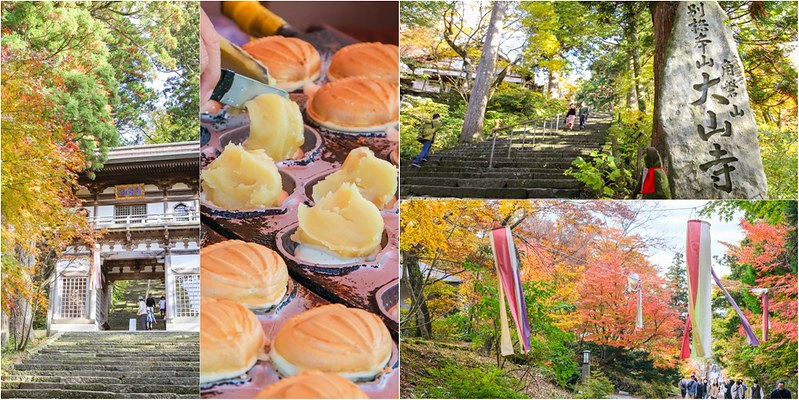
In autumn, follow layers of fiery foliage to Daisenji Temple, founded 1,300 years ago. After taking in the historic temple and one of Japan's celebrated peaks, finish with a warm chestnut-filled treat.
Daisenji Temple (
Official website
): 9 Daisen, Daisen-cho, Saihaku-gun, Tottori Prefecture; Tel: +81 859-52-2158; Opening hours: 09:00-16:00
If you had asked me about Tottori's autumn leaves a year ago, I genuinely would not have known what answer to give. It was not that I had never seen autumn foliage in Tottori, but none of it had left a deep impression. On my sixth visit to Tottori, however, I found the answer: Mount Daisen in Tottori, opened as a sacred mountain 1,300 years ago and one of Japan's four great sacred mountains. This article focuses on the hillsides covered in autumn color around Daisenji Temple, taking you into the allure of autumn in Japan's Sanin region, with a taste of chestnut cakes whose filling bursts into your mouth along the way.
My sixth visit to Tottori was also the only trip I spent entirely within the prefecture. The main destinations were Tottori City, Kurayoshi and Misasa Onsen, the two Japan Heritage sites at Mount Daisen, and Sakaiminato (red circles). I also added Yonago and Hokuei (Conan), marked with small blue circles, and Hamamura Onsen, home to the Sanin region's only Michelin-recognized ramen, focusing on autumn leaves and hot springs. Along the way, I sampled Tottori crab and Tottori wagyu. The trip also served as reconnaissance for next year's "
Little Tiger Foodie Tour
" to Tottori.
Mount Daisen is genuinely immense, much larger than I imagined, and its autumn leaves were more plentiful and more beautiful than I expected. A visit scheduled for two hours turned into an entire morning of photography, and I still could not stop... Yes, in nearly four hours, we only walked from the parking lot to Daisenji Temple--roughly the L-shaped blue line--plus the autumn-leaf mazes we kept wandering into. We will have to complete the rest next year.
Along the autumn-leaf avenue beside the Daisenji parking lot are quite a few hot-spring inns. Next time I must stay in one and enjoy a proper soak in Daisen Onsen. That will also leave more time to appreciate the beauty of this Japan Heritage site.
I am truly not exaggerating: it took us nearly an hour just to walk along this avenue of autumn leaves... Every angle, every color, every pose... I have no idea how many times I pressed the shutter.
Next came the shopping street and stalls in front of the temple, which did not yet seem to have fully regained their vitality after the pandemic. But this stall selling Daisen's famous chestnut cakes called to us from afar, appealing to our eyes and taste buds at once.
As a Japanese sweet, it was inevitably a little sugary. Fortunately, we had brought canned juice made from Tottori's best-known fruit, the 20th Century pear. Why did I not photograph a cross-section of the chestnut cake? Because it burst the moment I bit into it... Then everyone was busy dealing with the exploding filling--eating, licking, wiping... That sounds a little odd somehow... Anyway, we simply forgot to take the picture. But, but, but, these chestnut cakes were so, so, so delicious... delicious enough to make my writing completely incoherent. I hope the stall is still here when I bring the tour next year. One cake for every member of the Little Tiger Foodie Tour.
The best place to eat a chestnut cake is the nearby Daisen Hinokamidake footbath. Eat your cake while soaking your feet, then look up at the faintly shimmering autumn leaves. What could possibly be happier than this?
I know Japanese people will sit down anywhere and everywhere while viewing cherry blossoms, but I rarely see such a scene during autumn foliage season. For some reason, it made this single person terribly envious.
After finishing the chestnut cakes and 20th Century pear juice and soaking our feet, we continued into the mountain. With our spirits satisfied, our steps felt especially light, and even the stone stairways ceased to matter.
It does not look difficult on the map, but the actual walk is fairly steep, with both slopes and stone steps. Fortunately, breathtaking autumn foliage accompanied us on both sides, and the slightly cool weather made the walk quite comfortable.
Next came the green canopy around Daisenji Temple's Reihokaku treasure hall. In early November, it becomes a tunnel of autumn leaves interwoven in red, orange, yellow, and green, so beautiful that you cannot bear to move forward.
Farther ahead are the first torii of the inner shrine of Ogamiyama Shrine and Daisenji's temple gate. From here, you enter Daisenji Temple, the most mysterious and beautiful part of the Mount Daisen Japan Heritage site. This is also the starting point of the "
Daisen Great Lantern Offering--Wagasa Lights
" held in early October each year. More than 100 premium Japanese umbrellas made by specialist artisans are placed in front of Daisenji's main hall and along the approach to Ogamiyama Shrine, creating a spectacular and beautiful sight. I hope I have the chance to attend next year.
From this point, you can climb the stone steps and admire the autumn leaves while I introduce the history and origins of Daisenji Temple. The temple was founded in AD 718 by Toshikata, also known as Konren Shonin, and has a history of more than 1,300 years. At its peak during the Heian period, it had over 100 temples and 3,000 monks practicing here. Together with Mount Hiei, Mount Yoshino, and Mount Koya, it was known as one of Japan's four great sacred mountains. The prosperity did not last. Beginning with the separation of Shinto and Buddhism and the anti-Buddhist movement of the Meiji period, Daisenji rapidly declined. Only four worship halls and ten sub-temples survive today.
At 1,729 meters, Mount Daisen is the highest peak in the Chugoku region. It was once called a mountain of ascetic practice, so the succession of stone steps behind the temple gate and before the mountain closure also serves as a small exercise in discipline for visitors climbing the mountain to worship.
Mount Daisen is also one of Tottori's four Japan Heritage sites--the other three are Misasa Onsen, Mount Mitoku, and the Land of the Kirin--and was the second Japan Heritage site recognized in Tottori.
The Daisen faith that developed around Daisenji Temple,
the Daisen cattle and horse market that grew into Japan's largest market during the Meiji period,
and the Daisen roads that made it easier for people, cattle, and horses to reach Daisenji and the livestock market all form part of the story. In settlements along the routes through the four municipalities connected by the Daisen roads--Daisen, Hoki, Kofu, and Yonago--rest stops were built for worshippers, and overnight visitors came without end. Together, the four principal Daisen roads constitute the "
Jizo Faith and Daisen Cattle and Horse Market
," a Tottori Japan Heritage site selected in 2105.
For this reason, on the slopes of Daisenji stands a bronze statue of a cow with a rope tied around its nose, symbolizing the cattle and horse market. Just as roads and post stations once lined the Daisen routes, travelers who worship here today can touch the cow's nose to receive blessings and good health.
Farther uphill are Monju Hall, Fudo Myoo, and other small shrines commonly seen at Japanese temples. In autumn, fluttering red leaves lend them a special charm.
The magnificent main hall, Dainichido, burned down in a fire in 1928 and was finally rebuilt in 1951. The main hall also contains a statue of Jizo Bosatsu. The solemn Amidado Hall dates to 1131 and contains three statues of Amida Buddha. All are now Important Cultural Properties, and the interior opens to visitors on only a few designated days each year.
Daisenji's main hall and Amidado Hall offer zazen meditation sessions with guidance from monks, and both individual visitors and groups can take part. In addition to zazen, the monks explain the history of Daisenji Temple and its surroundings, so even beginners can join with confidence. Sit in meditation, calm your mind, and reflect on the days when so many monks practiced here. Below are the photographs I took after straying into a maze of autumn leaves. I edited until I no longer knew which pictures to delete, so I had no choice but to keep them all and upload them for everyone to enjoy.
Have you become as intoxicated as we were by the allure of Mount Daisen's autumn leaves in Tottori? Honestly, though, the photographs convey less than one-tenth of the impact I felt at the time. If you have the chance, make a trip to Mount Daisen in Tottori to see the autumn colors!
In the next article, we will introduce another autumn-viewing spot in Tottori that moved me: the Kagikake Pass Observatory.
Compared with autumn leaves in Kyoto, Tottori's foliage has an added sense of wilderness, nature, and innocence.
):
9 Daisen, Daisen-cho, Saihaku-gun, Tottori Prefecture; Tel:
+81 859-52-2158; Opening hours:
09:00-16:00
Source: 小虎食夢網 | Original URL: https://www.foodtigertw.com/blog/posts/3050237812
Where would you stay for this story?
This is a stay-recommendation demo. Partner links will be enabled after confirmation.
Kaike Onsen and Tottori stays
Choose an onsen inn, city hotel or stay area that fits the article context.