
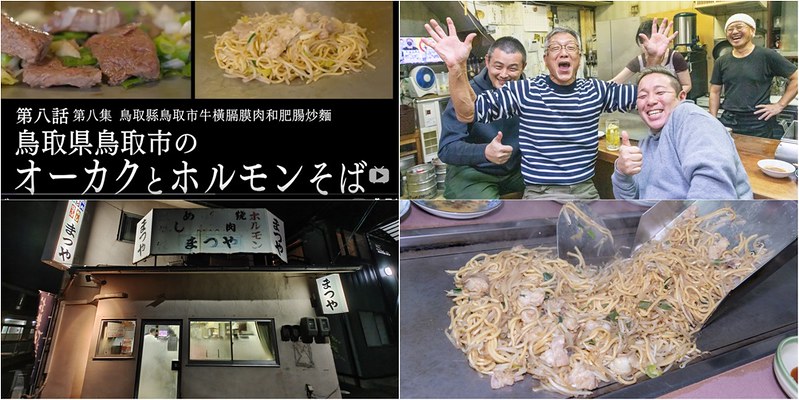
Follow in the footsteps of The Solitary Gourmet to Matsuya Horumon, a 60-year-old restaurant known for sizzling offal yakisoba, with oden and local sake also on the menu.
November
Monday
[The Solitary Gourmet Map and Visit No. 59] Matsuya Horumon: a warmhearted 60-year-old Tottori institution serving its famous offal yakisoba, teppanyaki, oden, local sake, and shochu
Matsuya Horumon (
Facebook fan page
): 4-432 Yoshikata Onsen, Tottori City, Tottori Prefecture; telephone: 0857-23-3050; hours: 11:30-13:30 and 17:00-22:00; closed Sundays and public holidays; Tabelog: 3.54
After waiting and waiting, the borders finally reopened. Japan lifted its restrictions at almost the same time, so I immediately returned. One reason I chose Tottori was this warmhearted local institution, Matsuya Horumon, which has been in business for 60 years. Why Tottori? Because one of the creators who drew The Solitary Gourmet came from Tottori, Japan's so-called manga kingdom. My series of real visits to restaurants from the show is officially back with installment 59. I hope that by the time I write about my hundredth restaurant, the program will still be filming just like Aibou and The Woman of S.R.I.
Since we are talking about long-running television dramas, here is a little trivia. Do you know which Japanese drama has run the longest? The top three include the still-airing
The Woman of S.R.I., now in its twenty-second season,
Aibou in its twenty-first season, and Keishicho Sosa Ikka 9 Gakari, whose twelfth and final season aired in April 2017. To be honest, I have never watched any of the three. The Solitary Gourmet has reached season ten, so it appears to have some catching up to do. Wataru Seken wa Oni Bakari, which I used to love, also had ten seasons and may have lasted the longest in calendar years. Other series periodically returning with new seasons include Tales of the Unusual, Seven Detectives, and Doctor-X.
Back to the subject: The Solitary Gourmet welcomed its tenth season in October 2022. Today's restaurant, Matsuya Horumon in Tottori, appeared in season eight, episode eight. When it aired, I wondered why Goro would travel all the way to rural Tottori when Japan has 47 prefectures and so many places he had not visited. I later learned that the manga's artist, Jiro Taniguchi, was from Tottori. To commemorate and pay tribute to the artist, who died in 2017, the eighth season broadcast in 2018 included a special episode sending Goro to Tottori. It lived up to the prefecture's reputation as a manga kingdom.
Tottori can never quite escape its association with rural Japan and last-place rankings. Yet, based on my six visits, it has all the sightseeing elements found elsewhere in Japan. If I must identify a drawback, it is simply a little far away. Transfers from Kansai or Okayama Airport are not excessively long, but an inconvenient flight schedule can consume almost two whole days at the beginning and end of a trip. My conclusion is simple: I love Tottori. Of course I love Goro too, so I followed him here. Two restaurants appear in this episode. The first half features city hall's plain ramen, since relocated to the Nihonkai Driving School. The second features Matsuya Horumon, a Tottori restaurant more than 60 years old whose specialty is the local horumon soba. Both are representative Tottori dishes and are said to have originated here.
One more aside: when the manga was adapted for television, its publisher and TV Tokyo agreed not to film restaurants that had appeared in the manga, in order to keep their respective rights clear. The trip to Tottori was an exception made in honor of the late Jiro Taniguchi, so the story "Plain Ramen at Tottori City Hall in Tottori City, Tottori Prefecture," from volume two, chapter six, was brought to the screen.
And now a quick plug for an article Little Tiger shared as the third installment in this series:
[The Solitary Gourmet Map and Visit No. 3] [Tokyo Nippori Food] New Maruya Western Restaurant and its hamburger steak
That delicious hamburger appeared only in the manga. Interestingly, a black-and-white drawing of the restaurant also appeared in the opening montage of the television version. Fans of the show may remember it.
We will discuss plain ramen next time. Besides the Nihonkai Driving School where Goro ate, visitors to Tottori might try Musashiya Shokudo, said to be the birthplace of Tottori plain ramen. Another signature Tottori ramen is beef-bone ramen, which shares its name with a dish in Oita but is somewhat different. All right, all right; this time we really are going to eat horumon soba.
Matsuya Horumon is about a ten-minute walk from Tottori Station. The neighborhood is a little dark at night and a little desolate by day, with the feel of an old Tokyo downtown district.
The calm exterior contrasts with a quietly bustling interior. The right side has a teppanyaki-style counter, while the left has low tables on tatami. Our party of eight was joined by two Tottori friends, making ten people. This was the least solitary of my nearly 60 restaurant visits. About ten earlier visits were with one companion, but most of the time I imitated Goro and became a thoroughly solitary gourmet.
Looking up, I saw autograph boards from celebrities covering the walls. My local friend explained many of them, but I did not recognize a single name. Yet where was Goro's autograph?
As if he could read the confusion on my face, the owner tapped me on the shoulder and said that Goro's and original author Masayuki Kusumi's autograph boards hung separately on the other side. That way fans of the drama and of Goro could spot them immediately.
Fans know that every restaurant shown in the series is real, which is what made my 59 visit reports possible. But if you have traveled around Japan to visit them, you will also notice that the owners and staff in the drama are generally played by actors, and even the customers are extras, sometimes with celebrity cameos. This episode set a record: the actual owner appeared as himself. The upper photograph was taken on my visit, while the lower image is a frame from the drama. Also, does the customer on the right in that frame look a little like Jiro Taniguchi?
The drinks menu is extensive. It centers on Tottori local sake but also includes cocktails and draft beer. Following Japanese custom, my first drink is usually a draft beer.
The yakisoba and teppanyaki are cooked to order, right in front of the customer. If a counter seat is available, I recommend sitting in the free front-row "rock zone," just like Goro.
Next comes the Goro set:
Diced steak
Horumon soba, or stir-fried noodles with beef intestine
Okaku and rice, meaning diaphragm meat with white rice
A separate order of okaku, or diaphragm. This is a cut I almost always order at yakiniku restaurants. Diaphragm is generally divided into harami on the inside and sagari on the outside. From what I found, okaku appears to be another name for harami, though I do not know whether it is regional. It certainly tastes like harami, with a little chew and the subtly sweet flavor peculiar to offal. The aroma produced as its fat hits the fire and iron plate is especially delicious. I liked this plate even more because it was seasoned with scallion, garlic, and salt. The remaining scallions, fragrant with salty griddled fat, tasted almost like scallion bread. They were outrageously good and perfect with alcohol.
My friend said nearly an entire street in old Tottori once sold horumon soba, which reminded me of the grilled-intestine street in Daegu, Korea. For nearby diners, the cook finishes the noodles in front of them and pushes the food directly across the iron plate. For customers farther away, the food is lifted with the iron dustpan-like scoop often used for okonomiyaki and yakisoba, then poured out in front of them. This scoop holds four servings. Does it not look a little like Taiwanese fried noodles?
Across Japan, yakisoba differs not only in local ingredients but also in its noodles and cooking method. Tottori noodles resemble Chinese-style noodles, yet they are cooked with moisture like yaki udon, giving them a damp, slightly soft texture. The soy-based seasoning is lighter than yakisoba in Kansai, especially Osaka. The main additions are bean sprouts and chopped scallions, while Tottori's signature protein is horumon, here meaning beef small intestine. This restaurant's intestine is rather chewy and the fat is handled skillfully. It has not been scrubbed until only skin remains, so a rich, rendered sweetness survives. It is very good.
If you dislike moist noodles, use the small spatula on the table to fry them drier. If the flavor seems too light, add the restaurant's special sauce, but it is a little salty, so do not pour on too much at once. Its garlicky, mildly spicy flavor is very appealing, especially while drinking.
Like Goro's order in the program, the diced steak comes with toasted garlic chips. Overall, it is not dramatically different from standard teppanyaki diced steak. It is not very fatty, but the meat is sweet and tender. The owner told me it was local Tottori beef, though not wagyu.
Next was something I wanted and my Tottori friend also recommended: beef liver. It was soft, tender, and almost melting, with an excellent textural contrast from bean sprouts that retained some crispness. The liver flavor is fairly strong, so people uneasy about liver or offal can add some of the mildly spicy table sauce.
Oden is one of Japan's most everyday foods, and its ingredients vary by region. When I asked my friend what distinguished Tottori oden, she thought for a while and said the broth was relatively strong and beef tendon was simmered in it too. Beef tendon is usually braised with miso as doteyaki. I asked her to choose a few items for us: familiar daikon, tofu, fish-paste products, a stuffed tofu pouch, both block konnyaku and shirataki, plus her recommended beef tendon.
The daikon here is simmered until quite soft and is juicy and thoroughly seasoned. It is a little salty, but especially delicious with a dab of the yellow mustard served alongside.
The tofu is fine-textured, silky, and fluffy. It absorbs plenty of broth and is exceptionally good, with a clearly handmade character.
The shirataki is crisp and springy, while the block konnyaku is bouncy and crunchy. Both have excellent texture. Their flavor is not especially distinctive and mainly reflects the lightly salty broth.
The satsuma-age fried fish cake is extremely moist and even releases a little juice when bitten. It is also satisfyingly substantial.
I cannot remember whether I actually ate the thick, rectangular piece of fried tofu.
When it comes to bursting broth, the stuffed pouch is unquestionably number one. It seemed to contain a fish-paste filling and was my favorite item in the pot. The beef tendon was good too, though the long simmer had made it a little dry. It lacked the melting, soft texture of doteyaki tendon, but offered a more substantial sense of eating meat.
After the draft beer came Hio-zakura junmai sake, recommended by my Tottori friend and made in Aoya, Tottori City, by
Yamane Shuzo
, founded in 1887. I remember drinking it several times in Taiwan. Its faint mature-sake yellow color made me curious, so I checked the label: 70 percent rice polishing ratio, sake meter value +13.0, acidity 2.1. The restaurant recommended serving it warm. It tasted thinner than expected, almost like shochu diluted with water. As anticipated, it had a faint aged-sake aroma, though those who dislike it might call it an odor. Despite being labeled very dry, perhaps because it had been heated, it was not as full-bodied as expected. A delicate rice sweetness lingered in the finish.
Suwaizumi junmai namazake is produced by
Suwa Shuzo Co., Ltd., founded in 1859 in Chizu, Yazu District, Tottori Prefecture. Oddly, I could not find any information on this particular bottle on the official website. I recall that the back label also showed a 70 percent rice polishing ratio. It had a transparent, sweet body and the gentle natural sweetness of water, like sake brewed with the extremely soft water of Kure, Hiroshima. I loved it and wanted to buy several bottles, but could not find it in shops.
Ever since my visit to Ehime's
Sakana Kobo Maruman
, I have suddenly become fond of Japanese izakaya. After a drink, I am willing to talk nonsense in my broken Japanese and rely on gestures. Receiving warmth while away from home is what makes travel truly feel like travel. At Matsuya Horumon in Tottori, I once again felt the hospitality of people in the countryside. Even the owner, usually shy in front of a camera, broke into a broad smile. I hope that someday, when I return to Tottori, I can revisit this welcoming restaurant and eat another serving of horumon soba. Perhaps these regulars will be there too, and I will have another chance to chat with the owner in my broken Japanese.
Matsuya Horumon (
Facebook fan page
4-432 Yoshikata Onsen, Tottori City, Tottori Prefecture; telephone:
0857-23-3050; hours: 11:30-13:30 and 17:00-22:00; closed Sundays and public holidays; Tabelog: 3.54
Sanin - Tottori (23)
More real visits to restaurants from The Solitary Gourmet:
Official website for The Solitary Gourmet
[Japan Food Guide] The Solitary Gourmet map and real-visit reviews: order what Goro ordered
[Visit No. 1] [Tokyo Food] Nakayama Tempura in Ningyocho from season two, episode two: black tempura rice bowl
[Visit No. 2] [Kanagawa Food] Sanchan Shokudo from season two, episode four
[Visit No. 3] [Tokyo Nippori Food] New Maruya Western Restaurant and its hamburger steak
[Visit No. 4] [Tokyo Bunkyo and Nezu] Sumire izakaya and its extra-spicy curry
[Visit No. 5] [Tokyo Ryogoku Station Food] Kokugido Japanese sweets shop from season two, episode eight
[Map and Visit No. 6] [Tokyo Ikebukuro Food] Chinese Home Cooking Yang No. 2
[Map and Visit No. 7] [Tokyo Nakano Food] Miyakoya's garlic pork saute in Saginomiya, season one, episode six
[Map and Visit No. 8] [Tokyo Sumida and Ryogoku Station Food] Kappo Chanko Ouchi and its sumo hot pot, season two, episode eight
[Visit No. 9] [Tohoku, Miyagi, Sendai Food] Gyutan Suisui from the 2016 summer Sendai business-trip special
[Map and Visit No. 10] [Tokyo Ikebukuro and Nishi-Sugamo Food] Shabutatsu and a solo Joshu black-wagyu sushi grill
[Map and Visit No. 11] [Tokyo Koto and Kiba Food] Tandoor Bar
[Map and Visit No. 12] [Tokyo Higashi-Nakano Food] Caravan Sarai
[Map and Visit No. 13] [Tokyo Meiji Shrine Food] Teppan Chinese Aoyama Shanway
[Map and Visit No. 14] [Tokyo Shinagawa and Gotanda Station] Shokudo Todaka and an extravagant beef-and-urchin dish
[Map and Visit No. 15] [Tokyo Koto and Kinshicho Station] Saien's superb pure liver rice bowl and a Skytree night view
[Map and Visit No. 16] [Osaka Hirano Food] Kushikatsu and doteyaki at Takeda, a little-known mysterious 50-year-old house
[Map and Visit No. 17] [Tokyo Ueno and Okachimachi Food] Lamb Three Ways at Yang Xiang Wei Fang
[Map and Visit No. 18] [Tokyo Setagaya Food] Sushi Daidokoya Sangenjaya
[Map and Visit No. 19] [Osaka Bishoen Food] Amakaraya okonomiyaki and yakisoba
[Map and Visit No. 20] [Asahikawa Food] Jiyuken from the season-five Hokkaido New Year business-trip episode
[The Solitary
Gourmet Map and Visit No. 21] [Tokyo Taito Food] Tsubaki in Uguisudani, with avocado chicken mince cutlet and chicken-pot rice
[Map and Visit No. 22] [Hokkaido Food] Dokushaku Sanshiro, the heartwarming izakaya from the season-five Hokkaido business-trip episode
[Visit No. 23] [Tokyo Akabane Food] Petit Monde's exceptionally refreshing fruit sandwiches
[Visit No. 24] [Tokyo Meguro Food] Shania medicinal soup curry, with a no-getting-lost map and reservation guide
[Visit No. 25] [Tokyo Hachioji Food] Daikoen black-wagyu yakiniku, Tabelog 3.91
[Visit No. 26] [Tokyo Okubo Food] Iseya Shokudo's ginger pork-belly set at Yodobashi Market in Shinjuku, Tabelog 3.56
[Visit No. 27] [Tokyo Setagaya Food] Ma-san's lamb shoulder and lamb chops in Chitose-Funabashi
[Visit No. 28] [Tokyo Akabane Food] Kawaei eel rice, guinea fowl and eel bowl in Kita Ward, Tabelog 3.77
[Visit No. 29] [Fukuoka Food] Miyake Udon's fish-cake udon, astonishingly inexpensive noodles from a 60-year-old shop, Tabelog 3.58
[Visit No. 30] [Tokyo Kamata Food] THI THI Vietnamese Cuisine
[Visit No. 31] [Fukuoka Nakasu Food] Ichitomi izakaya and Fukuoka local cuisine, Tabelog 3.58
[Visit No. 32] [Tokyo Kiyosumi-Shirakawa Food] Daruma Izakaya, Tabelog 3.52
[Visit No. 33] [Gunma Shimonita Food] Pork sukiyaki at Sukiyaki Columbia
[Map and Visit No. 34] [Seoul, Korea Food] Jongjeom Charcoal Galbi, ribs and side dishes in Seoul
[Map and Visit No. 35] [Tokyo Food] Tsuribori Musashinoen, a delicious dining room inside a fishing pond, Tabelog 3.42
[Map and Visit No. 36] [Tokyo Shinjuku Food] Zen-style Burmese cuisine at Nong Inlay
[Map and Visit No. 37] [Jeonju, Korea Food] Tobang's Jeonju bibimbap and fermented-bean soup
[Map and Visit No. 38] [Tokyo Meguro Food] Okinawan cuisine at Soka Mokka: Okinawa soba and naturally salted grilled pork
[Map and Visit No. 39] [Tokyo Arakawa Food] Shin Jitsu Ichiro's mapo tofu in red, white, green, black, and smoked styles
[Map and Visit No. 40] [Tokyo Kita Food] Taya casual kappo cuisine, Tabelog 3.56
[Map and Visit No. 41] [Tokyo Higashiyamato Food] Yakiniku Suien and the hostess's recommended premium salted beef tongue and rump
[Map and Visit No. 42] [Tokyo Setagaya Food] Hiroshima Okonomiyaki Hiroki, freely combining seafood and meat, Tabelog 3.59
[Map and Visit No. 43] [Tokyo Nippori Food] Yanaka Fukumaru Manju, Tabelog 3.55
[Map and Visit No. 44] [Tokyo Kita and Jujo Food] Tabelog 3.77
[Map and Visit No. 45] [Kanagawa Food] Daiichitei, a 60-year-old Taiwanese restaurant in Hinodecho, Tabelog 3.74
[Map and Visit No. 46] [Tokyo Meguro Food] Fisherman's cuisine at Kue and its overwhelmingly generous lunch set
[Map and Visit No. 47] [Tokyo Shibuya Food] Nagasaki Hanten and its abundant Taiwanese-style mixed noodles
[The Solitary Gourmet Map and Visit No. 48] [Kanagawa Tama Food] Sumibiyakiniku Juen's superb garlic harami, Tabelog 3.54
[Map and Visit No. 49] [Kyoto Ginkakuji Food] Nashimote, a charcoal-cooking izakaya
[Map and Visit No. 50] [Kagawa Takamatsu Food] Matsushita Seimensho, where you boil your own udon, Tabelog 3.74
[Map and Visit No. 51] [Ehime Matsuyama Food] Sakana Kobo Maruman, a fish-market-like izakaya, Tabelog 3.54
[Map and Visit No. 52] [Tokyo Food] Nakano's long-established Yamato-ya sweets shop and its superb kinako mochi and chestnut daifuku
[Map and Visit No. 53] [Fukuoka Food] Katsu Kaishu's surprising live-fish and French cuisine, with the most extravagant appetizer ever
[Map and Visit No. 54] [Fukuoka Food] Junchan, a warmhearted roadside stall selling almost everything
[Map and Visit No. 55] [Tokyo Ginza Food] Najimitei, a Korean izakaya in Shimbashi
[Map and Visit No. 56] [Nakano Food] Sai Sai Shokudo and Shanghai home cooking
[Map and Visit No. 57] [Chiba Ohara Food] Showado, an 80-year-old pastry shop, and its spiny-lobster roll cake
[Map and Visit No. 58] Original Braised Pork Rice, Goro's dry noodles with braised pork, offal soup, and superb Fuzhou pepper buns
Source: 小虎食夢網 | Original URL: https://www.foodtigertw.com/blog/posts/3050217092
Where would you stay for this story?
This is a stay-recommendation demo. Partner links will be enabled after confirmation.
Kaike Onsen and Tottori stays
Choose an onsen inn, city hotel or stay area that fits the article context.