
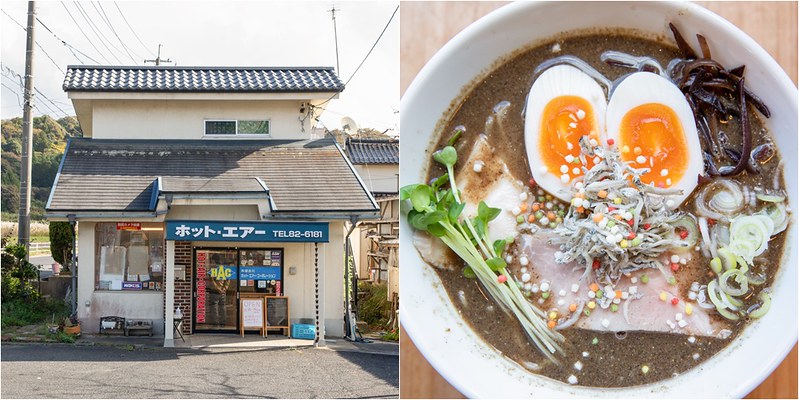
Savor Michelin-recognized ramen at Hot Air in a hot-spring town with 500 years of history, then warm your feet on a tour of three free footbaths.
Hot Air (
Facebook fan page
): 6-1 Hamamura, Ketaka-cho, Tottori City, Tottori Prefecture; Tel: +81 857-82-6181; Hours: 11:15–14:00 (closed Tuesdays); closes when the daily 60 bowls sell out
Tabelog: 3.53
People often call Tottori the Japanese countryside, while Hamamura Onsen is a hot-spring village in the countryside of Tottori. Yet hidden here is Tottori's only Michelin-listed ramen shop. Even more surprisingly, it used to be a secondhand car dealership. Come along, food lovers: let us travel to the countryside within the countryside of Japan for a bowl of modern Michelin ramen made with local Tottori ingredients, then soak our feet in the hot-spring village's three free footbaths.
When I first heard that a rural place constantly teased for having nothing but sand had a Michelin restaurant, my face was covered in question marks. Looking up the address only doubled them: how did the inspectors ever discover somewhere this remote? First, let us look at “
Hamamura Onsen
,” where the Michelin-listed ramen shop Hot Air is located. It is a small hot-spring village on the San'in Main Line toward Yonago, four or five stations from Tottori City, and limited express trains do not stop there. We will devote another article to this hot-spring village, which has more than 500 years of history. A complete list of Michelin establishments in Tottori appears at the end of this article.
I did a little homework before the trip and found that there are actually three free hot-spring footbaths nearby. The old hot-spring streets on both sides of the station also have two cafés and two long-established souvenir confectionery shops. Unfortunately, none of them were open on the day I visited. I imagine the damage that the pandemic did to these small hot-spring villages will not be reversed immediately just because the borders have reopened.
A semicircular free footbath stands right outside the station. You can soak while waiting for your train, especially during the slightly chilly autumn and winter seasons of the San'in region.
Walk straight out of the station and you will see the old hot-spring streets extending on both sides. The Hamamura Onsen tourist information center stands in the middle.
On a Friday afternoon, there were hardly any people or even cars on either side of the hot-spring streets. You could crouch in the middle of the road to take pictures and almost no one would pay any attention.
Turn right and, about halfway along the old hot-spring street leading to Hot Air, you will find the second hot-spring park, Yu-Yu Health Center Ketaka.
Across the street is the large public bath at Hamamura Sand Dune Park. From what I could find, it appears to have become a hot spring reserved for special groups after the pandemic and is no longer open to the general public.
Continue for about another 500 meters—roughly a ten-minute walk from the station—and you will see a small building beside the main road that looks nothing like a ramen shop.
I do not know the name of the stream beside it, but the bridge crossing it is called Hamamura Bridge. I stood on the road beside the bridge taking pictures and did not see a single car for quite some time.
Seeing the “SUBARU” sign in front, I wondered whether this ramen shop had once sold cars. A quick search confirmed that it really had been a Tottori dealership specializing in used vehicles. Digging deeper, I found that the ramen shop's current owner still works in car sales. He returned to his hometown in 2002 to open the used-car dealership and entered the ramen business because he and his family enjoyed it. As his cooking skills improved, he set up counter seats inside the shop in 2012 and began serving his special ramen. At first, only nearby residents and friends from the automotive trade came to support him. Word gradually spread throughout Tottori, the San'in region, and Kansai, and the shop eventually earned Michelin recognition.
A dragonfly perched on the anti-icing hanging decoration at the entrance looks very cute, even though it is only an artificial ornament.
The interior is interesting: it has the playful feel of a bric-a-brac shop, yet also resembles a manga café or an old-fashioned kissaten. All right, it also has a faintly retro atmosphere like a rural ramen shop or diner.
Sunlight enters the wooden building from all four sides, and cushions are thoughtfully provided in the waiting area to keep guests warm. The scattered sunlight gives this little shop a visual warmth that makes it hard not to like.
Many nostalgic signs hang inside. The shop also sells goods featuring its own logo and some of the seasonings it uses, made with ingredients from Tottori and the San'in region.
According to my brief research, Hot Air appeared in the Michelin Guide Kyoto Osaka + Tottori 2019, published in October 2018. It was selected in the Bib Gourmand category for good-value dining. There were only eight such selections in Kyoto and Osaka combined, and Hot Air was naturally the only establishment in Tottori Prefecture to receive this rating.
Besides the Michelin recognition, something else in the shop caught my eye: a figure from Solitary Gourmet. Look closely, however, and it is not the familiar Yutaka Matsushige but Goro from the manga. Apart from the fact that one of the artists who worked on Solitary Gourmet is from Tottori, I wonder whether the owner is a fellow Goro fan like me.
While I am here, a quick promotional aside: Tot
tori also has a restaurant featured in Episode 8 of Season 8 of the television version of Solitary Gourmet. It was also the 56th restaurant I personally visited in Japan while following Goro's trail, in addition to two in Korea and one in Taiwan.
[Solitary Gourmet Map + Visit No. 59] Matsuya Horumon: a warmhearted 60-year-old Tottori establishment; famous offal teppan yakisoba, teppanyaki, and oden
The shop mainly serves ramen in salt and soy-sauce flavors. It also offers tantanmen popular with regulars and miso ramen, and occasionally introduces double-broth ramen such as fish-miso and fish-soy sauce. Judging from the illustrations on the menu, the style leans toward modern Japanese ramen. Prices are generally 800 or 900 yen and top out at 1,000 yen. Just studying the details to decide which flavor to eat took me quite a while—just like Goro, after all.
The ramen seasoning can be customized to the customer's preference, and diners may add the condiments on the table themselves.
A sign on the table read “four slices of roast pork, 200 yen,” so I pointed to it while ordering my ramen. This roast pork differs from ordinary ramen chashu. It has a faint, ham-like springiness, is cooked to around seventy or eighty percent, and combines that with a tender, almost aged chew. The chili oil has a Sichuan-pepper-like fragrance, while the white and black peppercorns look a little excessive but prove exactly right. There is also the faintest trace of acidity. Overall, it is extremely delicious and offers a different way to think about ramen chashu.
In the end I chose the 1,000-yen “fish miso” ramen with a soft-boiled egg, mainly because the menu said it used local miso produced in Tottori. Most of the tiny dried fish, burdock, scallions, vegetables, and ginger on top also came from Tottori.
The noodles have a distinctive texture as well: a lightly raw-noodle bite combined with the suppleness of soba. They absorb the broth very well and suit this moderately rich ramen soup.
At first, the broth's color made me expect something extremely rich and salty. Instead, the first sip was surprisingly light and refreshing, which explains the “clear chicken broth” description placed before the shop's name. It still seemed based mainly on a double broth of miso and seafood. Midway through, its richness gradually began to feel a little salty and heavy, yet I still finished the entire bowl of soup. Overall, the broth has excellent layers of flavor.
It is a ramen broth that becomes more interesting with every sip, especially through the visual and gustatory presence of the tiny dried fish. You also encounter the texture and aroma of walnuts, along with a few pieces of colorful puffed rice often used in Japanese wagashi.
The included chashu comes in two slices and has a leaner texture. It also tastes a little like ham, but its texture and flavor clearly differ from the separately ordered roast pork. As you chew, the meat's sweetness is joined by an aroma like that left by searing. Since I personally prefer slightly fattier chashu, I liked the à la carte version better. The soft-boiled egg was also tender and springy, prepared to a very high standard, and I enjoyed it.
Below is the list of Michelin establishments in Tottori. I hope to visit every one someday.
Two Michelin Stars
🔸Kaniyoshi http://www.kaniyoshi.com/
The world's first restaurant specializing in crab to be awarded two Michelin stars.
🔸Mitsuki https://www.facebook.com/pages/%E3%81%BF%E3%81%A4%E3%81%8D/1419382514947642
The owner specializes in Kyoto cuisine and accepts only one party per day so guests will not be affected by other diners. They can enjoy the food in a relaxed setting.
One Michelin Star
🔸Jun https://ya11000.gorp.jp/
Dishes that make use of each ingredient's natural flavor and let diners enjoy the tastes of the season.
🔸Akiyama https://tabelog.com/tottori/A3102/A310201/31004297/
Authentic kaiseki cuisine that values not only beauty on the palate but also beauty to the eye.
🔸Shusai Kikyouya http://www.kikyouya-yonago.com/
Course meals made with local ingredients from the mountains and sea. The owner is a sake expert, particularly in warmed sake, and can recommend a Japanese sake suited to the food.
🔸Hakushu Suzunoki http://www.suzunoki.tottori.jp/
The owner's commitment is to traditional Japanese cuisine rather than creative fusion dishes.
Bib Gourmand
🥢Shokushu Totoro https://tabelog.com/tottori/A3101/A310101/31004114/
🥢Soba Kawaguchi https://soba-kawaguchi.gorp.jp/
🥢Tanrei Tori Ramen Hot Air https://www.facebook.com/hotairgo1/
🍴Fée des Neiges https://www.feedesneiges.jp/
🥢Rengatei http://sp.raqmo.com/rengatei/
🥢Mitakien https://ashidumitakien.jp/
🥢Ajidokoro Shin https://www.ajidokoro-shin.com/
🥢Sakedokoro Juan https://tabelog.com/tottori/A3103/A310301/31000703/
🥢Sobadokoro Kamidai https://tabelog.com/tottori/A3103/A310301/31000246/
🥢Mingei Kappo Onajimiya http://www.onajimiya.jp/
):
6-1 Hamamura, Ketaka-cho, Tottori City, Tottori Prefecture; Tel:
+81 857-82-6181; Hours: 11:15–14:00 (closed Tuesdays); closes when the daily 60 bowls sell out
More:
San'in–Tottori (24)
Source: 小虎食夢網 | Original URL: https://www.foodtigertw.com/blog/posts/3050223108
Where would you stay for this story?
This is a stay-recommendation demo. Partner links will be enabled after confirmation.
Kaike Onsen and Tottori stays
Choose an onsen inn, city hotel or stay area that fits the article context.