
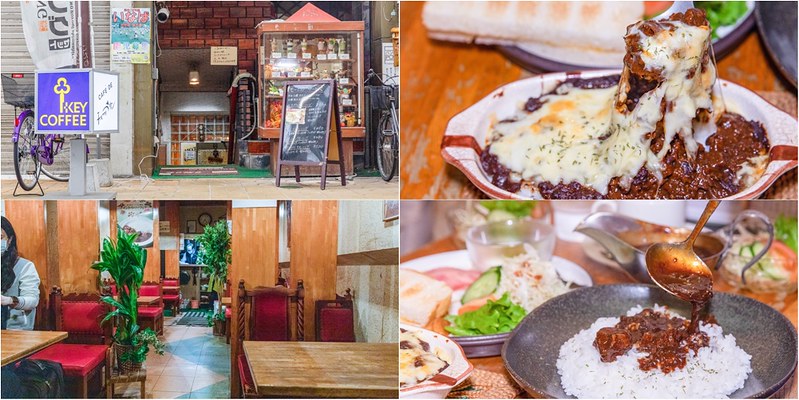
Start the morning at the 40-year-old, Showa-style Cafe Chaplin with curry and coffee, and get a taste of everyday breakfast in Tottori, Japan's “curry kingdom.”
Chaplin Coffee Shop: 719 Sakaemachi, Tottori City, Tottori Prefecture. Tel: +81 857-23-5756. Hours: 7:00 a.m.–7:00 p.m. (closed Thursdays)
I wanted to write an article about the “seven flavors of Tottori,” but after covering Tottori crab, Tottori wagyu, and Nijisseiki pears, I suddenly had no idea what to write next. I asked a local friend in Tottori and received an answer I had never expected: curry. Tottori reportedly leads all of Japan in annual consumption of curry roux, earning it the nickname “the Curry Kingdom.” I then asked at the front desk of the hotel where we were staying that night and was given the name of a coffee shop with a 40-year history. I loved the place as soon as I stepped inside, and one glance at the menu showed that the legend about Tottori residents eating curry with coffee for breakfast was true. The breakfast menu at this coffee shop actually offers four different curries. Can anyone still say that Tottori does not love curry?
Founded in 1978, Chaplin is in the shopping arcade opposite Tottori Station, about a three-minute walk away. Since we were staying at a nearby hotel that night, it was an easy place to skip the hotel breakfast and learn more about what people in Tottori eat in the morning.
I kept repeating the name “Chaplin,” which sounded both somewhat familiar and a little odd, as we walked to the entrance of the arcade. The moment I saw the sign, it all made sense: it really did refer to Charlie Chaplin, the master of comedy. Unfortunately, even after a great deal of searching, I could not find out why the shop had chosen the name. My Japanese is poor, and I could not understand what people were saying either. Still, never mind—I simply love this kind of shop, this kind of breakfast, and this kind of coffee house.
The sign also said “KEY COFFEE.” This famous Japanese coffee brand was founded in 1920. I looked it up and found that it even has a distributor in Taiwan, so it is reasonable to assume that the beans used here come from the company.
The glass case at the entrance holds models of all kinds of dishes. These food replicas are also essential fixtures at Showa-style restaurants, diners, and coffee shops. According to the hotel receptionist, the parfaits and pancakes here are famous in addition to the coffee and curry.
Chaplin was one of the few nearby restaurants opening at 7:00 a.m. that I found through
Tabelog.
It also offers the bargain breakfast service popular at Nagoya coffee shops, at a very considerate price of just 450 yen. Other than a convenience store, it would probably be hard to find a price like this.
As soon as I descended into the basement, I was captivated by the abundant Showa-era atmosphere. Even though the seats were a little small and cramped, this was exactly the style of Japanese breakfast coffee shop that I love most.
There were wooden tables and sofas upholstered in red velvet, which perhaps would have been considered fashionable in their day. The wall beside every seating area displayed posters or flyers in a slightly different style. I chose the spot with the poster from Kiki’s Delivery Service that I liked.
Chaplin offers roughly four breakfast choices priced from 450 to 500 yen. Most pair homemade toast with coffee, while pancakes and bagels are also available.
This other menu lists the regular dishes, though some are unavailable during breakfast hours. To my surprise, it even includes fried rice, along with the spaghetti commonly found in nostalgic coffee shops and desserts such as parfaits.
This menu shows the shop’s signature curries, with four choices: black curry, beef curry, meat-sauce curry (keema curry is a little difficult to translate), and finally Japone, whose story takes some explaining. The name comes from Japone, a famous old coffee shop of the same name in Ginza. In any case, this is the house specialty. When I asked the elderly woman in the shop for her recommendation, she pointed to this one as well. After ordering a curry, you can choose either salad or fruit as a side.
We therefore ordered two somewhat nostalgic curries and one coffee breakfast, satisfying our longing for a Japanese breakfast after being away for so long.
The toast breakfast set costs 450 yen and includes one long, thick slice of toast, salad, a fried egg with ham, a small dish of fruit yogurt, and either coffee or tea.
My younger sister was more inventive and placed the ham and egg directly on the toast. Cutting it open produced a wonderfully appetizing sight. When I asked if it tasted good, she merely nodded and smiled. In my view, breakfasts at old coffee shops like this throughout Japan maintain a certain standard; otherwise, how could they withstand the test of time?
Generally speaking, the coffee at these old shops run by elderly couples tends to be American-style but dark-roasted. It may taste slightly bitter on its own to young people today, but it actually pairs very well with strongly flavored dishes such as curry.
Because my friend does not eat beef, we asked the elderly woman to recommend a curry without it. She asked whether it would be all right to bake it with cheese, and I nodded. A curry rather like baked curry then appeared. Could this be an unexpected secret-menu curry?
It carried a hint of Indian spice but a little more sweetness, and with all that cheese there was no way it could taste bad. The minced meat inside was pork, with a little chili oil and spice powder drizzled over the top. It indeed tasted somewhat like baked curry and also resembled dry curry in certain ways.
The accompanying mini salad was broadly the same as the one in the toast set, except that it came in a small bowl and the portion was a little larger.
Japone curry could be described as a product of the old provincial fashion for giving things names associated with Ginza to make them sound stylish. For example, many distant Tokyo suburbs and other prefectures have streets called “Ginza-dori.” Japone was a popular coffee shop in Ginza at the time, and adopting its name was probably simply part of that trend. By extension, the name could also suggest a signature or recommended dish. In any event, the elderly woman strongly recommended it too.
The menu describes it as a curry made with fruit, while the meat is beef stewed until tender. Its flavor leans toward Indian curry, sweet and tart with a mild heat that lingers on the lips. Paired with white rice, which is rarely anything but delicious in Japan, the whole dish tasted wonderful. After all, I often eat curry at hotel breakfasts too. If you cannot handle spicy food, however, you may struggle toward the end. The heat of the Indian spices becomes increasingly distinct as you eat, and increasingly addictive as well.
More:
San’in–Tottori (27)
Source: 小虎食夢網 | Original URL: https://www.foodtigertw.com/blog/posts/3050228488
Where would you stay for this story?
This is a stay-recommendation demo. Partner links will be enabled after confirmation.
Kaike Onsen and Tottori stays
Choose an onsen inn, city hotel or stay area that fits the article context.