
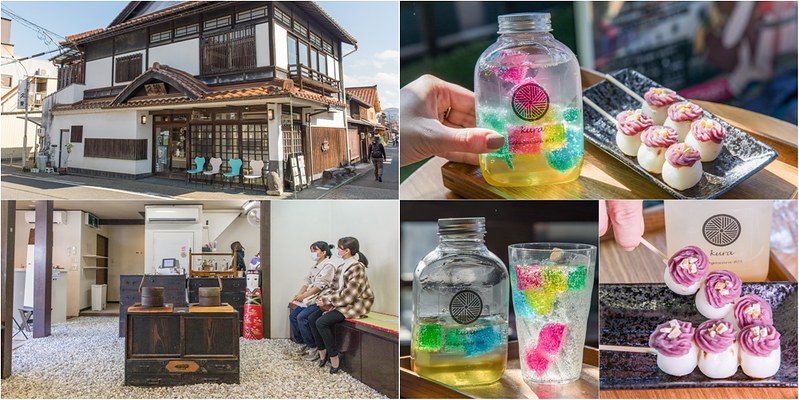
Kura, located in Kurayoshi’s Akagawara Building No. 5, is set inside a century-old traditional house. Try stone-milled coffee, rainbow jelly soda, and colorful grilled dango.
Akagawara Building No. 5 Kuraku (
Official website
): Akagawara Building No. 5, 1-2424-2 Shinmachi, Kurayoshi, Tottori Prefecture; Tel: 0858-23-1130; Hours: 09:00–17:00
If you have ever paid even a little attention to Tottori in the San'in region, you have probably heard of Kurayoshi's 400-year-old white-walled storehouses and red-tiled buildings. The area is filled with Edo-period streets and old Japanese houses, now occupied by restaurants, cafés, and all kinds of shops. In recent years, many new additions have appeared as well, including dining bars centered on San'in and Tottori sake and local ingredients. Akagawara is a project that links and revitalizes these buildings from the Edo and Meiji periods, which have been designated as a nationally important traditional group of buildings. Among them, Akagawara Building No. 5 Kuraku is a popular old-house-style café. It also has all the elements that attract young visitors, photo lovers, and influencers, including sparkling drinks with rainbow-colored jelly and cute, colorful grilled dango.
Most of these century-old red-tiled, white-walled buildings stand along the Tamagawa River, which runs through Kurayoshi's old town. This was also the castle town of Utsubuki Castle in Hoki Province during the Muromachi period. We will save the history of Utsubuki Castle for a fuller discussion when we introduce Kurayoshi's old streets. Akagawara Building No. 5, today's destination, is beside the Tamagawa River and quite close to Dairenji, a noted temple in Kurayoshi. The two blue circles on either side mark two long-established Kurayoshi restaurants previously featured here, “
Restaurant Mikazuki
” and “
Machiya Seisuian
.” They were also where we had lunch and dinner during our day trip to Kurayoshi.
Dairenji, one of Kurayoshi's noted temples, is right beside Akagawara Building No. 5 Kuraku. If you have to wait for a table, you might as well come over and take some photos.
The current uses of the various Akagawara buildings are as follows:
(Akagawara Building No. 1)
Converted from a soy sauce warehouse dating from the Taisho era. Its spacious interior is filled with many Tottori souvenirs.
(Akagawara Building No. 2)
In addition to its own wines, the “Wine Storehouse” has assembled a special selection of wines produced throughout western Japan. Paid tastings are also available.
The “Charred-Cedar Carving Gallery and Hand-Weaving Studio Kurayoshi Kasuri” displays works by Yamamoto Ryumon, a Buddhist sculptor living in Kurayoshi, as well as Kurayoshi kasuri looms and other exhibits.
(Akagawara Building No. 3)
“Nakano Bamboo Arts” occupies a converted sake brewery warehouse. It is a long-established bamboo craft shop founded in the first year of the Taisho era.
(Akagawara Building No. 5)
“Kuraku” is a café where visitors can enjoy coffee ground with a stone mill.
(Akagawara Building No. 6)
“Kuwata Soy Sauce Brewery” is lined with wooden soy sauce vats from the Meiji and Taisho eras, a rare sight today. In addition to soy sauce, it sells soy sauce ice cream, macarons, jelly, and more.
(Akagawara Building No. 7)
“Gensui Sake Brewery Main Shop” was founded during the Kaei era. Tastings and free brewery tours are available (reservations required for tours).
(Akagawara Building No. 8)
“Japanese Confectionery Hall Torazo” sells local specialties and crafts. Its tea area serves the locally famous Utsubuki Park dango.
“Handmade Soba Utsubukian” uses buckwheat flour grown at the foot of Mount Daisen and employs the traditional hot-water kneading method.
(Akagawara Building No. 10)
The “Kurayoshi White-Walled Storehouse District Tourist Information Center” offers advice on sightseeing in Kurayoshi and carries a rich selection of travel brochures. Wheelchairs, lightweight strollers, and other equipment can be borrowed free of charge.
(Akagawara Building No. 11)
At the “Pottery Gallery,” visitors can enjoy a short hands-on pottery experience.
(Akagawara Building No. 12)
“Kyuwa” displays renowned local specialties along with paintings and other works by local artists.
(Akagawara Building No. 13)
“Shirakabe Club” was built in 1908 and formerly housed the Kurayoshi branch of the Third Bank. It is now a Western-style restaurant using local ingredients. It is the only nationally registered Tangible Cultural Property in the white-walled storehouse district.
(Akagawara Building No. 15)
“Japanese Restaurant Asuka” is a local-ingredient Japanese restaurant housed in a converted machiya townhouse.
(Akagawara Building No. 16)
“Tea House Awayuki” is the only café in the white-walled storehouse district where visitors can play Go.
(Akagawara Building No. 18)
“Utsubuki Kairo” was designed by architect
Mitsuru Senda
and opened in July 2019 as a multipurpose complex. Its rooftop also has an observation deck overlooking the white-walled storehouses and red-tiled buildings.
Source for the above information: https://www.tottori-tour.jp/zh-tw/sightseeing/173/
I wonder whether anyone else is like me and completely powerless against restaurants, cafés, and afternoon tea in old Japanese houses. Before I had even stepped inside, I was already frantically pressing an imaginary shutter in my head—ding-dong, ding-dong.
I looked it up and apparently there is a dining area on the second floor too, although it did not seem to be open that day. Even so, the first floor alone offers plenty to photograph. A layer of white gravel covers the floor, while antique furniture and cabinets stand beside the stone mill used to grind coffee. Visitors can also reserve a hands-on stone-mill coffee experience.
As always, I am satisfied as long as coffee tastes good and do not need to understand it deeply; I can even do without it. Because I had seen the highly photogenic Kurabotoru (Kuraku bottle) online, I rather shamelessly abandoned the stone-milled coffee. Incidentally, these so-called Kuraku bottles can also hold coffee and serve as portable takeaway bottles. They are favorites among many Japanese influencers and Instagram users.
Detailed menu
The seats beside the glass window near the first-floor entrance had a beautiful interplay of light and shadow, so we chose to take our photos there.
Even the cute paper spoon used for ordering and waiting looks photogenic simply placed on a sunlit wooden table.
The iced stone-milled café au lait tasted quite good, and the foam on top was fine and silky smooth.
Kuraku bottles are available with coffee, latte, fruit soda, or sparkling drinks. For juice, we ordered a Twentieth Century pear juice; on the right is a yuzu soda with colorful jelly—brightly colored fruit jelly—added. Incidentally, Taiwanese bubble milk tea is also available.
The yuzu soda is ¥500, plus ¥50 for colorful jelly, and Taiwanese tapioca pearls can be added too. It is enough to send anyone's girlish heart soaring. Reportedly, the new drink took over Japanese Instagram feeds as soon as it was launched.
Add the sparkling bubbles that insist on clinging to the jelly, and even an old fellow like me cannot resist. I picked up my camera and fired the shutter nonstop, as though a beautiful woman willing to let me photograph her as much as I liked were sitting in front of me.
In terms of mouthfeel, it is essentially sparkling water, and the jelly is a little softer than expected. Most of the flavor comes from the yuzu jam at the bottom mixed with soda, although it is slightly on the sweet side.
Both kinds of grilled dango were quite tasty. The matcha and red bean flavor and the seasonal purple sweet potato flavor are each ¥500. A simple soy sauce flavor is also available for ¥400.
):
Akagawara Building No. 5, 1-2424-2 Shinmachi, Kurayoshi, Tottori Prefecture; Tel:
0858-23-1130; Hours: 09:00–17:00
Source: 小虎食夢網 | Original URL: https://www.foodtigertw.com/blog/posts/3050232412
Where would you stay for this story?
This is a stay-recommendation demo. Partner links will be enabled after confirmation.
Kaike Onsen and Tottori stays
Choose an onsen inn, city hotel or stay area that fits the article context.